
About This Worksheet
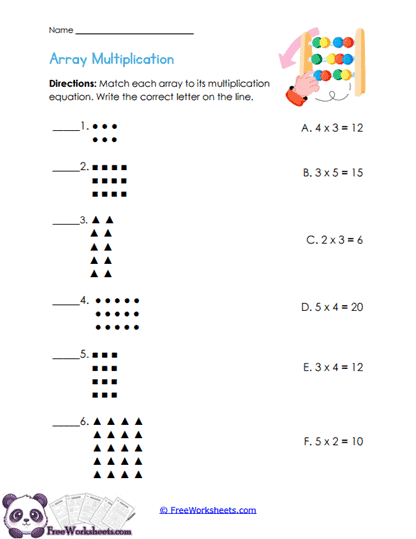
Array Match is a third grade multiplication activity that asks students to connect visual arrays with their correct multiplication equations. The page shows six arrays made from dots, squares, and triangles on one side and a lettered list of multiplication facts on the other. Students study each arrangement, count its rows and objects per row, and write the letter of the matching equation. For example, an array with 2 rows of 3 dots matches 2 × 3 = 6. This helps children move from visual models to symbolic multiplication facts.
Curriculum and Grade Alignment
This worksheet is intended for third grade learners who understand the basic structure of arrays and are ready to match them with multiplication equations. The main goal is to help students translate between a picture model and numerical notation. Before beginning, your child should understand that an array contains equal rows and that multiplication can describe those equal groups. The next step is writing equations for arrays without answer choices or drawing arrays from given equations. This activity supports multiplication representation, fact fluency, and visual reasoning.
Student Tasks
Students will examine six arrays and match each one with a multiplication equation from the answer list. The equations include facts such as 4 × 3 = 12, 3 × 5 = 15, 2 × 3 = 6, and 5 × 4 = 20. Students write the matching letter beside each array. Because some equations may have the same product but different factors, children need to notice the exact row-and-column arrangement rather than match by total alone. This builds careful array interpretation and multiplication understanding.
Common Challenges and Misconceptions
Some students may match an array only by the product and overlook the order of the factors shown in the model. Others may confuse rows and columns or begin counting individual objects rather than recognizing the equal groups. A child may also choose an equation with the correct total but the wrong arrangement. Encourage your child to describe each array as “___ rows of ___” before checking the choices. This makes the factor structure easier to compare.
Implementation Guidance
Teachers can use this worksheet after students have practiced writing equations directly from arrays. It works well as an independent matching activity or math center. Parents can have the child point across each row while counting before choosing an equation. If two answer choices seem possible, ask which one describes the actual number of rows and objects per row. This reinforces the visual meaning of each factor.
Details and Features
This worksheet includes six visual arrays and six lettered multiplication equations. The models use several shapes and arrangements, while the answer bank includes products through 20. Students write one matching letter beside each array. The printable supports multiplication facts, array interpretation, visual matching, and row-and-column reasoning.