
About This Worksheet
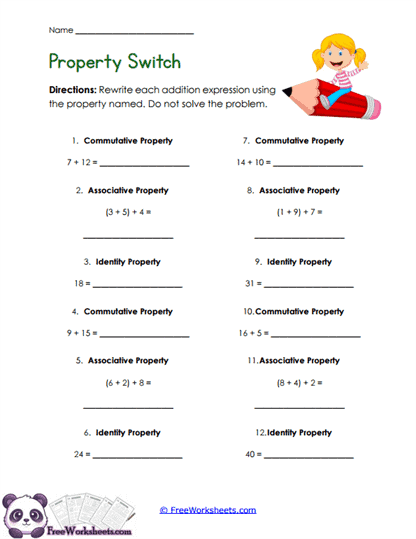
Property Rewrite is a third grade addition-properties activity that asks students to rewrite expressions using a named rule without actually solving the problem. Each item tells students whether to use the Commutative, Associative, or Identity Property. Children then change the order, grouping, or zero placement so the new expression shows the same value in a different form. For example, 7 + 12 can be rewritten as 12 + 7 using the Commutative Property, while (3 + 5) + 4 can become 3 + (5 + 4) using the Associative Property. This helps students focus on the structure of addition rather than only on finding a total.
Curriculum and Grade Alignment
This worksheet is made for third grade learners who already recognize the basic addition properties and are ready to use them independently. The main goal is to help students rewrite expressions while preserving their value. Before using this page, your child should understand that changing the order or grouping of addends does not change the sum, and that adding zero leaves a number unchanged. The next step is using these properties to make mental addition easier and to recognize equivalent expressions. This activity supports algebraic thinking, equation structure, and flexible computation.
Student Tasks
Students will rewrite twelve addition expressions. Each problem names the property that should be used, and students create an equivalent expression without solving. The Commutative problems require switching addends, the Associative problems require changing the grouping, and the Identity problems require showing the effect of adding zero. Examples include 7 + 12, (3 + 5) + 4, and 18. This builds understanding of equivalent forms and the meaning of each property.
Common Challenges and Misconceptions
Some students may calculate the total instead of rewriting the expression. Others may change both the order and grouping when only one property is named. The Associative Property can be especially tricky because the addends should stay in the same order while only the parentheses move. Encourage your child to ask, “What is allowed to change with this property?” before rewriting. This keeps the focus on the rule rather than the answer.
Implementation Guidance
Teachers can use this worksheet after students have practiced identifying properties from completed equations. It works well as independent practice because students must generate the equivalent expression themselves. Parents can remind the child that the directions say not to solve, which keeps attention on the structure. For Associative problems, have the child underline the addends and circle the grouping marks. This makes the change easier to see.
Details and Features
This worksheet includes twelve property-based rewriting problems in a two-column format. Each item clearly labels the Commutative, Associative, or Identity Property. Students have open lines to write the equivalent expression. The printable supports equivalent expressions, addition properties, algebraic reasoning, and flexible number relationships.