
Grade 3 Spelling Worksheets
Third-grade spelling involves recognizing patterns and applying rules rather than memorizing every word individually. These grade 3 spelling worksheets ask children to identify silent letters, practice consonant doubling, and correct misspelled words within sentences or paragraphs. Additional exercises explore syllables, homophones, plural forms, and alphabetical order. The free printable PDFs include word-level practice and more challenging proofreading activities for developing writers. When children make mistakes, compare the incorrect and correct spellings together and discuss the pattern or rule that explains the difference.
About This Collection of Worksheets
Spelling instruction in 3rd grade helps children move beyond memorizing individual words toward understanding the patterns and rules that explain how words are written. As students encounter longer vocabulary and become more independent writers, they need strategies for recognizing syllables, identifying familiar letter combinations, and applying spelling conventions to unfamiliar words. This collection provides opportunities to develop those abilities through engaging activities focused on common spelling patterns, silent letters, consonant doubling, homophones, and regular and irregular plurals. Students also practice alphabetizing words, recognizing correctly spelled forms, and understanding how spelling connects to pronunciation and meaning. These foundational skills support stronger reading fluency, clearer written communication, and greater confidence when approaching new vocabulary.
The worksheets feature a variety of practice formats that encourage children to examine words from different perspectives. Students divide words into syllables, rearrange scrambled letters, construct words by adding suffixes, and select correct spellings from multiple choices. Other exercises focus on proofreading, requiring children to identify misspelled words within sentences or revise an entire paragraph containing errors. Context-based activities ask students to choose homophones according to sentence meaning, complete sentences with silent-letter words, and form plural nouns using both predictable and irregular patterns. The collection also includes opportunities to use spelling words in original sentences, organize vocabulary alphabetically, and evaluate statements about spelling rules. This combination of recognition, construction, application, and editing activities helps reinforce spelling knowledge in ways that extend beyond traditional word lists.
Teachers can use these printable materials for weekly spelling instruction, phonics review, literacy centers, independent practice, or informal assessments of word-study skills. Individual pages make it easy to target particular spelling challenges, while combining several activities provides a broader review of concepts taught throughout the school year. Parents and homeschool educators can select exercises that match a child’s current needs, using verbal word practice and short explanations to reinforce the written work. Tutors may find the proofreading and spelling-choice activities particularly useful for identifying whether students struggle with vowel patterns, letter order, word endings, or visual recognition of familiar words. By offering several approaches to spelling development, the collection helps children become more accurate, attentive, and independent readers and writers.
Paul’s Teacher Tip
When introducing a new spelling pattern, I recommend showing students several examples and asking them to explain what the words have in common before presenting the rule. For syllable practice, have children clap or tap each spoken beat, while consonant-doubling activities benefit from highlighting the final vowel and consonant in the base word before adding an ending. During homophone lessons, require students to explain how the sentence’s meaning determines the correct spelling instead of relying only on how the word sounds. I also encourage teachers to use proofreading activities regularly because recognizing an error in connected writing often requires a different level of understanding than spelling an isolated word correctly. For an effective extension, have students maintain a personal spelling notebook organized by patterns, recording corrected words and using each one in an original sentence.
Worksheet Collection Skill Spotlights
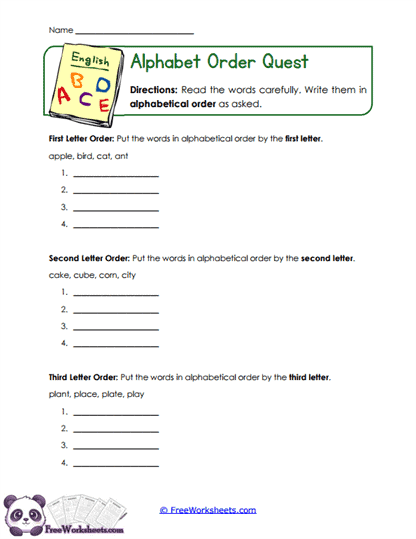
Alphabetical Order Quest
What Kids Do:
Students organize groups of words into alphabetical order through three progressively challenging sections. The first activity asks them to arrange words by comparing their initial letters, using familiar examples such as apple, bird, cat, and ant. In the next section, children encounter words beginning with the same letter and must examine the second letter to determine their placement. The final section requires comparison of third letters when multiple words share the same beginning. Students record their answers on numbered lines, working carefully from left to right to establish the correct sequence.
Target Skill:
This activity develops alphabetical sequencing, letter-by-letter comparison, and foundational reference skills. Students learn that arranging words requires examining successive letters whenever the earlier letters match, rather than sorting by the first letter alone. The increasing difficulty promotes attention to spelling details and reinforces accurate recognition of letter order within words. These abilities support 3rd grade language arts curriculum goals involving dictionary use, vocabulary organization, independent reference skills, and careful examination of written word forms.
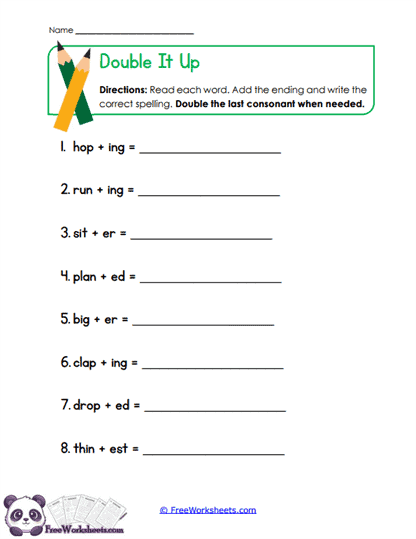
Double Consonant Practice
What Kids Do:
Children practice adding common word endings to eight base words while determining when the final consonant must be doubled. They work with examples such as hop, run, sit, plan, big, clap, drop, and thin, combining each with an assigned ending like -ing, -ed, -er, or -est. Students write the complete new word on the provided line, applying the spelling pattern rather than simply copying a finished example. Transformations such as hop into hopping and big into bigger help children see how adding an ending can change the written form of a word.
Target Skill:
The focus is understanding and applying consonant-doubling conventions when adding suffixes to appropriate base words. Students examine final vowel-consonant patterns and learn to recognize when a consonant must be repeated to preserve the intended word structure. This strengthens knowledge of spelling rules, suffix formation, and the relationship between base words and their inflected or comparative forms. These skills reinforce 3rd grade spelling and word-study expectations while helping children construct unfamiliar word forms more accurately during independent writing.
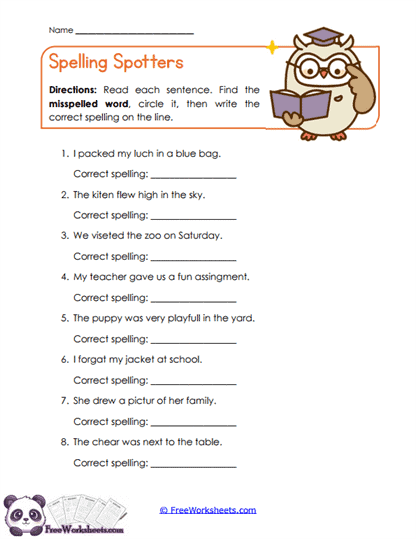
Error Spotters
What Kids Do:
Students become spelling detectives as they examine eight complete sentences, each containing one incorrectly spelled word. They read each sentence carefully, locate the error, circle the misspelled word, and write its correct form on a separate answer line. Examples include mistakes such as luch, kiten, Satrday, and assingment, requiring children to notice missing letters, incorrect sequences, and unfamiliar-looking word patterns. Unlike a traditional spelling test, this format asks students to discover the problem independently before making the correction.
Target Skill:
This proofreading activity strengthens spelling recognition, visual word memory, and attention to letter patterns in meaningful contexts. Students practice identifying discrepancies between familiar spellings and incorrect written forms, then applying their knowledge to produce accurate corrections. The process helps children recognize errors involving omitted letters, vowel combinations, and incorrect letter placement. These abilities support 3rd grade language arts expectations involving spelling accuracy, editing conventions, and independent revision of written work, encouraging students to check their own sentences more carefully.
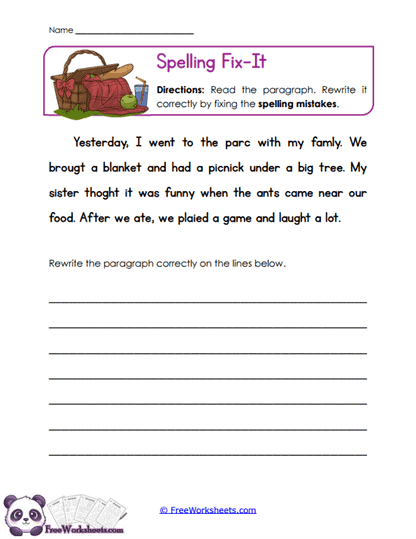
Picnic Spelling Rescue
What Kids Do:
Children read a short paragraph describing a family picnic and search for spelling mistakes hidden throughout the passage. Words such as parc and famly illustrate the kinds of errors they must notice while reading connected text. After identifying the misspellings, students rewrite the entire paragraph correctly on the lined space provided. They must preserve the original story, sentence order, capitalization, and punctuation while repairing the incorrect words. The task requires students to move beyond fixing isolated examples and demonstrate careful proofreading across several connected sentences.
Target Skill:
The activity develops paragraph-level spelling accuracy, proofreading habits, and the ability to revise connected writing without changing its intended meaning. Students practice recognizing incorrect spellings in context, recalling standard word forms, and transferring corrections into a complete rewritten passage. Maintaining the original sentence structure also reinforces careful copying, attention to detail, and overall writing accuracy. These skills support 3rd grade writing and language conventions by preparing students to identify and correct spelling errors independently in stories, paragraphs, and classroom assignments.
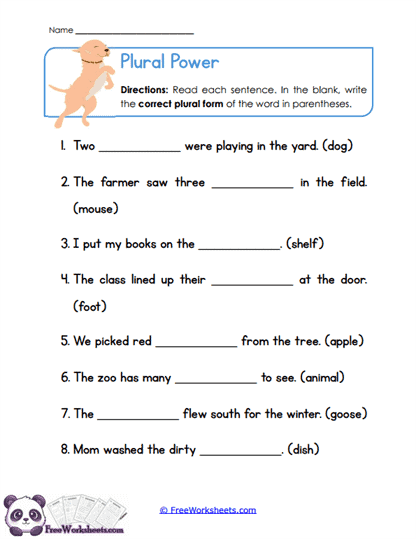
Plural Word Power
What Kids Do:
Students complete eight sentences by converting singular nouns into their correct plural forms. Each sentence contains a blank and provides the singular word in parentheses as a clue. Some examples involve straightforward changes such as dog to dogs, while others require irregular transformations such as mouse to mice, foot to feet, and goose to geese. Words such as shelf introduce additional spelling changes that occur when forming certain plurals. After completing each blank, children reread the sentence to check whether the chosen plural form fits naturally and makes grammatical sense.
Target Skill:
This exercise strengthens understanding of regular and irregular noun plurals while connecting spelling rules with sentence meaning. Students learn to distinguish nouns that simply add -s or -es from those requiring internal vowel changes or different endings. Recognizing these variations develops morphological awareness and helps children understand that plural formation does not always follow a single predictable pattern. The activity supports 3rd grade grammar and spelling expectations by improving word formation, noun agreement, and accurate use of plural vocabulary in everyday writing.
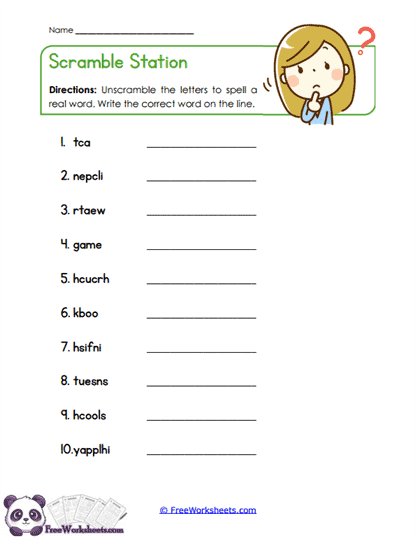
Scramble Solver
What Kids Do:
Children work through ten scrambled words, rearranging mixed-up letters to create correctly spelled vocabulary. The word list includes familiar terms such as cat, pencil, water, game, church, book, finish, upset, school, and happily. Students examine the available letters, consider possible combinations, and write the completed word on the corresponding answer line. Some items involve short, recognizable words, while longer selections require closer attention to letter placement and common spelling patterns. Each solution must use every provided letter exactly once, encouraging careful checking before moving to the next challenge.
Target Skill:
The activity strengthens letter-order awareness, visual spelling recognition, and the ability to reconstruct familiar words from individual letters. Students practice recognizing common letter combinations, identifying meaningful word patterns, and testing whether their completed spellings match known vocabulary. Longer scrambled words also encourage flexible problem-solving and attention to syllable or letter-group structures. These abilities reinforce 3rd grade spelling development and support accurate word recognition, proofreading, and independent spelling when children encounter unfamiliar or challenging letter sequences.
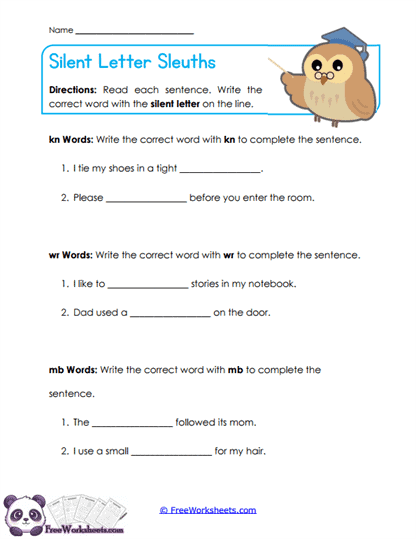
Silent Letter Search
What Kids Do:
Students complete sentences using vocabulary containing silent letters, with the page organized into three spelling-pattern sections. The first section focuses on words beginning with kn-, the second explores words beginning with wr-, and the third introduces words ending with -mb. Children encounter examples such as knot, knock, write, wrap, lamb, and comb. For each item, they read the sentence, consider its meaning, and write the appropriate silent-letter word in the blank. The organized format helps them notice similarities among words that include written letters not pronounced aloud.
Target Skill:
This activity reinforces recognition and accurate spelling of common silent-letter patterns, particularly kn-, wr-, and -mb. Students learn that written English includes letter combinations whose pronunciation does not directly match every visible letter, requiring knowledge of established spelling conventions. Using the words in sentences also connects orthographic recognition with vocabulary meaning and reading comprehension. These skills support 3rd grade phonics and spelling expectations while helping children decode, recognize, and write words that cannot be spelled accurately through sound alone.
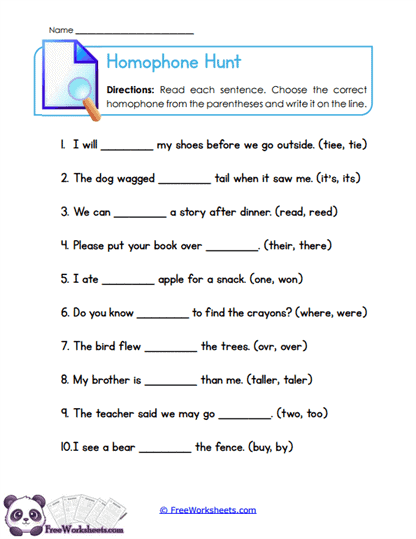
Sound-Alike Choices
What Kids Do:
Children read ten sentences containing blanks and select the appropriate word from two similar-sounding spelling choices. The exercise includes commonly confused forms such as its/it’s, read/red, their/there, and too/two, along with other words requiring attention to spelling and context. Students examine the entire sentence, determine which word expresses the intended meaning, and write that choice on the answer line. For example, a sentence about a dog wagging its tail requires understanding the difference between the possessive its and the contraction it’s. The activity challenges students to use meaning rather than pronunciation alone.
Target Skill:
The central skill is distinguishing homophones and frequently confused words by connecting their spellings to their meanings and grammatical functions. Students practice recognizing that similar or identical pronunciations do not always indicate interchangeable written forms. Sentence context helps them choose between possessives, contractions, location words, number words, and other commonly confused vocabulary. These abilities reinforce 3rd grade spelling and language conventions while supporting accurate word choice, stronger reading comprehension, and fewer homophone errors during independent writing.
Spelling Choice Check
What Kids Do:
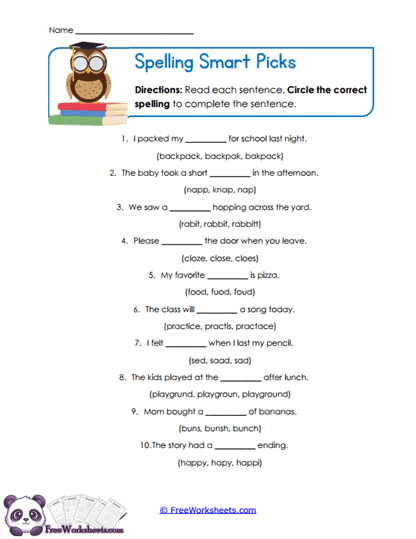
Students read ten sentences, each presenting three possible spellings of a target word. They examine the choices, identify the version that is spelled correctly and fits the sentence, and circle their selection. The vocabulary includes familiar words such as backpack, nap, rabbit, close, food, practice, sad, playground, bunch, and happy. Incorrect options contain errors involving missing letters, doubled consonants, vowel patterns, or word endings. After making each choice, children reread the sentence to confirm that the selected word looks correct and communicates the intended meaning.
Target Skill:
This exercise develops visual discrimination between correct and incorrect spellings while reinforcing knowledge of common English word patterns. Students practice comparing similar letter sequences, recognizing conventional vowel and consonant combinations, and noticing small changes that make a written word incorrect. The sentence-based format also encourages them to consider spelling and meaning together rather than relying on visual familiarity alone. These skills support 3rd grade spelling expectations and strengthen the proofreading awareness needed to identify mistakes in personal writing and classroom assignments.
Spelling Rule Test
What Kids Do:
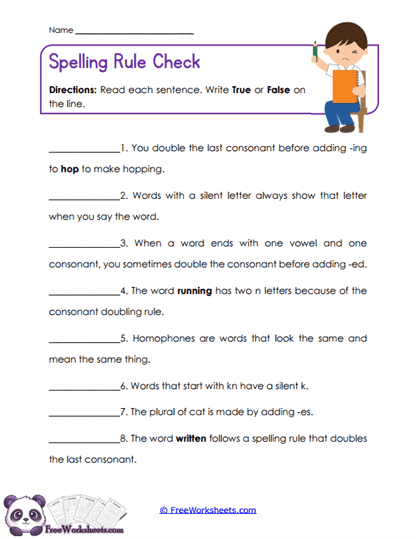
Children evaluate eight statements about familiar spelling rules and determine whether each statement is true or false. Topics include final consonant doubling, silent letters, homophones, plural noun formation, and other common word patterns. One statement may describe adding -ing to hop to form hopping, while another addresses whether silent letters can be heard when a word is pronounced. Students write True or False beside each statement, using examples and previously learned spelling knowledge to guide their decisions. The format encourages them to think about the rules behind correct spelling rather than completing another traditional word list.
Target Skill:
The activity strengthens explicit knowledge of spelling conventions, rule recognition, and the ability to evaluate statements about word formation. Students practice connecting familiar examples to broader patterns involving consonant doubling, silent letters, homophones, and plural endings. Determining whether a rule is accurate promotes analytical thinking and helps distinguish genuine understanding from memorization of individual spellings. These skills reinforce 3rd grade language arts goals by developing more transferable spelling strategies that children can apply when reading, writing, and correcting unfamiliar words.
Spelling Sentence Builder
What Kids Do:
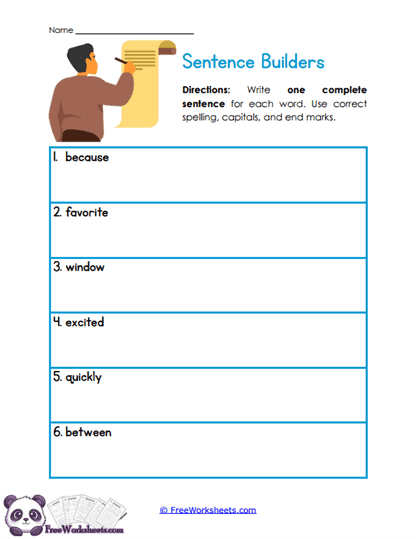
Students use six assigned spelling words to construct original, complete sentences. The target vocabulary includes because, favorite, window, excited, quickly, and between. Each word has its own large response area where children write a sentence that uses the word exactly as provided. Students must make sure their statements communicate a complete idea, begin with capital letters, and end with appropriate punctuation. The open-ended format encourages creativity while requiring accurate spelling and meaningful word use. Children also demonstrate whether they understand how each vocabulary word functions naturally within a sentence.
Target Skill:
This writing-based activity reinforces correct spelling through meaningful application rather than isolated repetition. Students practice incorporating target vocabulary into complete grammatical sentences while maintaining accurate capitalization, punctuation, and word usage. Creating original examples also deepens understanding of each word’s meaning and grammatical role. These skills support 3rd grade spelling, vocabulary, and writing expectations by helping children transfer learned word forms into authentic communication and develop greater confidence when using challenging vocabulary independently.
Syllable Scoops
What Kids Do:
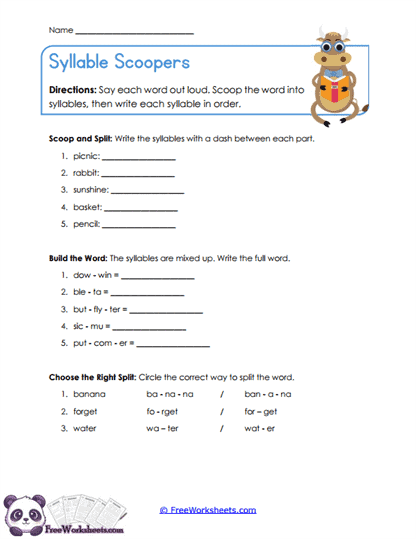
Children complete three different activities focused on identifying and manipulating syllables within familiar words. In Scoop and Split, they say words such as picnic, rabbit, sunshine, basket, and pencil aloud before writing each one with dashes separating its syllables. During Build the Word, students rearrange scrambled syllable parts to reconstruct complete words. Finally, Choose the Right Split presents two possible divisions for words such as banana, forget, and water, and children circle the correct option. The changing formats encourage students to listen for spoken word parts, recognize their written forms, and understand how syllables combine.
Target Skill:
This activity strengthens syllable awareness, word segmentation, blending, and recognition of spelling patterns within longer words. Students learn to identify spoken word parts and connect those parts with written letter groups, making multisyllabic vocabulary more manageable. Rearranging syllables develops flexible word-building abilities, while choosing correct divisions reinforces careful attention to pronunciation and word structure. These skills support 3rd grade phonics and spelling curriculum expectations and provide useful strategies for decoding, reading, and spelling increasingly complex words.