
About This Worksheet
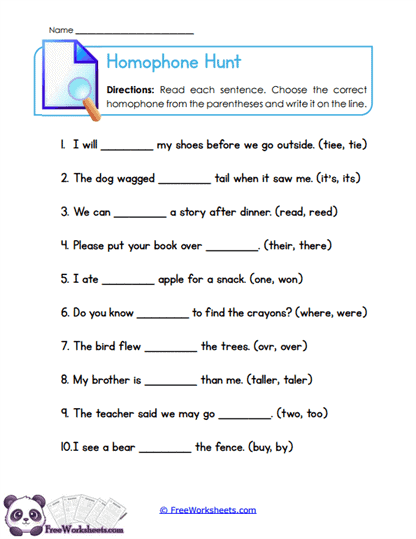
This Grade 3 spelling worksheet helps children work with homophones, which are words that sound alike but have different spellings and meanings. Students read 10 sentences and choose between pairs such as tie/tiee, its/it’s, read/red, their/there, and too/two.
The important part is that children cannot depend only on how the word sounds. Both choices may sound similar or identical when spoken. They have to understand the sentence and choose the spelling that gives the sentence the correct meaning.
Learning Goals
The main goal is to help students connect spelling with meaning. Children learn that hearing a word is not always enough to know how it should be written. They need to think about what the sentence is trying to say.
Students practice common homophone pairs while also reviewing possessives, contractions, location words, number words, and other frequently confused spellings.
This skill is especially useful in everyday writing because homophones are easy to misuse even when a child can spell both words correctly.
What Students Will Do
Students read each of the 10 sentences from beginning to end. Each sentence has a blank and two choices in parentheses.
They decide which spelling belongs in the blank and write that word on the line.
For example, if a sentence says the dog wagged ___ tail, the child has to decide whether the sentence needs it’s or its. Another sentence asks whether a book should be placed their or there.
The examples cover several kinds of sound-alike words, so students must pay close attention to meaning rather than follow one repeated rule.
Common Challenges
Some children may pick the word they see most often instead of thinking about what it means. Homophones can also be tricky because reading the sentence aloud does not always reveal which spelling is correct.
A helpful strategy is to ask, “What does each choice mean?” For example, where asks about a place, while were is a form of the verb be. Once the meanings are clear, the right choice is usually easier to see.
Students may also confuse its and it’s. A simple reminder is that it’s can be replaced with “it is.” If “it is” does not make sense in the sentence, its may be the correct form.
Teaching Suggestions
Before children begin, review two or three of the harder pairs and use each word in a different sentence. This helps students connect the spelling to a meaning instead of memorizing the pair by sight.
Parents can ask the child to explain why the other choice would be wrong. That extra step often shows whether the student really understands the difference.
Teachers can also have students keep a small “tricky words” list. Any pair that causes trouble on this page can be added to the list and reviewed later.
For an extension, have students choose two homophone pairs and write their own sentences that clearly show the difference in meaning.
Worksheet Features
The page includes 10 sentence-based spelling problems using common homophones and frequently confused sound-alike words. Every answer has to be chosen through context, making this useful for spelling, vocabulary, editing, or independent language arts review.