
Decodable Texts Worksheets
Reading longer passages requires children to apply familiar phonics patterns while keeping track of vocabulary and story meaning. These grade 3 decodable texts worksheets include locating prefixes in a treehouse story, sorting vowel patterns after reading about camping, and sequencing instructions for building a bird feeder. The free printable PDFs also provide repeated-reading exercises and comprehension questions for developing readers. Encourage children to decode unfamiliar words carefully, then reread the complete sentence to confirm that its meaning makes sense.
About This Collection of Worksheets
Learning to read individual words is an important achievement, but becoming a confident reader requires children to recognize those words accurately while following the meaning of an entire passage. Decodable texts help bridge that gap by giving students opportunities to apply familiar phonics patterns within connected sentences and stories. Instead of approaching every word as something new to memorize, children learn to notice recognizable spelling structures, blend sounds together, and use their growing knowledge of word parts to read more independently. For 3rd grade students, this practice is particularly valuable because reading demands increasingly involve longer passages, more varied vocabulary, and a greater expectation that students can understand what they read without constant assistance. Well-chosen decodable and phonics-focused texts allow children to strengthen word-reading accuracy while gradually developing the fluency and comprehension needed for more complex classroom materials.
This collection brings together a wide range of reading experiences that connect phonics instruction with meaningful language arts skills. Students explore vowel teams through stories about sailing and camping, locate prefixes within a treehouse adventure, and build new words after reading about a classroom robot. Other activities focus on using context clues to understand unfamiliar vocabulary, selecting correctly spelled homophones, and proofreading sentences containing common spelling mistakes. Reading fluency receives special attention through a repeated-reading exercise that allows children to compare their accuracy across two timed attempts. The collection also moves beyond decoding into comprehension, inviting students to sequence the steps involved in building a bird feeder, retell a kite story using beginning, middle, and end, and answer questions about characters, events, and the central idea of a garden story. Together, these varied tasks help children see that recognizing words, understanding vocabulary, and making sense of a passage are closely connected parts of successful reading.
Teachers can use these printables to reinforce specific phonics patterns while also developing broader reading habits through engaging, manageable texts. The vowel-pattern and word-building activities work well after explicit phonics instruction, allowing students to recognize familiar spelling structures within a story rather than only on flashcards or word lists. Repeated reading provides opportunities for individualized fluency practice, while context-clue and comprehension exercises encourage students to return to the passage and support their answers with textual evidence. Parents, tutors, and homeschool educators can also use the collection for short reading sessions that combine oral reading with guided discussion and written responses. Because the activities address different aspects of literacy, educators can select pages according to a child’s particular needs, whether that means strengthening decoding accuracy, improving recognition of word parts, reading more smoothly, or learning to explain what a story means.
Paul’s Teacher Tip
One of the most useful habits to develop with decodable texts is helping children distinguish between figuring out what a word says and understanding what the sentence means. When a student encounters an unfamiliar word, encourage them to examine the spelling pattern, blend the sounds, and then reread the complete sentence to check whether the pronunciation and meaning make sense together. For vowel-team activities, have students compare words such as rain and day or boat and snow, noticing that similar vowel sounds can be represented by different letter combinations without assuming that every vowel pair follows the same rule. During repeated reading, avoid making speed the primary goal; a child who reads slightly slower but accurately, with natural phrasing and clear understanding, is demonstrating more meaningful progress than one who rushes through the passage. When students complete comprehension activities, ask them to point to the sentence that helped them answer rather than relying entirely on memory, especially when questions involve event order or the main idea. These small instructional routines help children develop a balanced approach to reading in which decoding supports comprehension rather than becoming a separate task.
Worksheet Collection Skill Spotlights
Bird Feeder Sequence
What Kids Do:
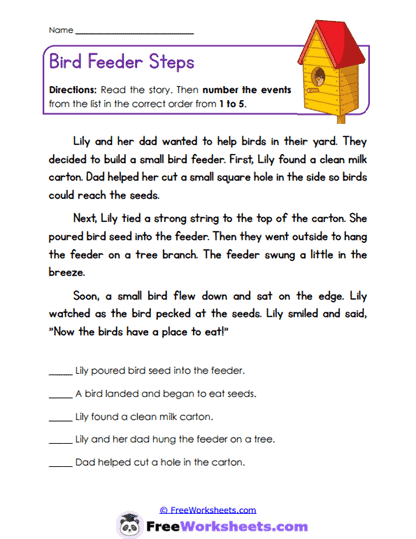
Students read a short story about Lily and her father making a bird feeder from an empty milk carton. As they follow the project, they learn how the characters find the carton, prepare it for the birds, add string and seeds, hang it outside, and eventually watch a bird arrive for food. After reading, children examine five events from the story that have been presented in a mixed-up order. They return to the passage to determine when each event happened and number the statements from 1 through 5. Because several steps depend on something happening beforehand, students must pay attention to the actual sequence rather than simply selecting an order that seems reasonable.
Target Skill:
This activity strengthens reading comprehension through the careful identification and organization of events. Students practice recognizing chronological relationships and using sequence clues to determine what happened first, next, and last. The process also develops an understanding of how actions connect, since some events are only possible after earlier steps have been completed. By returning to the passage to verify their answers, children reinforce the important habit of using textual evidence rather than relying on memory or assumptions. These skills support 3rd grade expectations for recounting events, understanding narrative structure, and explaining processes in a logical order, while also providing a foundation for more organized informational and procedural writing.
Camping Pattern Sort
What Kids Do:
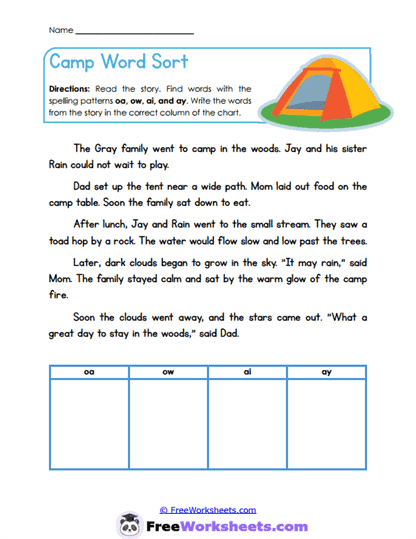
Children read a camping adventure about the Gray family as they set up their campsite, prepare food outdoors, walk near a stream, and observe the changing weather around them. While exploring the passage, students search for words containing the vowel patterns oa, ow, ai, and ay. After identifying the appropriate words, they record each one in a four-column sorting chart according to the exact letters it contains. Students must distinguish among the different spelling combinations, even when words share similar vowel sounds. The activity encourages them to revisit the story carefully, locate each example, and organize their discoveries rather than simply underline random words that contain vowels.
Target Skill:
This exercise builds recognition of common vowel spelling patterns and helps students understand that similar sounds may be represented by different letter combinations. Sorting words according to their written patterns strengthens visual word analysis, spelling awareness, and the ability to identify familiar phonics features within connected reading. Because students must locate the words inside a complete story, the activity encourages them to apply knowledge that may have originally been learned through isolated examples. The distinction between what a vowel sounds like and how it is spelled is particularly valuable for 3rd grade readers developing more accurate decoding and spelling strategies. Repeated attention to these patterns can also support quicker recognition of familiar words during independent reading.
Cave Clue Challenge
What Kids Do:
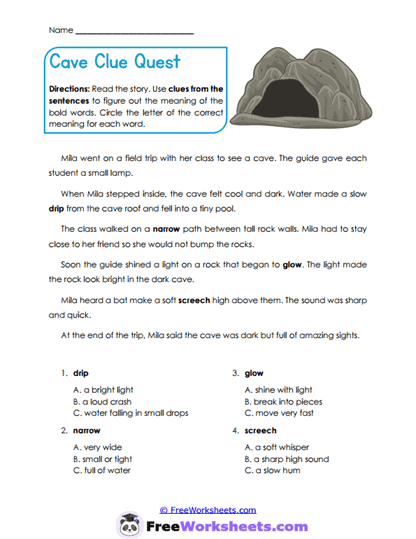
Students accompany Mia and her classmates on a fictional visit to a cave, reading about the sights and sounds they experience underground. The passage introduces descriptive words such as drip, narrow, glow, and screech, each appearing within sentences that provide clues about its meaning. After reading, children answer four multiple-choice questions that ask them to identify the correct meaning of each highlighted vocabulary word. They compare three possible definitions for each question and return to the surrounding sentences to decide which interpretation makes the most sense. Rather than guessing based on familiarity alone, students are encouraged to use details from the story to support their selections.
Target Skill:
This reading activity develops the ability to determine unfamiliar word meanings through context clues. Students learn to examine nearby descriptions, actions, and sentence details to make reasonable vocabulary inferences rather than stopping whenever they encounter an unfamiliar term. Comparing possible meanings also strengthens semantic reasoning because children must decide which definition best fits the specific situation described in the passage. The activity reinforces comprehension monitoring, vocabulary development, and thoughtful interpretation of descriptive language. These skills become increasingly important in 3rd grade as students encounter unfamiliar words in stories and informational texts and need strategies for understanding them independently.
Garden Story Check
What Kids Do:
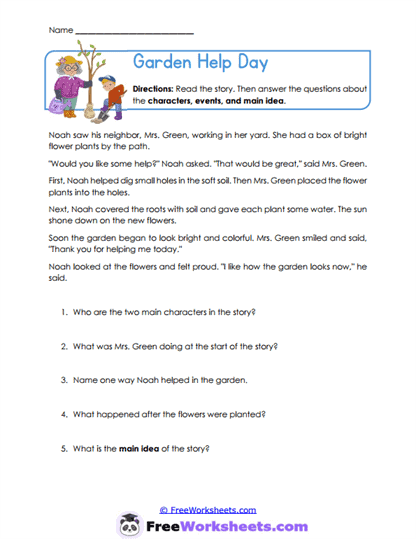
Children read a story about Noah helping his neighbor, Mrs. Green, with work in her garden. They follow the characters as Noah notices his neighbor working outside, offers to help, digs holes, plants flowers, covers their roots with soil, and waters the garden. After completing the passage, students answer five comprehension questions that examine different parts of the story. They identify the main characters, describe what Mrs. Green was doing at the beginning, explain how Noah helped, recall what happened after the flowers were planted, and determine what the story is mainly about. The questions encourage students to move from remembering specific details toward understanding the larger meaning of the passage.
Target Skill:
This comprehension activity strengthens students’ ability to distinguish between important story details and the central idea of a narrative. Questions about characters and actions reinforce literal understanding, while prompts involving event order and results develop awareness of sequence and cause-and-effect relationships. The final main-idea question requires children to consider the passage as a whole rather than focus on one isolated moment. Writing complete responses also provides opportunities to explain understanding clearly and refer to evidence from the text. Together, these skills support 3rd grade reading comprehension expectations and help teachers identify whether students can recall information, interpret relationships among events, and summarize a story’s overall message.
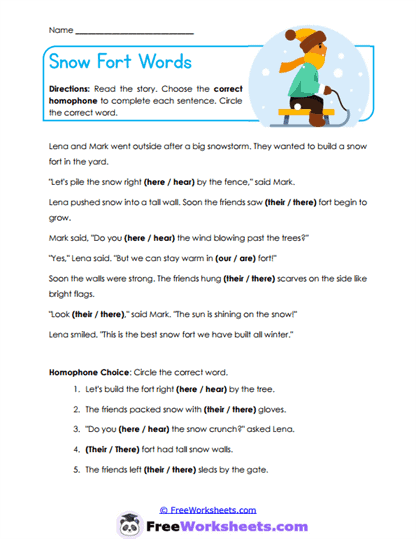
Homophone Snow Fort
What Kids Do:
Students read a winter story about Lena and Mark building a snow fort after a storm. Throughout the passage, they encounter pairs of homophones presented as choices within sentences, including here/hear, their/there, and our/are. Children must read each sentence, consider what it communicates, and circle the spelling that correctly completes the thought. Because the words sound alike when spoken, the answers cannot be determined by pronunciation alone. After finishing the story, students complete five additional sentences that require them to choose appropriate homophones in different contexts. This second section allows them to demonstrate whether they can apply the same reasoning beyond the original passage.
Target Skill:
The exercise develops understanding of homophones by emphasizing the relationship between spelling, meaning, and sentence context. Students learn that words can share a pronunciation while communicating entirely different ideas, making comprehension essential when choosing the correct written form. Distinguishing between words that indicate location, possession, or an action strengthens vocabulary knowledge and grammatical awareness. The combination of story-based questions and separate practice sentences encourages children to transfer their understanding across multiple language situations. These skills support accurate spelling, careful reading, and clearer written expression, particularly when 3rd grade students begin composing longer sentences and more detailed paragraphs.
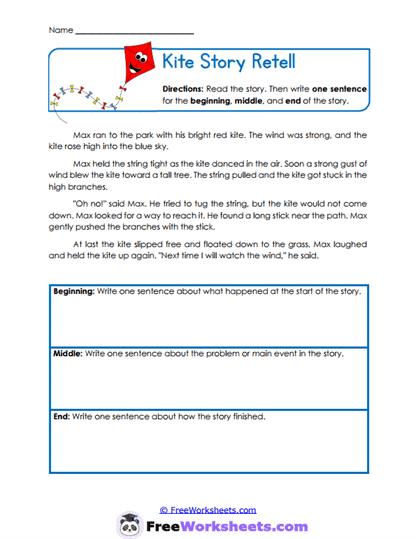
Kite Story Retell
What Kids Do:
Children read a short narrative about Max flying his red kite on a windy day. They follow the story as Max enjoys flying the kite, encounters a problem when it becomes caught in a tree, and finds a way to bring it back down. Once the reading is complete, students organize the most important events using three clearly labeled response boxes: Beginning, Middle, and End. They write one sentence describing how the story starts, another explaining the main problem or significant event, and a final sentence telling how the situation is resolved. Rather than copying the entire passage, children are expected to select essential information and retell it in their own words.
Target Skill:
This activity builds understanding of narrative structure and the ability to summarize events in a logical sequence. Students must distinguish the setup of a story from its central problem and resolution, which requires them to recognize which details are most important to the overall plot. Condensing each section into one clear sentence encourages concise written communication without losing meaningful information. The retelling format also reinforces cause-and-effect thinking by showing how the problem creates a need for action and how the ending resolves that situation. These skills support 3rd grade comprehension and writing expectations by helping students organize ideas, recount narratives accurately, and communicate story events in a coherent order.
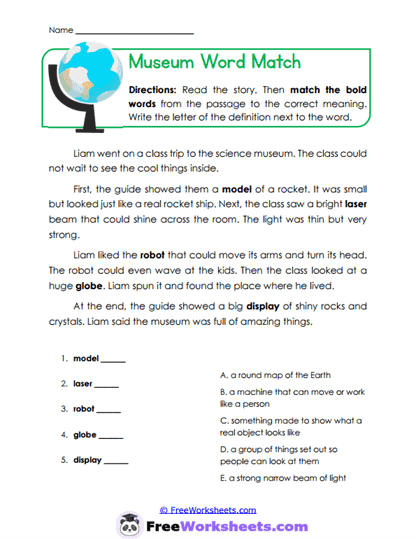
Museum Meaning Match
What Kids Do:
Students visit a science museum through a short reading passage about Liam and his classmates. As they follow the group’s exploration, they encounter vocabulary such as model, laser, robot, globe, and display while reading about exhibits that include a rocket model, a laser beam, a working robot, a globe, and a collection of rocks and crystals. After reading, children examine five definitions and match each one to the appropriate word from the passage. They write the correct matching letter beside each vocabulary term, using information from the story to confirm their choices. The activity encourages students to think about how each word is used within the museum setting rather than simply relying on a memorized definition.
Target Skill:
This vocabulary exercise strengthens students’ ability to understand academic and content-related words through reading context. Matching definitions requires children to connect words with the objects, actions, and descriptions presented in the passage. The activity also introduces the idea that some words, such as model and display, may have different meanings depending on how they are used. Recognizing the intended meaning within a particular sentence develops semantic flexibility and more careful comprehension. These skills support vocabulary acquisition, nonfiction reading, and the interpretation of subject-area language, helping 3rd grade students become more comfortable with the specialized terms they encounter in science and other classroom subjects.
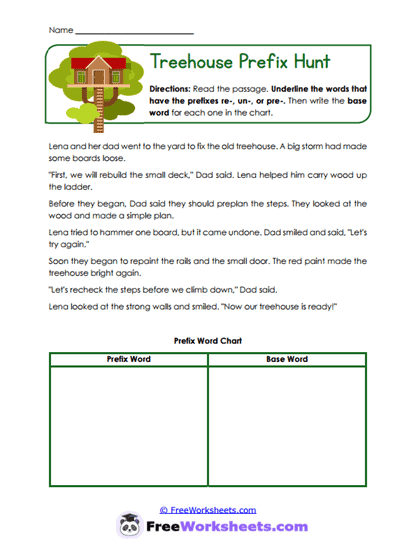
Prefix Treehouse Hunt
What Kids Do:
Children read a story about Lena and her father repairing an old treehouse after a storm. While following their work, students search the passage for words containing the prefixes re-, un-, and pre-. They underline each qualifying word and then transfer their findings into a two-column Prefix Word Chart. In the first column, they write the complete word from the passage, while the second column contains the base word that remains after removing the prefix. For example, students can separate rebuild into re- and build. By completing the chart, children make the structure of each word visible and can begin considering how the added beginning changes its meaning.
Target Skill:
This activity develops morphological awareness by helping students recognize prefixes as meaningful word parts rather than random letter combinations. Identifying the base word encourages children to analyze vocabulary structurally and use familiar components to understand longer or unfamiliar terms. Studying re-, un-, and pre- also reinforces how prefixes can communicate ideas such as repetition, reversal, negation, or something happening beforehand, depending on the word. Locating these structures within a story strengthens the connection between word analysis and reading comprehension. For 3rd grade students, this skill supports vocabulary expansion, decoding, and more accurate interpretation of increasingly complex words across literary and informational texts.
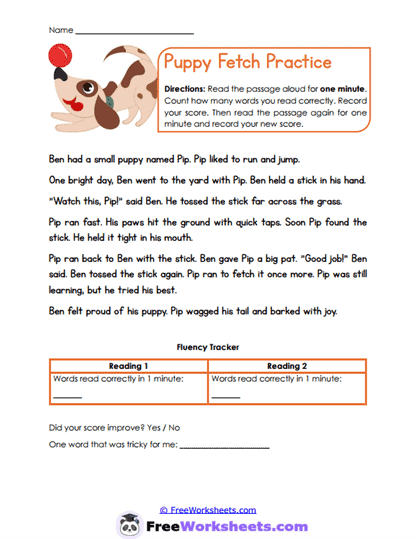
Puppy Fluency Run
What Kids Do:
Students practice oral reading with a short story about Ben and his puppy, Pip, who enjoys playing fetch and learning to bring back a stick. They read the passage aloud for one minute while a teacher, parent, or partner tracks their accuracy. At the end of the first attempt, children record how many words they read correctly in the designated score box. They then read the same passage for another minute and record a second score. After both readings, students compare the results, indicate whether their performance improved, and identify one word that was difficult to read. The reflection encourages children to think about their reading experience instead of concentrating exclusively on the number of words completed.
Target Skill:
This repeated-reading exercise strengthens oral reading fluency by giving students structured opportunities to improve word recognition, accuracy, and pacing with familiar text. Reading the same passage more than once can reduce the effort needed to decode individual words, allowing children to focus more attention on smooth phrasing and comprehension. Recording correctly read words provides a simple way to observe changes between attempts, while identifying a challenging word promotes awareness of specific decoding difficulties. The activity also helps children develop confidence as they notice improvements through practice. For 3rd grade readers, the goal is not speed alone but a more automatic, accurate, and expressive reading process that supports understanding.
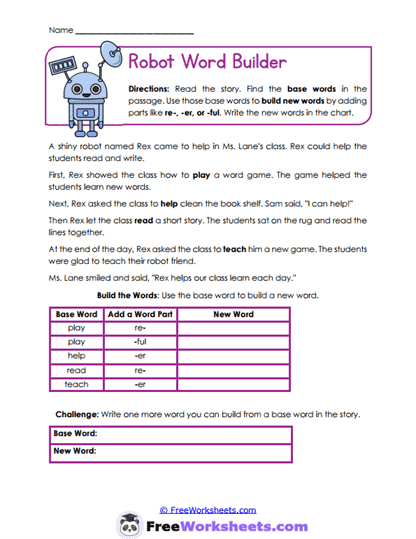
Robot Word Workshop
What Kids Do:
Children read a classroom story featuring a helpful robot named Rex, then use words from the passage to explore how new vocabulary can be created. They identify familiar base words such as play, help, read, and teach and examine word parts including re-, -ful, -er, and -ed. In a word-building chart, students combine each base word with the assigned prefix or suffix and write the completed word in the final column. Examples include changing play into replay or teach into teacher. Once the guided combinations are complete, children choose another base word from the story and create an additional word independently, applying what they have learned about meaningful word parts.
Target Skill:
This activity strengthens understanding of prefixes, suffixes, and base words as building blocks of vocabulary. Students learn that adding a word part can change meaning, grammatical function, or the way a word is used within a sentence. Combining these elements requires attention to spelling and word structure, while connecting the activity to a reading passage reinforces how the resulting words function in meaningful language. The independent challenge encourages children to apply morphological knowledge creatively rather than merely reproduce provided examples. These skills support vocabulary growth, decoding longer words, spelling accuracy, and grammatical awareness as students encounter more complex language in 3rd grade texts.
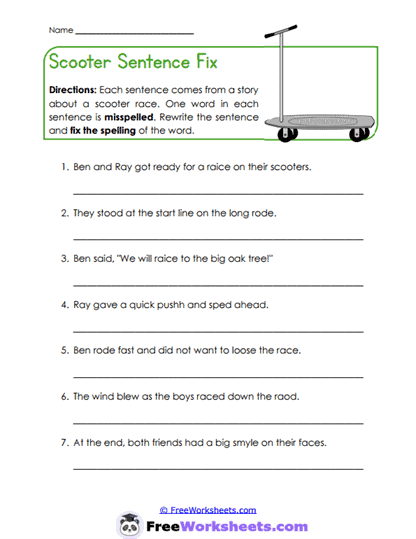
Scooter Spelling Repair
What Kids Do:
Students become careful proofreaders as they read seven connected sentences about Ben and Ray participating in a scooter race. Each sentence contains exactly one intentionally misspelled word, and children must locate the error before deciding how to correct it. They examine the spelling patterns they recognize, including vowel teams, blends, and other familiar letter combinations, then rewrite the complete sentence with the corrected spelling. For example, they may need to determine the proper written form of a word such as rode. Because the activity requires a full rewrite, students also practice preserving every word, using appropriate capitalization, maintaining spaces, and including the original punctuation while improving spelling accuracy.
Target Skill:
This proofreading exercise helps students transfer phonics and spelling knowledge into authentic sentence-level editing. Recognizing an error requires careful attention to letter patterns, while determining the correction draws on familiar relationships between sounds and spellings. Rewriting the sentence encourages children to apply the correction accurately and maintain proper writing conventions. The activity also develops self-monitoring, teaching students to question unfamiliar spellings and verify their written work rather than depending entirely on adult corrections. These habits support 3rd grade writing development, especially as children become responsible for reviewing and improving their own sentences, stories, and classroom assignments.
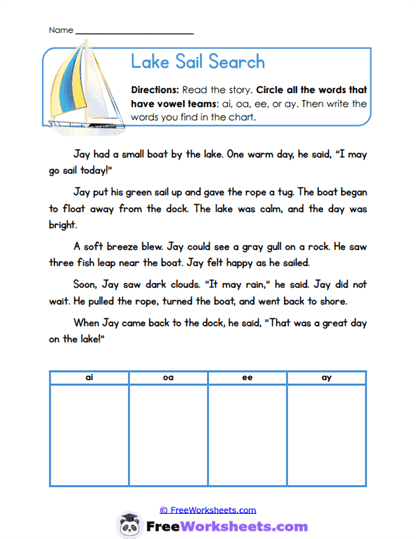
Vowel Team Voyage
What Kids Do:
Children follow Jay on a sailing adventure at the lake while investigating four common vowel teams: ai, oa, ee, and ay. They begin by reading the story from start to finish, paying attention to words that contain these specific spelling patterns. As they discover matching words, they circle them directly in the passage. Once the reading is complete, students return to the words they identified and sort them into four labeled boxes according to their vowel teams. Words such as rain, boat, see, and day provide examples of the patterns being practiced. The activity combines story reading with a focused phonics search, requiring students to recognize and organize familiar vowel spellings within connected text.
Target Skill:
This worksheet strengthens recognition of common vowel teams and helps students connect written letter patterns with the sounds they represent. Identifying these combinations within a complete passage encourages children to apply phonics knowledge during meaningful reading instead of relying only on isolated word lists. Sorting the words by their exact spelling develops visual discrimination and reinforces the understanding that different letter combinations can represent similar vowel sounds. The process also supports more automatic word recognition, accurate decoding, and stronger spelling memory. For 3rd grade students, these skills help reduce hesitation when encountering vowel-team words and encourage more confident reading of increasingly varied passages.