
About This Practice
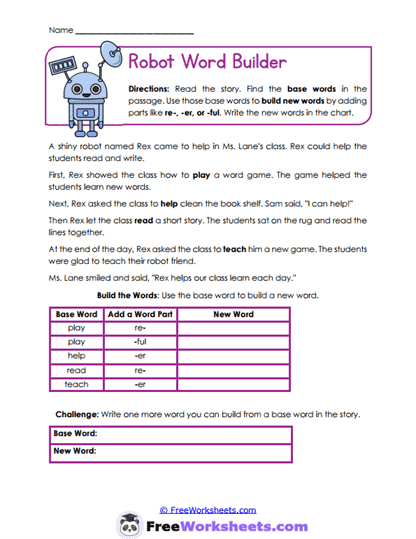
This Grade 3 language arts activity helps children build new words from familiar base words. Students read a short story about a robot named Rex helping in a classroom. Then they use base words from the story, such as play, help, read, and teach, and add word parts like re-, -ful, -er, or -ed to create new words.
This is a helpful step because students are not just memorizing prefixes and suffixes. They are using a story to find base words first, then changing those words to make something new.
Learning Goals
The main goal is to help students understand how prefixes and suffixes change a base word. Children practice recognizing the original word, adding a meaningful word part, and checking that the new word is real and makes sense.
This builds vocabulary, spelling, grammar, and decoding. It also helps students become more confident when they meet longer words because they can break those words into familiar pieces.
What Students Will Do
Students first read the robot story and find the base words used in the passage. Then they move to the Build the Words chart.
Each row gives them a base word and a word part to add. They combine the two and write the new word in the last column. For example, play plus re- becomes replay, and teach plus -er becomes teacher.
At the bottom, students complete a challenge by choosing another base word from the story and creating one more new word on their own.
Common Challenges
Some children may place the word part on the wrong side of the base word. Others may form a real word but spell it incorrectly when the ending is added.
A parent or teacher can slow the process down by asking, “Does this part go before the word or after it?” Then have the child say the finished word aloud and use it in a sentence.
Teaching Suggestions
Before students begin the chart, review the difference between a prefix and a suffix. A prefix goes before the base word, while a suffix goes after it.
Teachers can have students circle the base word and box the added word part in each answer. Parents can also ask, “How did the meaning change?” after each new word is formed. That keeps the activity focused on meaning instead of only spelling.
Worksheet Features
The page includes a classroom story, a word-building chart, and an open-ended challenge. Students move from reading to word analysis to creating a new word of their own.
This makes it useful for vocabulary work, morphology practice, spelling lessons, literacy centers, or independent Grade 3 review.