
Blends, Digraphs, And Trigraphs Worksheets
Some consonant combinations preserve individual sounds, while others work together to represent a single sound. These grade 3 blends, digraphs, and trigraphs worksheets examine those differences through sound sorting, identifying letter patterns within passages, and correcting spelling mistakes involving combinations such as sh, tch, and dge. The free printable PDFs also introduce syllable analysis and word-building exercises for students applying phonics to longer vocabulary. Compare contrasting examples aloud before asking children to explain how each letter combination affects pronunciation.
About This Collection of Worksheets
Learning to recognize blends, digraphs, and trigraphs is an important part of helping children become confident readers and accurate spellers. Although these letter combinations may look similar, they function differently within words. In a consonant blend, such as br in bright or cl in clap, each consonant contributes its own sound. Digraphs, such as sh in shine and th in thunder, use two letters to represent a single sound, while trigraphs, such as tch in catch and dge in badge, use three letters to represent one sound. For 3rd grade students, understanding these differences becomes especially valuable as they encounter longer words, unfamiliar vocabulary, and more demanding reading assignments. Rather than guessing at unfamiliar spellings, children can use recognizable sound patterns to work through words systematically and understand why certain letter combinations appear together.
This collection provides a varied approach to phonics instruction by connecting sound recognition with syllable analysis, vocabulary development, reading comprehension, and written expression. Students investigate consonant patterns through sorting activities, identify where letter combinations appear within words, and divide multisyllabic vocabulary into smaller units. Other exercises introduce spelling conventions involving -tch, -ch, -dge, and -ge, while word-building tasks demonstrate how prefixes and suffixes change familiar base words. Reading-focused activities invite children to search for sound patterns within stories, complete missing words using context clues, and practice expressive oral reading. The collection also includes proofreading challenges, science vocabulary analysis, paragraph writing, and a comprehensive review that asks students to explain their phonics knowledge rather than simply recognize the correct answer.
Teachers can use these materials to reinforce explicit phonics instruction while helping students transfer their knowledge into everyday language arts activities. Sound sorting and syllable exercises work particularly well during targeted word-study lessons, while reading passages and fluency activities provide opportunities to practice those same patterns within meaningful text. Writing and proofreading assignments reveal whether students can apply spelling knowledge when they are no longer working from a list of carefully selected words. Parents, tutors, and homeschool educators can also use the printables to identify specific areas of difficulty, such as confusing blends with digraphs, struggling with syllable division, or recognizing a spelling pattern without consistently using it in writing. The different formats allow children to approach familiar phonics concepts from several directions, helping them build the flexible word-analysis skills needed for increasingly independent reading and writing.
Paul’s Teacher Tip
One difficulty that often goes unnoticed is that a student may correctly identify sh or br in a word without understanding how the letters contribute to its pronunciation. Before assigning the sorting or syllable activities, have children compare brush and ship, stretching the beginning sounds aloud so they can hear that br contains two distinct consonant sounds while sh represents one. As students progress into longer words, encourage them to underline familiar sound patterns before dividing words into syllables, but remind them that the boundaries of a syllable do not always follow the consonant group they first notice. When teaching spelling conventions such as -tch and -dge, compare examples like catch and badge with much and huge so children learn to examine vowel sounds and word structure rather than memorize a rule without understanding its limits. During reading and writing activities, pay attention to whether children can recognize a pattern in isolation but struggle to apply it within a sentence, since that difference often signals the need for additional guided practice. A useful closing routine is to ask students to explain one word they decoded or spelled successfully and identify the sound-pattern knowledge that helped them make the decision.
Worksheet Collection Skill Spotlights
Fluency Lines
What Kids Do:
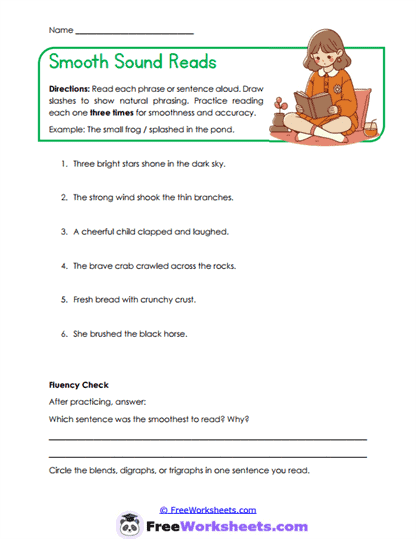
Students practice reading six short sentences containing familiar blends, digraphs, and trigraphs, including examples such as “Three bright stars shine in the dark sky” and “The strong wind shook the thin branches.” They begin by reading each sentence aloud and adding slashes to show where natural phrase breaks belong. Rather than stopping after every word, children identify groups of words that should be spoken together to communicate a complete thought. They then practice reading each line three times, working toward smoother pacing and more natural expression. After completing the repeated readings, students reflect on which sentence sounded the smoothest and circle an example of a blend, digraph, or trigraph to connect their oral reading practice with phonics recognition.
Target Skill:
This activity strengthens oral reading fluency by teaching students to group words into meaningful phrases rather than reading in a slow, disconnected manner. The repeated-reading structure gives children opportunities to improve accuracy, expression, and confidence as they become more familiar with each sentence. Identifying appropriate phrase boundaries also reinforces sentence comprehension because students must consider how words work together to communicate meaning. The phonics component supports automatic recognition of familiar consonant patterns, reducing the effort required to decode individual words. Together, these skills help 3rd grade readers develop a more natural reading rhythm and devote greater attention to understanding what they read instead of concentrating entirely on pronunciation.
Pattern Paragraph
What Kids Do:
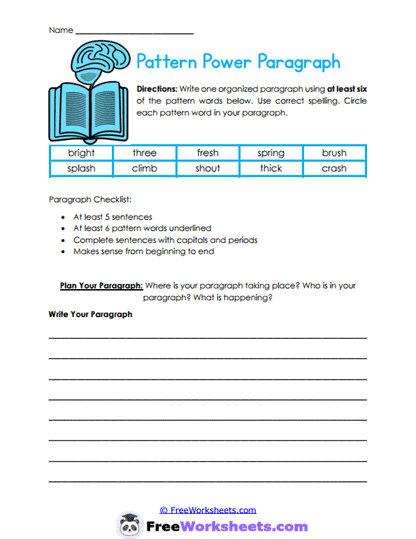
Children become authors as they create an original paragraph using a word bank that includes bright, three, fresh, spring, brush, splash, climb, shout, thick, and crash. Before writing, students make a simple plan by deciding where their paragraph takes place, who or what will be involved, and what happens. They then compose at least five complete sentences while incorporating six or more words from the provided vocabulary bank. Once their paragraph is finished, children circle the selected pattern words and review their writing for capitalization, punctuation, sentence completeness, and spelling. This final checking step encourages students to see phonics knowledge as something they can use while creating their own writing rather than only when completing word-identification exercises.
Target Skill:
This writing assignment strengthens the transfer of phonics knowledge into independent composition. Students must accurately spell words containing blends, digraphs, and trigraphs while also selecting vocabulary that fits naturally within their ideas. Planning and organizing a paragraph develops sentence connections, logical sequencing, and the ability to communicate a complete thought across several sentences. The requirement to use specific vocabulary encourages flexible word choice without losing sight of the paragraph’s meaning. By circling target words and proofreading the finished passage, students also develop stronger editing habits and greater awareness of spelling patterns within their own work. These combined skills support 3rd grade expectations for written expression, vocabulary application, and increasingly independent revision.
Pattern Positions
What Kids Do:
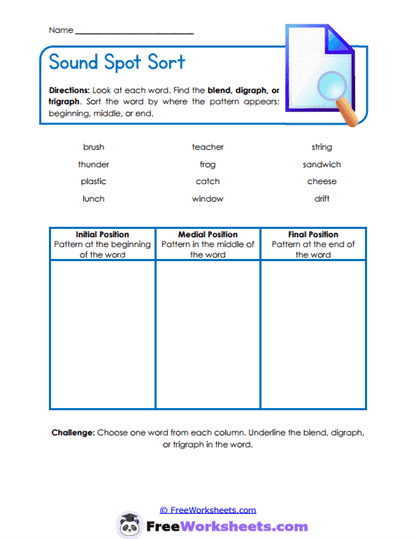
Students examine a collection of 12 words, including brush, thunder, plastic, lunch, teacher, frog, catch, window, string, sandwich, cheese, and drift, to locate blends, digraphs, and trigraphs within each word. After identifying the relevant letter pattern, they determine whether it appears at the beginning, middle, or end. Children organize their answers into three labeled sorting sections: Initial Position, Medial Position, and Final Position. Once the words have been classified, they select an example from each group and underline the identified consonant combination. This additional step allows them to demonstrate that they can locate the actual pattern within the spelling rather than simply remember which sorting column they selected.
Target Skill:
The exercise develops careful word analysis by requiring students to identify consonant patterns and recognize their positions within complete words. Understanding where a blend, digraph, or trigraph occurs encourages children to examine the entire spelling structure instead of concentrating only on the beginning of a word. Students also strengthen their understanding of the academic vocabulary used to describe sound positions, including initial, medial, and final. This type of close observation supports more accurate decoding, spelling, and recognition of familiar letter combinations in unfamiliar vocabulary. For 3rd grade readers, locating sound patterns within longer words provides another strategy for approaching complex spellings systematically instead of relying on visual guessing.
Science Word Study
What Kids Do:
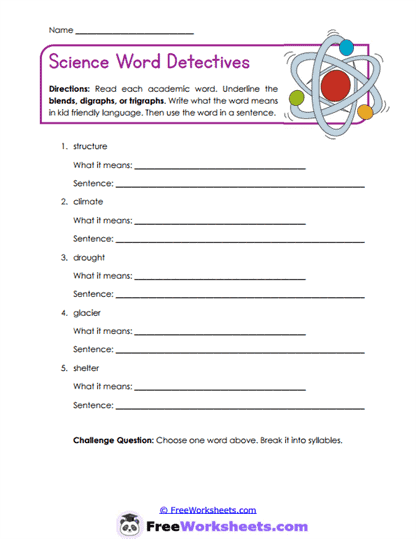
Children explore five science-related vocabulary words, including structure, climate, drought, glacier, and shelter, through a combination of phonics analysis and meaningful language practice. They begin by reading each word and underlining any blend, digraph, or trigraph they recognize. Next, students explain what each vocabulary word means using language they understand, rather than simply copying a formal definition. They then write an original sentence that demonstrates the meaning of the word within a realistic context. To complete the activity, children choose one of the science terms and divide it into syllables. This combination of tasks encourages students to examine pronunciation, spelling, meaning, and word structure while becoming more comfortable with academic vocabulary.
Target Skill:
This cross-curricular activity strengthens students’ ability to apply phonics knowledge to the more specialized language they encounter in science and informational texts. Recognizing familiar consonant patterns within academic vocabulary helps children decode unfamiliar words more confidently, while syllable division supports the analysis of longer word structures. Writing student-friendly definitions develops vocabulary understanding and encourages children to explain concepts in their own language. Using each term in a meaningful sentence adds an important comprehension check because students must demonstrate that they understand how the word functions beyond its pronunciation. These connected tasks support word recognition, academic vocabulary growth, spelling accuracy, and stronger comprehension of nonfiction materials across the 3rd grade curriculum.
Snowy Sound Hunt
What Kids Do:
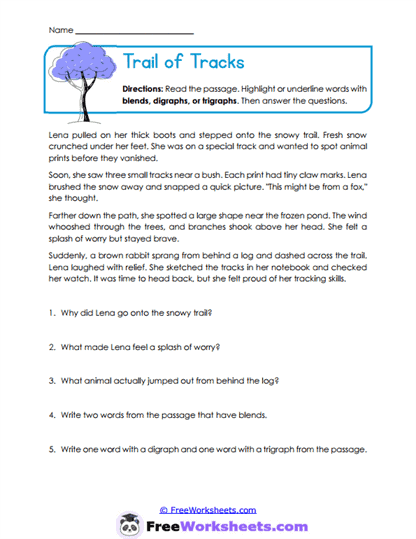
Students read a short winter-themed story about Lena following animal tracks along a snowy trail and encountering a rabbit. During the activity, they search the passage for words containing blends, digraphs, and trigraphs, highlighting or underlining the letter combinations they recognize. After examining the story, children answer three comprehension questions about Lena’s reason for going outside, what made her feel worried, and the animal that appeared from behind a log. They then return to the passage to locate and record examples of the targeted sound patterns. By moving between reading for meaning and searching for phonics features, students practice analyzing a connected text without losing sight of the events taking place in the story.
Target Skill:
This activity connects phonics recognition with reading comprehension, helping students recognize familiar consonant patterns while engaging with a meaningful narrative. Identifying blends, digraphs, and trigraphs within continuous text encourages children to transfer skills developed through word lists into authentic reading situations. The comprehension questions reinforce attention to story details, events, and character experiences, while the sound-pattern search develops careful word analysis and visual recognition. Revisiting the passage for a second purpose also teaches students that reading may involve examining both what a text communicates and how its words are constructed. These combined skills support decoding automaticity, comprehension monitoring, vocabulary development, and greater independence when reading unfamiliar 3rd grade passages.
Sound Skills Review
What Kids Do:
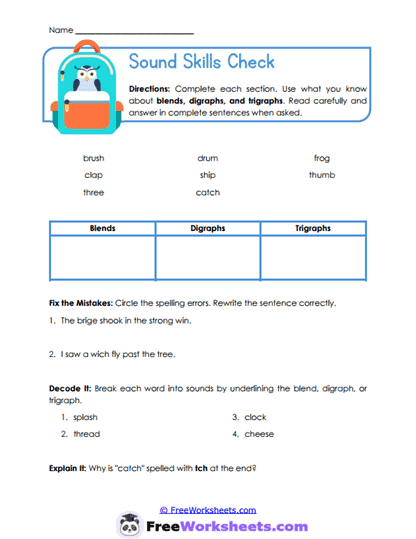
Students complete a four-part phonics review that brings together recognition, spelling, decoding, and written explanation. First, they sort words such as brush, clap, three, drum, ship, catch, frog, and thumb into categories for blends, digraphs, and trigraphs. Next, they read sentences containing intentional spelling mistakes, circle the errors, and rewrite the corrected sentences. In another section, children examine words such as splash, thread, clock, and cheese, underlining significant consonant patterns and considering how the letters represent sounds. The final challenge asks students to explain why catch ends with tch, requiring them to express a familiar spelling convention in their own words instead of merely choosing an answer from a list.
Target Skill:
This review measures how well students can use their understanding of consonant patterns across several different language tasks. Word sorting evaluates their ability to distinguish blends, digraphs, and trigraphs, while spelling corrections reveal whether they can recognize and repair incorrect letter combinations in context. Underlining sound patterns reinforces careful decoding and attention to word structure. Explaining a spelling convention develops reasoning and demonstrates whether children understand the relationship between sounds and written letters rather than simply memorizing familiar spellings. Because the activity combines several response formats, it can help teachers identify specific gaps between recognizing a phonics feature and applying it independently during reading or writing. The overall practice reinforces spelling accuracy, proofreading, word analysis, and the ability to communicate phonics knowledge clearly.
Sound Sort
What Kids Do:
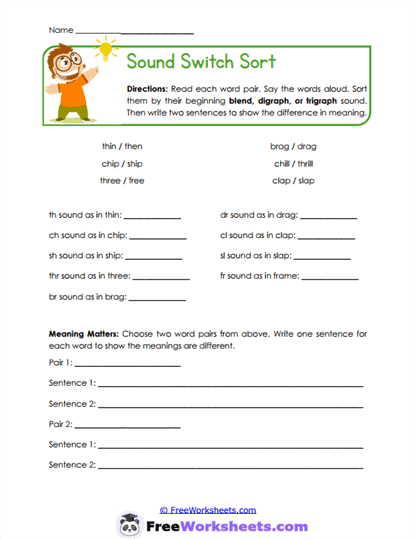
Children investigate beginning consonant sounds by reading and comparing word pairs such as thin/then, chip/ship, brag/drag, and clap/slap. They say the words aloud, listen carefully to how the beginning sounds are formed, and sort the targeted patterns into categories for blends, digraphs, and trigraphs. The paired format encourages students to notice how changing a letter combination can change both pronunciation and word meaning. Once the sorting section is complete, children select two word pairs and write original sentences that demonstrate what the words mean. This extension gives students a chance to use the vocabulary purposefully after examining the sound patterns.
Target Skill:
This activity strengthens phonemic awareness and phonics knowledge by helping students distinguish consonant combinations that contain separate sounds from those that represent a single sound. Comparing similar-looking words encourages closer listening and helps children recognize how small spelling differences influence pronunciation. Sorting the patterns develops accurate sound-symbol classification, while sentence writing connects the phonics work to vocabulary understanding and meaningful language use. The combination is particularly useful for students who can recognize familiar letter groups visually but still confuse the sounds those groups represent. These skills support more accurate decoding, spelling decisions, word recognition, and vocabulary application in 3rd grade language arts.
Spelling Cleanup
What Kids Do:
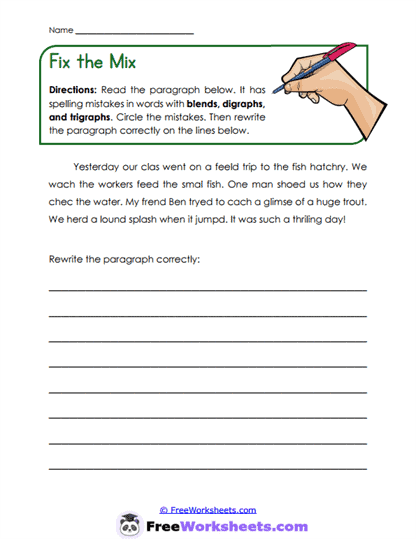
Students take on the role of editors as they read a short paragraph about a field trip that contains several intentional spelling mistakes involving blends, digraphs, and trigraphs. They begin by reading the entire passage and circling words that appear to be spelled incorrectly. For each error, children think about the sounds within the word and determine which letters or consonant combinations need to be corrected. After identifying the mistakes, they rewrite the complete paragraph on the provided lines, preserving the original sentence order and meaning while fixing the spelling. The full-paragraph rewrite encourages careful attention because students must carry their corrections into a polished version rather than simply mark errors on the original page.
Target Skill:
This proofreading activity strengthens the ability to apply phonics and spelling knowledge within connected writing. Students must recognize when a familiar consonant pattern has been represented incorrectly, determine the appropriate correction, and use that knowledge while rewriting complete sentences. Unlike isolated spelling exercises, the paragraph format requires children to maintain comprehension and pay attention to the surrounding language as they edit. Rewriting also reinforces accurate letter sequencing, capitalization, punctuation, and careful self-checking. The exercise can reveal whether students understand sound-pattern conventions well enough to recognize and repair errors independently, supporting stronger spelling accuracy, revision habits, and written language development throughout the 3rd grade curriculum.
Spelling Rules
What Kids Do:
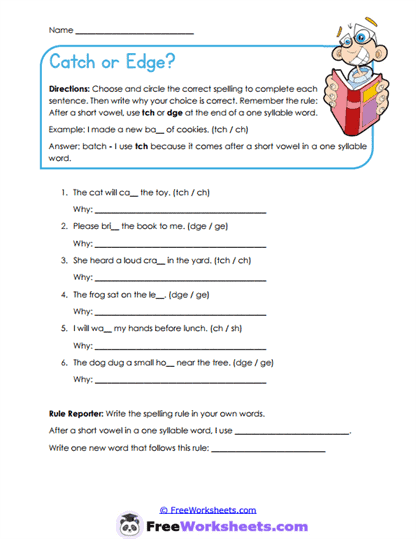
Children investigate common spelling conventions involving the word endings -tch, -ch, -dge, and -ge. They read six sentences containing incomplete words and decide which ending correctly completes each spelling. Rather than stopping after choosing an answer, students write a brief explanation describing why the selected pattern makes sense. After finishing the sentence-based questions, they complete a statement about the spelling rule and provide another example of a word that follows it. The exercise encourages children to examine relationships between vowel sounds and consonant endings, using examples such as catch, badge, much, and huge to notice how spelling patterns vary.
Target Skill:
This activity develops understanding of how particular consonant spellings are influenced by the sounds and structures surrounding them. Students practice recognizing that -tch and -dge commonly follow short vowel sounds in one-syllable words, while also learning that these patterns are not universal rules for every word ending in the same sound. Explaining the reasoning behind each spelling strengthens phonics knowledge and discourages dependence on visual memorization alone. The sentence format reinforces the connection between spelling and meaningful language, while the final rule-writing challenge develops the ability to communicate spelling generalizations. Together, these tasks support accurate spelling, word analysis, and more independent editing decisions.
Story Sound Fill
What Kids Do:
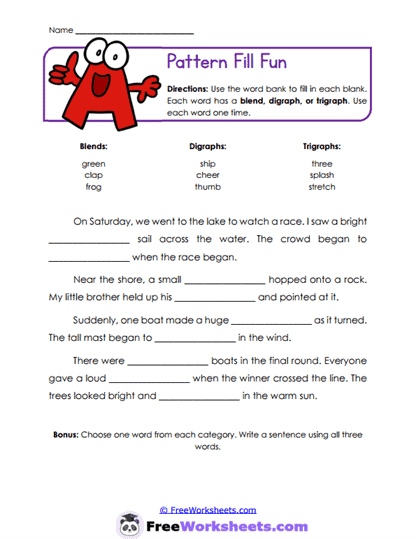
Students use a phonics-focused word bank to complete a short story about activities taking place around a lake and boat race. The available vocabulary is organized into blends, digraphs, and trigraphs, with examples such as green, clap, frog, ship, cheer, thumb, three, splash, and stretch. Children read the story one sentence at a time and decide which word best completes each blank based on what is happening and how the sentence is structured. Every word can be used only once, so students must consider their choices carefully and check that the completed passage remains logical. After finishing the story, they select one word from each sound-pattern group and combine all three into an original sentence.
Target Skill:
The story-completion format develops students’ ability to use phonics knowledge alongside vocabulary and context clues during connected reading. Recognizing familiar blends, digraphs, and trigraphs helps children decode the available choices, but successfully completing each sentence also requires understanding its meaning and grammatical structure. This encourages readers to verify that a decoded word makes sense instead of assuming that correct pronunciation automatically produces comprehension. The one-use-only word bank adds a layer of reasoning, requiring students to consider relationships among the available options. The concluding sentence-writing challenge transfers the same vocabulary into independent expression, strengthening comprehension, flexible word use, and the integration of phonics with reading and writing.
Syllable Safari
What Kids Do:
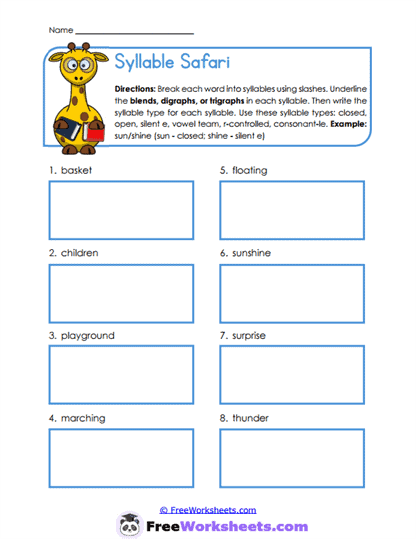
Children explore the internal structure of eight multisyllabic words, including basket, children, playground, marching, floating, sunshine, surprise, and thunder. Using a worked example for guidance, they read each word and insert slashes to show where one syllable ends and the next begins. Students then underline any blends, digraphs, or trigraphs they identify and label the appropriate syllable types, such as closed, open, silent e, vowel team, r-controlled, or consonant-le. The activity requires children to examine each word in several ways, considering its pronunciation, syllable boundaries, spelling patterns, and structural features rather than focusing on only one characteristic.
Target Skill:
This word-analysis activity strengthens the ability to break longer words into manageable syllables while recognizing familiar consonant and vowel patterns within them. Identifying syllable types provides children with useful information about how letters work together and how individual word parts should be pronounced. Underlining blends, digraphs, and trigraphs adds another layer of attention to sound-symbol relationships, helping students distinguish patterns that represent separate sounds from those that function as a single unit. These connected strategies support decoding unfamiliar multisyllabic words, spelling accuracy, and increasingly fluent reading. For 3rd grade students, the ability to analyze word structure systematically becomes especially important as classroom texts introduce longer vocabulary across multiple subjects.
Word Builder
What Kids Do:
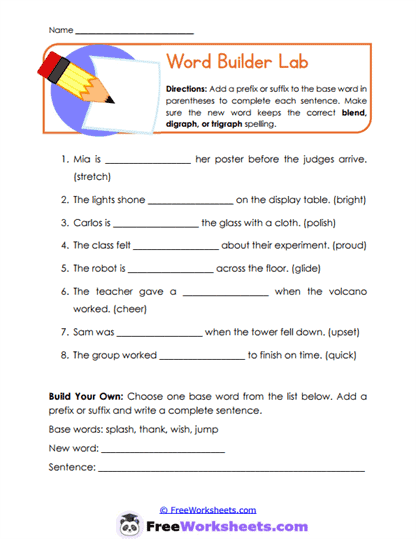
Students become word builders by adding prefixes or suffixes to familiar base words such as stretch, bright, polish, proud, glide, cheer, upset, and quick. Each of the eight sentence-completion questions presents a base word in parentheses and asks children to choose an appropriate word part that creates a new form fitting the sentence. Students write the completed word and can reread the sentence to check that the meaning and grammar are correct. After completing the guided examples, they choose one of the base words, create an additional word of their own, and use it in a complete original sentence. The activity encourages children to notice both the added word part and the familiar spelling patterns that remain within the base word.
Target Skill:
This activity introduces morphological awareness by showing how prefixes and suffixes can modify a base word’s meaning or grammatical function. Students strengthen their understanding of word structure while practicing accurate spelling and recognizing familiar blends, digraphs, and trigraphs within longer word forms. Choosing the correct word for a sentence also requires attention to context, helping children understand that forming a real word is not always the same as selecting the word that fits a particular meaning. The independent word-building challenge encourages flexible vocabulary use and reinforces the relationship between word parts and complete sentences. These skills support vocabulary expansion, spelling development, grammar awareness, and the ability to interpret unfamiliar words encountered in increasingly complex 3rd grade texts.