
About This Worksheet
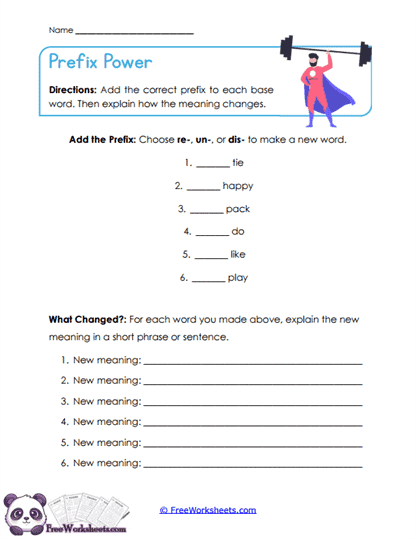
This Grade 3 vocabulary worksheet helps children see how adding a prefix can change the meaning of a base word. Students work with the prefixes re-, un-, and dis- and add them to familiar words such as tie, happy, pack, do, like, and play.
The activity does not stop after students build the new word. They also explain how the meaning changed. That extra step is important because it shows whether the child understands what the prefix is doing instead of simply attaching letters to the front of a word.
Learning Goals
The main goal is to help students understand that prefixes carry meaning. Children practice learning that re- can mean again, un- can mean not or reverse an action, and dis- can show the opposite or not.
This helps students unlock unfamiliar words when they read. If a child knows what happy means and understands un-, then unhappy becomes much easier to figure out.
These skills support vocabulary growth, spelling, decoding, and reading comprehension.
What Students Will Do
In the first section, students look at each base word and choose the correct prefix from re-, un-, or dis-. They write the prefix in front of the word to make a new word.
After creating all six words, they move to the What Changed? section.
There, students explain what each new word means in a short phrase or sentence. For example, they might explain that replay means to play again.
The goal is to show both the new word and the meaning created by the prefix.
Common Challenges
Some children may know a real word but choose the wrong prefix for the base word. Others may build the word correctly but struggle to explain the new meaning.
A helpful question is, “What does the prefix tell us?” Then ask, “What does the base word mean?” Putting those two pieces together usually makes the answer clearer.
Teaching Suggestions
Teachers can model one example by covering the prefix first and talking about the base word. Then add the prefix and ask what changed.
Parents can do the same thing aloud. Say, “If redo has re- in front, what does that tell us?” This helps children connect the word part to its meaning.
For stronger students, ask them to think of one more word for each prefix and explain it.
Worksheet Features
The page includes six base words, three possible prefixes, and a second section where students explain each new meaning. This gives children both word-building practice and vocabulary thinking.
This worksheet works well for morphology lessons, vocabulary review, spelling practice, or independent language arts work.