
About This Worksheet
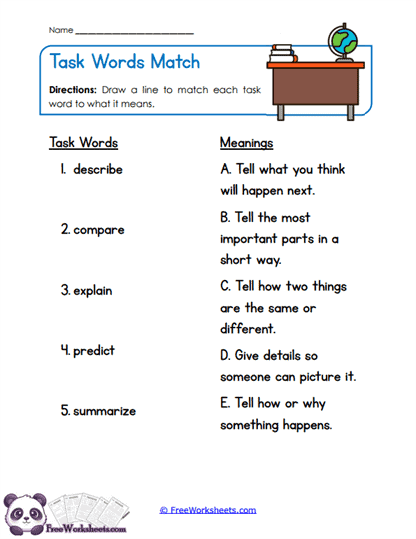
This Grade 3 vocabulary worksheet helps children understand common task words they will see in directions across many subjects. Students work with words such as describe, compare, explain, predict, and summarize. They match each word to a simple meaning that tells them what the teacher is actually asking them to do.
This is very useful because sometimes a child knows the answer to a question but gets confused by the direction word. If they do not understand what compare or summarize means, they may give the wrong kind of response even when they understand the lesson.
Learning Goals
The main goal is to help students understand academic direction words so they can follow assignments more independently.
Children practice learning that describe means to give details, compare means to tell how things are alike or different, explain means to tell how or why something happens, predict means to tell what they think will happen next, and summarize means to give the most important parts in a shorter way.
These words show up in reading, science, social studies, and writing, so learning them can help across the whole school day.
What Students Will Do
Students read the five task words on the left side of the page and the five meanings on the right.
They draw a line from each word to the meaning that fits best.
For example, predict should connect to the meaning about saying what you think will happen next, while summarize should connect to the meaning about telling the most important parts in a short way.
Students continue until all five school words have been matched.
Common Challenges
Some children may confuse describe and explain because both can require more than one sentence. A simple way to separate them is to say that describing tells what something is like, while explaining tells how or why.
Students may also think summarize means retelling every detail. Remind them that a summary only includes the most important information.
Teaching Suggestions
Teachers can make this page even more useful by giving one quick example question for each task word after the matching is done.
Parents can do the same thing at home. Ask, “If I said, ‘Describe your room,’ what would you do?” Then try, “Compare a cat and a dog.”
For stronger students, ask them to write one sample classroom question using each task word.
Worksheet Features
The page includes five important academic vocabulary words and five clear meanings. The simple matching format makes it easy for children to focus on what each direction word actually asks them to do.
This worksheet works well for classroom vocabulary, test preparation, homework help, or beginning-of-year language arts review.