
About This Worksheet
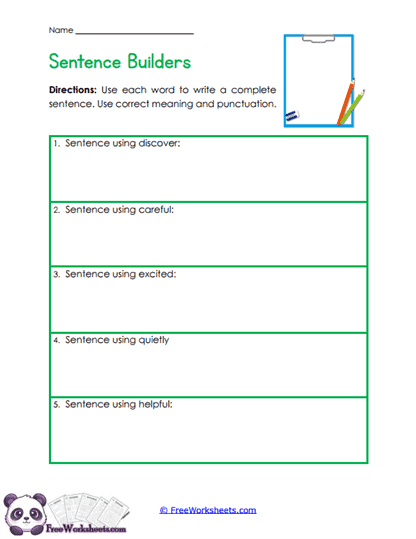
This Grade 3 vocabulary worksheet asks children to take five useful words and use each one in a complete sentence. Students work with discover, careful, excited, quietly, and helpful. Instead of choosing an answer from a list, they have to show what each word means through their own writing.
This is valuable because using a word correctly is a stronger skill than simply matching it to a definition. When children create a sentence on their own, teachers and parents can see whether they truly understand both the meaning and how the word fits into normal language.
Learning Goals
The main goal is to help students move vocabulary from recognition into real use. Children practice writing a complete thought that includes the target word and makes its meaning clear.
They also review sentence basics such as capitalization, punctuation, and making sure the sentence sounds complete.
This supports vocabulary growth, grammar, writing fluency, and confidence with new words.
What Students Will Do
Students are given five target words, one at a time.
For each word, they write a complete sentence in the large space provided. The sentence should use the word naturally and show that the student understands what it means.
For discover, a child might write about finding something new. For careful, the sentence should show someone being cautious. For quietly, the sentence should describe how an action is done.
Students repeat this process until all five words have been used.
Common Challenges
Some children may write a sentence that includes the word but does not really show the meaning. For example, “I like the word careful” uses the word but does not demonstrate understanding.
A parent or teacher can ask, “If someone read your sentence, would they be able to guess what this word means?” If not, the sentence needs more detail.
Another common issue is forgetting capitals or punctuation because the child is concentrating on vocabulary.
Teaching Suggestions
Have students say their sentence aloud before writing it. Oral practice helps them hear whether the sentence sounds complete and whether the vocabulary word fits naturally.
Teachers can model the difference between a weak sentence and a strong one. For example, compare “She was careful” with “She was careful while carrying the full glass of water.” The second sentence gives a much clearer picture.
Parents can also ask the child to draw a quick mental picture of the word before writing. That often makes the sentence easier to create.
Worksheet Features
The page includes five Grade 3 vocabulary words with generous writing space for original sentences. The open-ended format gives students room to show what they know instead of relying on multiple-choice answers.
This worksheet works well for vocabulary centers, writing practice, homework, or as a follow-up after introducing new words.