
About This Worksheet
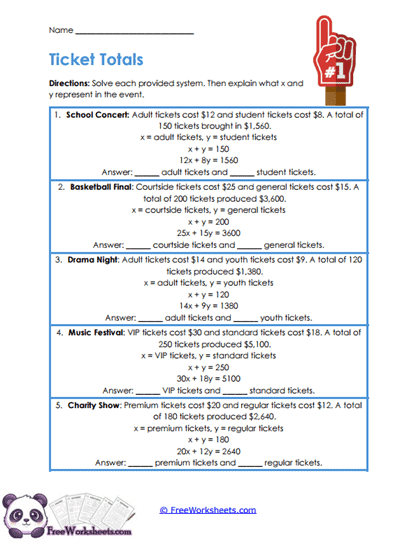
This worksheet helps eleventh-grade Algebra 2 students practice solving real-world systems about ticket sales and then interpreting what the answers mean. Students work through five event situations involving school concerts, basketball games, drama nights, music festivals, and charity shows. Each problem gives the total number of tickets sold and the total money collected for two ticket types.
The equations are already provided, so students can focus on solving the system and interpreting the ordered-pair result. Once they find the two variable values, they write how many tickets of each type were sold. This helps connect the algebra directly back to the story.
What Students Practice
Students practice solving systems that combine a total-number equation with a total-revenue equation. They may use substitution or elimination depending on which method feels more efficient. After solving, they interpret x and y using the variable definitions given in the problem.
The worksheet also reinforces that an ordered pair has meaning in context. The first number is not just an x-value; it might represent adult tickets, VIP tickets, or premium tickets. The second value represents the other ticket type.
Why This Skill Matters
Systems of equations are commonly used when two unknown quantities are connected to two different totals. Ticket problems are a clear example because students must satisfy both the total number sold and the total money earned at the same time.
This skill also teaches students to interpret solutions instead of stopping with algebra. A correct ordered pair becomes more useful when students can explain what each value represents in the situation.
Common Challenges
Students may solve the system correctly but forget which number belongs to which ticket type. Encourage them to look back at the variable definitions before writing the final sentence.
Another common mistake is mixing up the total number equation with the revenue equation. Students should notice that the money equation includes the ticket prices, while the count equation does not.
How To Use It
Teachers can use this worksheet after students are comfortable solving systems and writing systems from stories. It works well for independent practice, homework, partner work, or an applied review near the end of the unit.
Parents and homeschool teachers can ask, “What does x stand for, and what does y stand for?” after the system is solved. That simple question helps students turn the algebra answer into a complete real-world answer.
Grade Alignment
This worksheet is intended for Grade 11 Algebra 2 and supports CCSS HSA-REI.C.6 and HSA-CED.A.3 through solving and interpreting real-world systems of linear equations.
Students should already know substitution or elimination and understand variable definitions. After this practice, they are ready for broader system applications involving rates, mixtures, costs, and other real-world situations.