
About This Worksheet
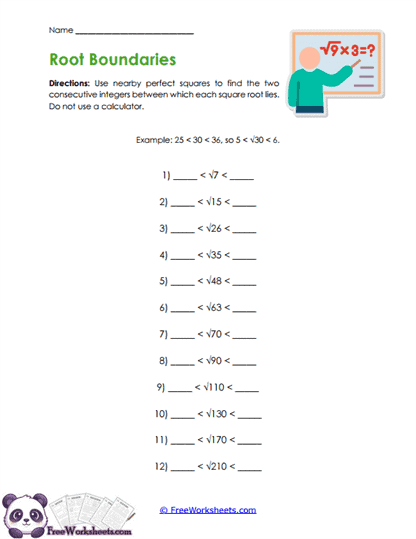
This worksheet helps eleventh-grade Algebra 2 students practice estimating square roots by placing them between two nearby whole numbers. Students work through twelve square roots that do not simplify to exact integers. Instead of using a calculator, they identify the two consecutive whole numbers that the square root falls between.
For example, if the number under the radical falls between two nearby perfect squares, students can use those perfect squares to estimate the root. If a value is greater than one perfect square but less than the next, then its square root must fall between the matching whole numbers. This helps students build stronger number sense instead of depending on decimal approximations.
What Students Practice
Students practice recognizing nearby perfect squares and using them as reference points. They compare the number under the radical to those perfect squares, then write the two whole numbers that bound the square root.
The worksheet also reinforces the idea that an irrational square root can still be located very accurately on the number line even if it does not simplify nicely. Students learn to make a reasonable estimate without needing the exact decimal value.
Why This Skill Matters
Estimating radicals is useful throughout Algebra 2 because irrational numbers often appear in equations, geometry problems, and function work. Students do not always need a calculator if they can quickly place the value between two familiar numbers.
This skill also helps when comparing and ordering real numbers. A radical may look harder to compare than a fraction or decimal, but bounding it between two whole numbers makes the size much easier to understand.
Common Challenges
Students may compare the square root itself to the wrong perfect squares. Remind them to first look at the number inside the radical and find the perfect squares just below and above it.
Another common mistake is skipping too far apart. The directions ask for consecutive integers, so students should identify the two whole numbers directly surrounding the square root rather than giving a wider estimate.
How To Use It
Teachers can use this worksheet after students review perfect squares and before moving into ordering mixed real numbers. It works well for independent practice, homework, warm-up work, or a no-calculator review.
Parents and homeschool teachers can ask, “Which two perfect squares is this number between?” Once those are found, take the matching whole-number roots to determine the lower and upper bound.
Grade Alignment
This Grade 11 Algebra 2 worksheet supports students in reasoning about irrational numbers and estimating square roots. It connects with CCSS HSN-RN.A.2-3 by strengthening understanding of real-number values and radical expressions.
Students should already know common perfect squares. After this practice, they can compare radicals with fractions, decimals, and other irrational values more confidently.