
About This Worksheet
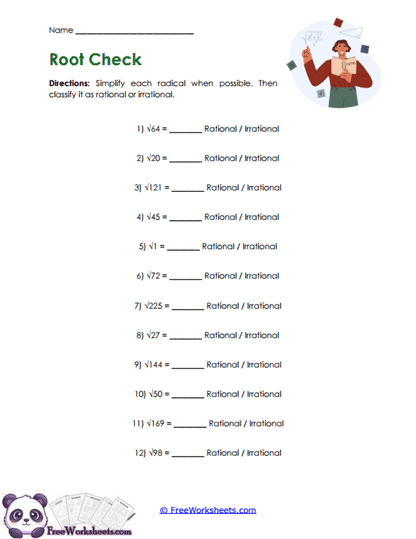
This worksheet helps eleventh-grade Algebra 2 students practice simplifying square roots and then deciding whether the result is rational or irrational. Students work through twelve radicals, some of which simplify to whole numbers and some of which do not. The activity makes students simplify first instead of judging the number only by how it looks.
For example, the square root of a perfect square becomes a whole number, so the result is rational. A square root that cannot simplify to an exact whole number remains irrational. This helps students see why the radical symbol alone does not tell them the number type.
What Students Practice
Students practice checking whether the number under a square root is a perfect square. If it is, they simplify the radical completely and classify the result as rational. If it is not, they recognize that the square root remains irrational.
The worksheet also reinforces the difference between a radical expression and its actual value. Students learn to focus on what the expression simplifies to rather than automatically labeling every square root as irrational.
Why This Skill Matters
Radicals appear often in Algebra 2, especially in quadratic equations, distance problems, and function work. Students need to know when a radical represents an exact rational value and when it represents an irrational number.
This skill also supports more advanced radical simplification. Before students can work confidently with larger radical expressions, they need a strong sense of which roots simplify cleanly and which do not.
Common Challenges
Students may assume every square root is irrational. Remind them that perfect squares have exact whole-number square roots, which are rational.
Another common mistake is classifying before simplifying. Encourage students to always check the value of the radical first. A number that looks irrational at first may simplify to a very simple integer.
How To Use It
Teachers can use this worksheet after students review rational and irrational numbers. It works well for independent practice, homework, a quick warm-up, or a bridge into more advanced radical work.
Parents and homeschool teachers can ask, “Is the number under the radical a perfect square?” If yes, simplify it and classify the result. If not, the square root is irrational.
Grade Alignment
This worksheet is designed for Grade 11 Algebra 2 and supports understanding of rational and irrational numbers while reinforcing radical simplification. It connects with CCSS HSN-RN.A.3 by helping students reason about number types.
Students should already understand perfect squares and basic square roots. After this practice, they can move into decimal patterns and estimating irrational values.