
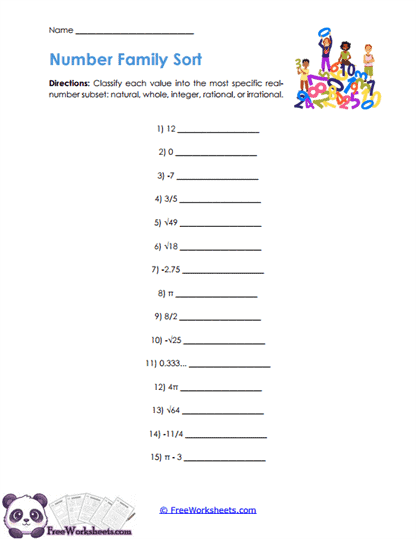
About This Worksheet
This worksheet helps eleventh-grade Algebra 2 students understand how real numbers fit into different number groups. Students look at fifteen values and classify each one using the most specific name possible, such as natural number, whole number, integer, rational number, or irrational number. The list includes positive and negative numbers, fractions, decimals, square roots, and expressions involving pi.
For example, a positive counting number belongs to several groups, but students should choose the smallest and most specific group that describes it. A negative whole value is an integer, while a fraction is rational. A square root that does not simplify to a whole number may be irrational. This helps students see how the real-number system is organized like a family tree.
What Students Practice
Students practice telling the difference between natural numbers, whole numbers, integers, rational numbers, and irrational numbers. They also learn that some numbers belong to more than one group, even though the worksheet asks them to choose the most specific category.
The activity includes several number forms so students cannot depend on appearance alone. A decimal might be rational, a square root might simplify to an integer, and an expression with pi will usually be irrational. Students must think about the value of each number before naming its family.
Why This Skill Matters
Understanding number sets gives students a stronger foundation for Algebra 2. Different kinds of numbers behave differently, and students need to know what type of answer they are working with when solving equations, simplifying radicals, or studying functions.
This skill also helps students make sense of the real-number system as a whole. Natural numbers fit inside whole numbers, whole numbers fit inside integers, and integers fit inside rational numbers. Irrational numbers join rational numbers to make the complete set of real numbers.
Common Challenges
Students may think a number can belong to only one group. Remind them that many numbers belong to several sets at the same time. The goal here is to choose the most specific group that fits.
Another common mistake is assuming every square root is irrational. Some square roots simplify perfectly. Students should check whether the number under the radical is a perfect square before deciding.
How To Use It
Teachers can use this worksheet as an introduction to the real-number system or as review before working with radicals and irrational numbers. It works well for independent practice, partner discussion, homework, or a quick warm-up.
Parents and homeschool teachers can ask, “What is the smallest number family this value belongs to?” Start with natural numbers and move outward only when the number does not fit. This makes the classification process easier.
Grade Alignment
This worksheet is designed for Grade 11 Algebra 2 and supports students in understanding the structure of the real-number system. It connects well with CCSS HSN-RN.A.3, which involves explaining why sums and products of rational and irrational numbers behave in certain ways.
Students should already understand basic fractions, decimals, and square roots. After this practice, they can move into identifying the smallest set that contains a number and explaining why a number is rational or irrational.