
About This Worksheet
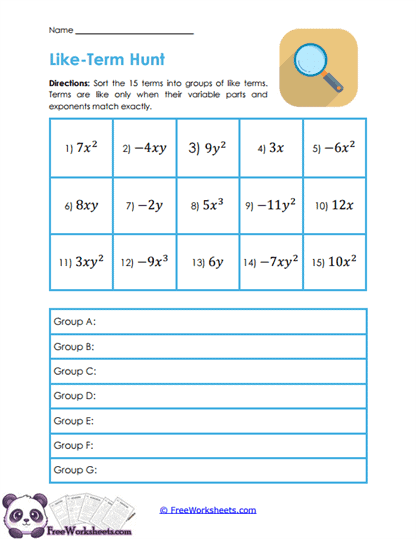
This worksheet helps eleventh-grade students practice sorting algebraic terms into groups of like terms. Students are given fifteen separate terms and must place them into groups based on matching variable parts and matching exponents. The coefficients can be different, but the letters and powers must be exactly the same for the terms to belong together.
For example, two terms involving the same variable raised to the same power belong in the same group even if one is positive and the other is negative. On the other hand, a term with the variable squared does not belong with a term using that same variable to the first power. This helps students understand exactly what “like terms” means.
What Students Practice
Students practice comparing the variable portion of each term instead of focusing only on the number in front. They look carefully at which variables appear and what exponent each variable has. Once the variable parts match, those terms can be grouped together.
The worksheet also includes terms with more than one variable. This makes the activity more challenging because students must check every variable and every exponent. A small difference means the terms are not alike.
Why This Skill Matters
Combining like terms is one of the most important skills in polynomial operations. Students need to recognize like terms before they can add or subtract polynomials correctly. If unlike terms are combined, the entire expression changes meaning.
This skill also helps students organize longer expressions. When polynomials have many terms, grouping matching pieces first makes the work cleaner and easier to check.
Common Challenges
Students may think that any two terms with the same variable can be combined. Remind them that the exponent must also match. A variable squared and that same variable cubed are different types of terms.
Another common mistake is grouping terms based on the coefficient. The number in front does not decide whether terms are alike. The variable letters and exponents are what matter.
How To Use It
Teachers can use this worksheet before introducing polynomial addition or subtraction. It works well for partner sorting, independent practice, homework, or a quick review. Having students circle matching variable parts before placing terms into groups can make the pattern easier to see.
Parents and homeschool teachers can ask, “Do the letters match exactly?” and then, “Do the exponents match too?” If both answers are yes, the terms belong in the same group.
Grade Alignment
This Grade 11 Algebra 2 worksheet supports CCSS HSA-SSE.A.1 by helping students recognize the structure of algebraic expressions. It also prepares students for polynomial addition and subtraction by strengthening their ability to identify like terms.
Students should already understand variables, coefficients, and exponents. After this practice, they can begin combining terms across larger polynomial expressions.