
About This Worksheet
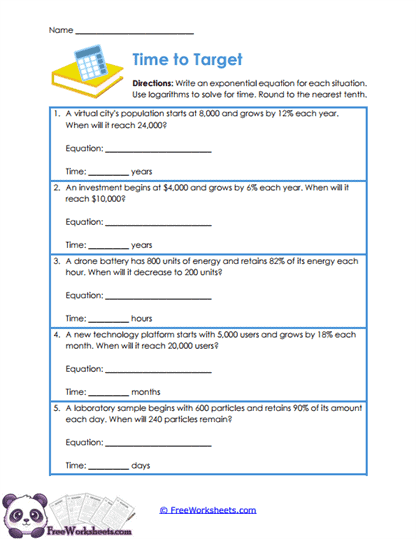
This worksheet helps eleventh-grade students apply exponential and logarithmic equations to real-world growth and decay situations where time is the unknown. Students work through five contexts involving population growth, investments, battery energy loss, platform users, and laboratory samples. They first write an exponential equation for each situation and then use logarithms to solve for the time needed to reach a target value.
For example, if a population starts at 8,000 and grows by 12% each year, students can model the amount with an exponential growth equation. They then set that expression equal to 24,000 and use logarithms to solve for the number of years. Other problems use decay factors such as retaining 82% or 90% of an amount over time.
What Students Practice
Students practice identifying an initial value, growth or decay factor, target value, and time variable. They write equations in the form of exponential models and then use logarithms to isolate the exponent. This combines modeling with equation solving.
The worksheet also helps students distinguish growth rates from decay or retention rates. A 12% increase means multiplying by 1.12 each period, while retaining 82% means multiplying by 0.82. Correctly building that factor is an important part of the problem.
Why This Skill Matters
One of the most useful applications of logarithms is solving for time in exponential models. When the unknown appears in the exponent, ordinary algebra operations are not enough. Logarithms give students a way to bring the exponent down and solve.
This skill appears in finance, population studies, science, technology, and many other real-world areas. Students learn that logarithms are not just another set of rules-they are a practical tool for answering questions about when a changing quantity will reach a particular level.
Common Challenges
Students may use the percent rate itself as the exponential factor. Remind them that growth by 12% means a factor of 1.12, not 0.12. For decay or retention problems, students need to decide whether the wording gives the percent lost or the percent remaining.
Another common mistake is trying to isolate the time without taking logarithms. Once the exponential expression is isolated, logarithms allow the exponent to come down so the equation can be solved with ordinary algebra.
How To Use It
Teachers can use this worksheet after students have learned to solve exponential equations with logarithms. It works well for guided modeling, independent practice, homework, or a real-world Algebra 2 lesson. Completing one growth example and one decay example together can help students see the difference in the multipliers.
Parents and homeschool teachers can ask four questions: “What is the starting amount? What percent changes each period? Is it growth or decay? What target are we trying to reach?” Once those pieces are clear, students can write the model and solve for time.
Grade Alignment
This worksheet is intended for Grade 11 Algebra 2 and strongly supports CCSS HSF-LE.A.4, which asks students to use logarithms to solve exponential equations arising from real-world models. It also reinforces building exponential functions from growth and decay situations.
Students should already know how to write basic exponential models and solve exponential equations using logs. After this practice, they are ready for more complex applications involving varying rates, compound interest, and exponential modeling.