
About This Worksheet
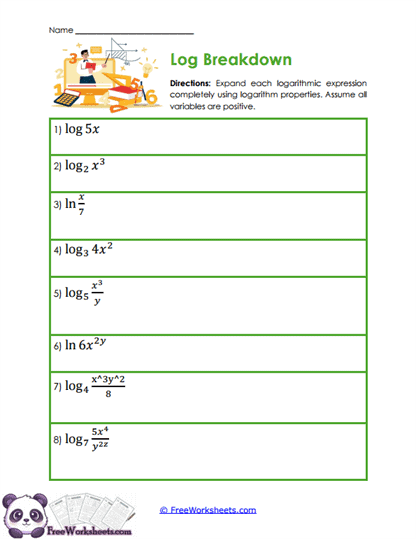
This worksheet helps eleventh-grade Algebra 2 students practice expanding logarithmic expressions by using the product, quotient, and power properties. Students work through eight expressions and rewrite each one as a sum or difference of simpler logarithms. The problems include products, quotients, powers, constants, and several variables, so students must decide which logarithm properties apply and in what order.
For example, an expression like log(5x) can be expanded into two logarithms because 5 and x are being multiplied. A quotient such as ln(x/7) becomes a difference, while an exponent such as x3 allows the 3 to move in front as a coefficient. More involved problems combine several of these ideas in the same expression.
What Students Practice
Students practice looking inside a logarithm and identifying multiplication, division, and powers. They then apply the matching property one step at a time until the expression is completely expanded. This helps them understand that a complicated logarithm can often be broken into several simpler parts.
The worksheet also includes expressions with more than one variable and exponent. Students must keep coefficients attached to the correct logarithm and make sure every factor or divisor is represented in the final answer. This encourages careful algebraic organization.
Why This Skill Matters
Expanding logarithms is useful because it makes complicated expressions easier to work with. Students may need expanded form when solving equations, simplifying expressions, or comparing terms. The process also helps them see how logarithm rules are connected to exponent properties.
This skill is especially important later in Algebra 2 when students solve logarithmic equations. Being able to separate products and quotients can reveal terms that can be combined or isolated more easily.
Common Challenges
Students may try to split a logarithm across addition inside the argument. Remind them that the product property works only with multiplication, not with addition. An expression such as log(x + 5) cannot be separated into two logs.
Another common mistake is forgetting to move an exponent all the way in front of the logarithm. For example, log(x3) becomes 3 log x. Students should look for powers after handling products and quotients.
How To Use It
Teachers can use this worksheet after students have learned to identify the three main logarithm properties. It works well for guided practice, independent work, homework, or review before solving logarithmic equations. Modeling one expression with both a quotient and a power can help students see how multiple rules work together.
Parents and homeschool teachers can ask, “Is there multiplication, division, or a power inside the log?” That question usually tells the student which property to use first. Then continue until no more properties can be applied.
Grade Alignment
This worksheet is designed for Grade 11 Algebra 2 and supports work with equivalent logarithmic expressions and logarithm properties. It reinforces the algebraic structure students need for solving logarithmic equations and understanding inverse exponential relationships.
Students should already recognize the product, quotient, and power properties. After this practice, they can move into condensing several logarithms into one expression.