
About This Worksheet
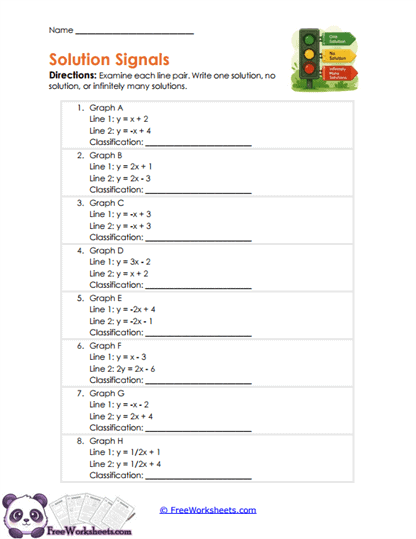
This worksheet helps eighth-grade students determine whether a system of equations has one solution, no solution, or infinitely many solutions. Students examine eight pairs of equations and compare their slopes and y-intercepts. Instead of solving for an exact ordered pair every time, they decide how the two lines relate to one another. This helps students understand that systems do not always produce exactly one answer.
For example, two lines with different slopes will eventually intersect, so the system has one solution. Two different lines with the same slope are parallel and have no solution. If two equations describe the exact same line, every point on that line works for both equations, giving infinitely many solutions.
What Students Practice
Students practice comparing equations in slope-intercept form and identifying the slope and y-intercept of each line. They then use those values to classify the system without needing to graph every pair. This helps students become faster at recognizing important patterns in linear equations.
The activity also strengthens the connection between algebra and geometry. Students learn that “one solution” means intersecting lines, “no solution” means parallel lines, and “infinitely many solutions” means the equations represent the same line. That connection makes the classifications easier to remember.
Why This Skill Matters
Not every system behaves the same way, and students need to recognize all three possibilities. If they expect every system to have one ordered-pair answer, parallel or equivalent equations can be confusing. This worksheet gives those special cases direct attention.
Understanding the number of solutions also becomes important when students use substitution or elimination. Sometimes the variables disappear and leave a true statement or a false statement instead of an ordered pair. Knowing what that means ahead of time helps students interpret those results correctly.
Common Challenges
Students may assume that equations with the same slope always have no solution. Remind them to check the y-intercepts too. The same slope with different intercepts means parallel lines and no solution, while the same slope and same intercept mean the equations describe the same line.
Another common mistake is thinking infinitely many solutions means the student made an error. In some systems, that is exactly the correct answer. Encourage students to compare both slope and intercept before deciding which classification fits.
How To Use It
Teachers can use this worksheet after students understand slope-intercept form and before or during formal system solving. It works well as a warm-up, independent activity, homework assignment, or quick formative assessment. Drawing a small sketch of intersecting, parallel, and overlapping lines before students begin can make the three categories very clear.
Parents and homeschool teachers can use a simple comparison routine. Ask, “Are the slopes the same or different?” If they are the same, then ask whether the y-intercepts are also the same. Those two questions are usually enough to determine the number of solutions.
Grade Alignment
This Grade 8 worksheet directly supports CCSS 8.EE.C.8b, which asks students to solve systems algebraically and recognize cases with one solution, no solution, or infinitely many solutions. It also reinforces students’ understanding of slope and y-intercepts from linear equations.
Students should already know how to identify slope and the y-intercept from y = mx + b. After this practice, they are ready to recognize these same solution types while solving systems by substitution and elimination.