
About This Worksheet
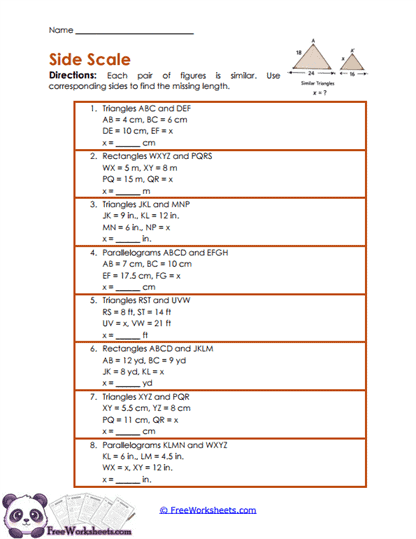
This worksheet helps eighth-grade students use proportions to find missing side lengths in similar figures. Eight problems give pairs of similar triangles, rectangles, parallelograms, or other polygons with corresponding side lengths. Students identify which sides match, set up a proportion, and solve for the unknown measurement. This connects proportional reasoning directly to geometry.
For example, if one triangle has a side of 4 cm corresponding to a side of 6 cm in a larger triangle, students use that scale relationship to find another missing side. The same multiplicative relationship must hold for all corresponding sides. This helps students see that similarity is really a proportional relationship between shapes.
What Students Practice
Students practice matching corresponding sides and using them to build a correct proportion. They then solve for x using scale factors or cross multiplication. This gives them repeated practice combining geometry vocabulary with ratio reasoning.
The worksheet also includes different measurement units such as centimeters, meters, feet, yards, and inches. Students must keep those units attached to the final answer. That helps reinforce the idea that a side length is a measurement, not just a number.
Why This Skill Matters
Similar figures appear often in geometry, scale drawings, maps, models, and indirect measurement. Students need to understand that corresponding sides in similar figures are proportional. This worksheet gives them a practical way to apply that idea.
The skill also supports later work with dilations and similarity proofs. Once students understand side-length proportions, they are better prepared to reason about scale factors and geometric transformations. This makes proportion work feel connected to a larger math story.
Common Challenges
Students may pair the wrong sides when setting up the proportion. Encourage them to identify the matching vertices or positions before writing any equation. A correct proportion depends on keeping the same order on both figures.
Another common mistake is switching units or forgetting them completely. Remind students to carry the unit from the unknown side into the final answer. A number without a unit is not a complete measurement.
How To Use It
Teachers can use this worksheet after introducing similar figures and corresponding sides. It works well for guided practice, independent work, homework, or a geometry review station. Completing one example together and labeling the matching sides can help students see how the setup works.
Parents and homeschool teachers can ask, “Which side on the second shape matches this side on the first shape?” Once the corresponding pairs are clear, students can set up the proportion more confidently. This keeps the focus on the geometry before the arithmetic.
Grade Alignment
This worksheet is designed for Grade 8 math and supports work with similarity and proportional relationships. It connects with CCSS 8.G.A.4, which asks students to understand similarity through transformations and use properties of similar figures. The proportional reasoning also builds from CCSS 7.RP.A.2.
Students should already know how to solve proportions and identify corresponding parts of figures. After this practice, they can move into scale factors, dilations, and more advanced similarity problems.