
About This Worksheet
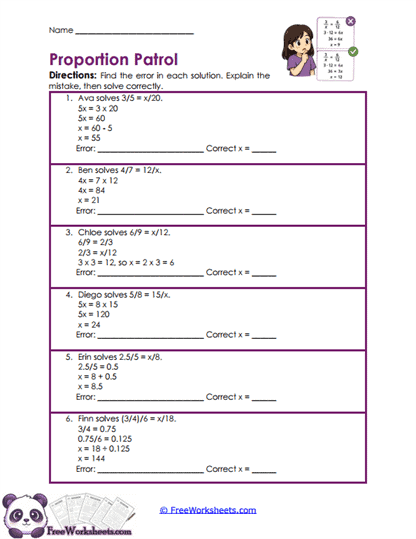
This worksheet helps eighth-grade students find and correct mistakes in proportion-solving work. Six examples show a student’s attempted solution, and students must identify the error, explain what went wrong, and find the correct value of x. The mistakes include incorrect cross products, arithmetic errors, poor fraction setup, and misuse of decimal values. This turns the page into a reasoning activity instead of simple answer practice.
For example, a student may cross multiply 3/5 = x/20 incorrectly and end up with the wrong equation. Another may convert a fractional proportion into decimals and then perform the multiplication incorrectly. By analyzing these errors, students learn to watch for the same problems in their own work.
What Students Practice
Students practice reading a proportion solution step by step and checking whether each move is valid. They identify the first wrong step and then repair the solution using a correct method. This helps build deeper understanding of cross multiplication and equivalent ratios.
The worksheet also reviews several number forms. Students work with whole numbers, fractions, decimals, and mixed proportional structures. That variety makes the error analysis more useful because students cannot rely on one repeated pattern.
Why This Skill Matters
Error analysis helps students become better at checking their own work. A proportion can look correct at first glance even when one multiplication or division step is wrong. Learning to inspect the reasoning helps students catch mistakes before they become final answers.
This skill also strengthens mathematical communication. Students must explain what the student did incorrectly instead of only writing the correct answer. That kind of explanation shows stronger understanding than answer-only work.
Common Challenges
Students may see that the final answer is wrong but struggle to explain the exact mistake. Encourage them to find the first line where the math stops being equivalent. This makes the explanation much clearer.
Another common issue is correcting the answer without showing the proper setup. Have students rewrite the proportion or cross products correctly before solving. This reinforces the method rather than turning the task into guess-and-check.
How To Use It
Teachers can use this worksheet for partner discussion, small-group review, test preparation, or a whole-class error-analysis lesson. It is especially helpful after students have already solved many proportions and need practice checking reasoning. Asking students to explain one correction aloud can lead to strong mathematical conversations.
Parents and homeschool teachers can treat each example like a puzzle. Ask, “Where did this person first go wrong?” and then, “What should that step have looked like?” This keeps the focus on understanding rather than simply fixing the answer.
Grade Alignment
This worksheet supports Grade 8 math by reinforcing proportional reasoning and accurate equation solving. It builds from CCSS 7.RP.A.2 and supports the algebraic habits students need for Grade 8 linear relationships and similarity work. The error-analysis format also strengthens mathematical reasoning and self-checking.
Students should already know how to solve basic proportions. After this practice, they will be better prepared to solve more complex proportional problems accurately and explain their work clearly.