
About This Worksheet
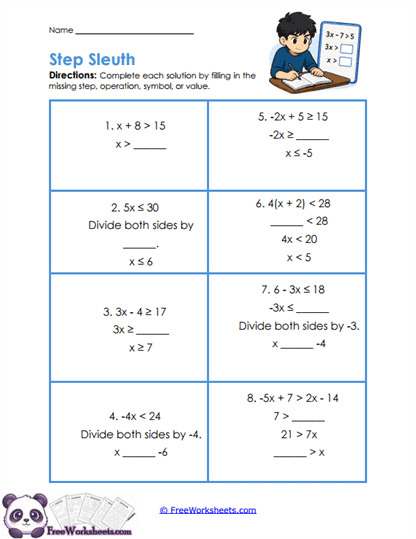
This worksheet helps eighth-grade students complete partially solved inequalities by filling in missing steps, operations, symbols, or values. Eight problems show parts of the work already completed, and students must determine what belongs in each blank. Some questions require a missing number, while others ask for the operation, inequality symbol, or final boundary value. This makes the activity a useful check of whether students understand each step of the solving process.
For example, a student may see 5x ≤ 30 followed by “Divide both sides by ___” and then x ≤ 6. The missing value must be 5. In another problem, a negative coefficient may require students to recognize both the correct divisor and the need to reverse the inequality symbol.
What Students Practice
Students practice reading a solution from top to bottom and understanding why each step follows from the one before it. They use inverse operations, simplification, and inequality rules to fill in missing information. This is different from solving every problem from scratch because students must analyze the structure of existing work.
The worksheet also reinforces symbol accuracy. Students may need to decide whether a blank should contain >, <, ≥, or ≤ after an operation. This helps strengthen attention to detail, especially in problems involving negative coefficients.
Why This Skill Matters
Students who understand the steps of a solution can usually solve new problems more reliably. Filling in missing work forces them to think about the purpose of each operation instead of simply copying a routine. This builds stronger algebra reasoning.
The activity also helps students become better at checking their own work. If they can tell what step must come next in someone else’s solution, they are more likely to notice when one of their own steps does not make sense. That skill is valuable in both classwork and assessments.
Common Challenges
Students may focus only on the final answer and try to guess the missing blank. Encourage them to compare the line before the blank with the line after it and ask what operation would create that change. This makes the reasoning much more dependable.
Another common problem is missing a required sign reversal. If the variable is divided by a negative number, students need to check whether the inequality symbol should switch direction. Teachers can have students circle any negative divisor before filling in the missing symbol.
How To Use It
Teachers can use this worksheet as a review after students have practiced solving inequalities independently. It works well for partner work, small-group intervention, homework, or an exit activity because the blanks reveal exactly where a student’s understanding breaks down. You can also ask students to explain one missing step aloud.
Parents and homeschool teachers can guide students by asking, “What changed from this line to the next?” That question usually points to the missing operation or value. If the sign also changes, ask what caused that change.
Grade Alignment
This Grade 8 worksheet supports one-variable inequality solving and the algebraic reasoning connected with CCSS 8.EE.C.7. It reinforces inverse operations, symbol use, and step-by-step solution structure. The activity is especially helpful for students who can sometimes reach an answer but need stronger understanding of the process.
Students should already know the basic rules for solving inequalities. After this practice, they are better prepared to solve multi-step problems independently and explain their reasoning clearly.