
About This Worksheet
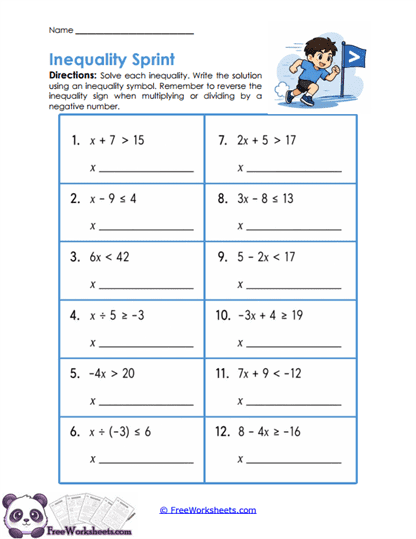
This worksheet helps eighth-grade students practice solving one-variable inequalities, which are math statements that show a range of possible values instead of just one answer. Students work through twelve inequalities that include addition, subtraction, multiplication, and division. Some problems can be solved in one step, while others require students to simplify two-step expressions before isolating x. The worksheet also introduces an important rule: when students multiply or divide both sides of an inequality by a negative number, they must reverse the inequality symbol.
For example, if a student solves x + 7 > 15, subtracting 7 from both sides gives x > 8. In a problem such as -4x > 20, dividing both sides by -4 gives x < -5 because the inequality sign must switch direction. Seeing positive and negative examples together helps students learn when the symbol stays the same and when it must change.
What Students Practice
Students practice using inverse operations to isolate the variable while keeping both sides of an inequality balanced. They work with all four basic operations and must choose the correct step based on how the variable is being changed. Several problems also include negative coefficients, giving students repeated practice with the sign-switching rule.
The mix of one-step and two-step inequalities helps students build fluency instead of depending on one repeated pattern. Students must pay attention to both the operation and the inequality symbol as they work. This makes the page useful for checking whether students understand the reasoning behind solving inequalities rather than simply copying a procedure.
Why This Skill Matters
Solving inequalities is important because many real situations do not have one exact answer. A budget might allow someone to spend no more than a certain amount, or a student may need at least a certain score. Inequalities give students a mathematical way to describe all the values that fit those limits.
This skill also builds directly on equation solving. Students use many of the same inverse operations they already know, but they must learn the extra rule involving negative multiplication and division. Understanding that difference prepares students for graphing solutions and solving more complicated inequalities later.
Common Challenges
The biggest challenge is usually remembering when to reverse the inequality symbol. Students should switch the sign only when multiplying or dividing both sides by a negative number, not simply because a negative number appears somewhere in the problem. It can help to have students circle the negative number when they reach the multiplication or division step.
Another common mistake is treating an inequality exactly like an equation and writing only one value as the answer. Remind students that a solution such as x > 8 represents many possible numbers. Teachers can reinforce this by asking students to name two or three values that would make the finished inequality true.
How To Use It
Teachers can use this worksheet after students have learned the basic steps for solving one-variable inequalities. It works well for guided practice, independent classwork, homework, a math station, or a quick review before graphing inequality solutions. You might solve one positive-coefficient problem and one negative-coefficient problem together before students continue independently.
Parents and homeschool teachers can use a simple question-and-answer approach. Ask, “What operation is being done to x?” and then, “What opposite operation will undo it?” If the student divides or multiplies by a negative number, follow with, “Do we need to switch the sign?” This keeps the process clear without making the language too technical.
Grade Alignment
This worksheet is designed for Grade 8 math and supports work with one-variable inequalities and algebraic reasoning. It connects well with CCSS 8.EE.C.7, which develops students’ ability to solve linear equations and supports the same inverse-operation reasoning used when solving linear inequalities. It also prepares students for later standards involving graphing and interpreting inequality solutions.
Students should already understand integer operations and basic equation solving. After this practice, they can move on to graphing inequality solutions on number lines, checking possible values, and solving inequalities with variables on both sides.