
About This Worksheet
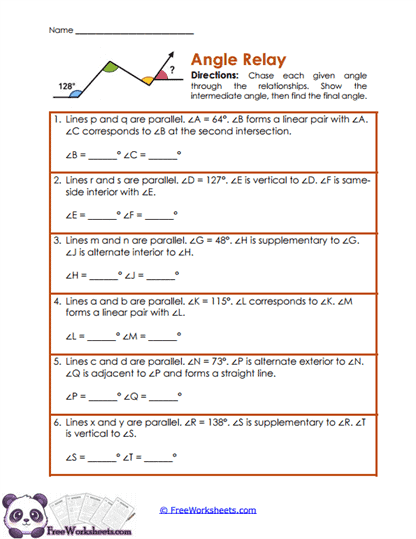
This worksheet gives eighth-grade students practice following one angle relationship after another to find missing measures. Each problem includes parallel lines and a sequence of linked angle facts, so students must use the first relationship to find one angle and then use that result to find another. The activity is designed like a relay because one answer leads directly into the next step. This helps students see how several angle rules can work together in the same problem.
For example, a problem may begin with one angle measuring 64° and state that another angle forms a linear pair with it. Students first subtract from 180° to find that angle, then use a corresponding relationship to find a third angle. This step-by-step chain encourages careful reasoning instead of quick guessing.
What Students Practice
Students practice using linear pairs, corresponding angles, vertical angles, same-side interior angles, supplementary relationships, alternate interior angles, and alternate exterior angles. They must decide which rule applies at each stage and then carry the correct measure into the next part. This gives them valuable multi-step practice.
The worksheet also helps students organize their work. Because every problem asks for two missing angles, students need to keep track of the first result before moving on. That supports stronger problem-solving habits and better accuracy.
Why This Skill Matters
Many geometry problems require more than one angle relationship to reach the final answer. Students who only know how to solve single-step problems may struggle when several relationships are connected. This worksheet helps bridge that gap.
The activity also prepares students for more formal geometric reasoning. Later, students may need to explain a sequence of facts that proves two angles are equal or supplementary. Practicing a chain of relationships now makes that reasoning much easier.
Common Challenges
Students may use the correct first relationship but lose track of which angle measure should be used next. Encourage them to write the first answer clearly before moving to the second part. Labeling each step can make the process much easier to follow.
Another challenge is applying the wrong rule when switching from one relationship to another. Have students say the relationship name out loud or write it beside the step before calculating. This helps keep the logic clear.
How To Use It
Teachers can use this worksheet after students are comfortable with single-step angle problems. It works especially well for partner work or guided practice because students can explain how one result leads to the next. You might model one complete relay problem on the board before students begin independently.
Parents and homeschool teachers can help by breaking each problem into two small parts. Ask the student to solve only the first angle, check it, and then use that answer to continue. This makes the worksheet feel much more manageable.
Grade Alignment
This worksheet is written for Grade 8 math and supports CCSS 8.G.A.5 through connected reasoning with angle relationships. Students use facts about parallel lines, transversals, linear pairs, and vertical angles to find missing measures. The activity strengthens both geometry knowledge and multi-step problem solving.
Students should already know the basic rules for common angle relationships. After completing this page, they are better prepared for proof-style reasoning and more complex diagrams with several linked angles.