
About This Worksheet
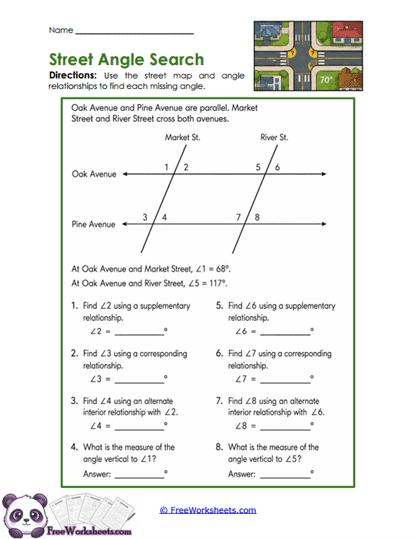
This worksheet helps eighth-grade students use angle relationships in a real-world street map. Two parallel streets are crossed by two other streets, creating sets of angles that students must study and compare. The problems ask students to use supplementary, corresponding, alternate interior, and vertical relationships to find missing angle measures. This setup makes the geometry feel more practical because students can see how intersecting lines show up in something familiar like roads.
For example, if one angle at an intersection measures 68°, its vertical angle also measures 68°. A neighboring angle that forms a straight line with it must add to 180°, so students can use subtraction to find the missing measure. These problems encourage students to combine angle facts instead of treating each relationship as a separate idea.
What Students Practice
Students practice reading a diagram carefully and deciding which angle relationship applies to each pair. They use supplementary angles to find adjacent measures, corresponding angles to transfer a measure from one intersection to another, and alternate interior angles to connect angles across the parallel streets. Vertical angles are also used to find equal measures at the same intersection.
The worksheet gives students a chance to follow a chain of reasoning. One answer may help them understand another angle farther along in the diagram. This helps build confidence with multi-step geometry thinking.
Why This Skill Matters
Students need to understand how angle relationships work together in a larger diagram. Real geometry problems often do not tell them exactly which rule to use, so they must recognize the structure on their own. This worksheet supports that kind of decision-making.
The street-map setting also shows that parallel lines and transversals are not just classroom drawings. Similar relationships appear in roads, buildings, rail lines, and many other structures. Seeing that connection can make the math easier to remember and more meaningful.
Common Challenges
Students may look at the wrong intersection or confuse which angles correspond across the parallel streets. Encourage them to point to the two angles in the diagram before calculating anything. This helps make sure they are using the correct pair.
Another common problem is forgetting which angle relationships are equal and which are supplementary. Remind students that vertical, corresponding, and alternate interior angles are congruent in this setup, while adjacent angles forming a straight line add to 180°. A quick note beside the problem can help keep those rules clear.
How To Use It
Teachers can use this worksheet as applied practice after students have learned the major angle relationships. It works well for independent work, partner discussion, homework, or a geometry center. You might have students explain which rule they used for each answer before allowing them to write the measure.
Parents and homeschool teachers can guide students by asking, “Are these angles at the same intersection or different ones?” and then, “Do they match, or do they add to 180?” Those questions can help students choose the right relationship without giving away the answer.
Grade Alignment
This worksheet is designed for Grade 8 math and supports CCSS 8.G.A.5. That standard asks students to use angle relationships created by parallel lines and transversals and to reason about angle measures. The real-world diagram gives students a practical way to apply those ideas.
Students should already know vertical, corresponding, alternate interior, and supplementary angle relationships. After this practice, they can move into more complex multi-step geometry problems and algebraic angle equations.