
About This Worksheet
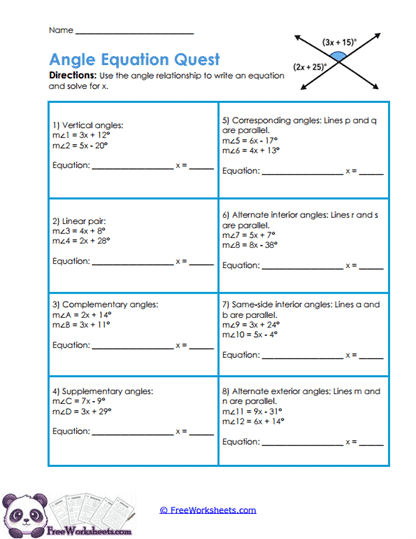
This worksheet helps eighth-grade students write and solve equations based on angle relationships. Each problem gives two algebraic angle expressions and identifies the relationship between them, such as vertical, linear pair, complementary, corresponding, alternate interior, same-side interior, or alternate exterior. Students first write an equation that matches the angle relationship and then solve for x. This combines geometry knowledge with algebra in a very direct way.
For example, vertical angles are equal, so expressions representing vertical angles should be set equal to each other. Complementary angles must add to 90°, while supplementary or same-side interior angles must add to 180°. Students must understand the angle relationship before they can build the correct equation.
What Students Practice
Students practice translating geometric information into algebraic equations. They decide whether two expressions should be set equal or added to a known total, then solve the resulting equation for x. This gives students practice with both one-step and multi-step reasoning.
The worksheet also reviews several angle relationships at once. Students work with intersecting lines as well as parallel lines cut by transversals. That mix helps them see how the same algebra skills can be used in many different geometry settings.
Why This Skill Matters
Geometry and algebra often work together, and angle problems are one of the clearest examples of that connection. Students need to know not only what an angle relationship is called, but also how to represent that relationship mathematically. Writing equations from geometry prepares them for more advanced problem solving.
This skill becomes especially important when angle measures are not given as simple numbers. Instead, students may see expressions such as 3x + 12 or 5x – 20 and need to use a geometric fact to solve for x. Practicing that process now builds a strong bridge between algebra and geometry.
Common Challenges
One common mistake is setting every pair of expressions equal. Students need to remember that only some relationships create congruent angles, while others require the measures to add to 90° or 180°. Encourage them to write the angle rule in words before building the equation.
Students may also solve for x correctly but stop before checking whether the equation matched the geometry. A good habit is to substitute the value of x back into both expressions and see whether the resulting angle measures make sense. This helps catch both algebra and setup errors.
How To Use It
Teachers can use this worksheet after students are comfortable finding missing numeric angle measures and are ready to add algebra. It works well for guided practice, independent work, homework, or test review. Modeling one “set equal” problem and one “add to 180” problem can help students see the two main equation patterns.
Parents and homeschool teachers can support students by asking, “What must be true about these two angles?” If they are equal, the expressions should be set equal; if they are supplementary, the expressions should total 180. This keeps the geometry rule connected to the algebra instead of treating them as separate skills.
Grade Alignment
This worksheet is intended for Grade 8 math and supports CCSS 8.G.A.5 through algebraic reasoning with angle relationships. It also reinforces Grade 8 equation-solving skills by asking students to create and solve equations from geometric information. The activity helps students connect parallel-line and intersecting-line facts with symbolic expressions.
Students should already understand basic angle relationships and how to solve linear equations. After this practice, they can handle more complex diagrams where several angle expressions must be connected in multiple steps.