
About This Worksheet
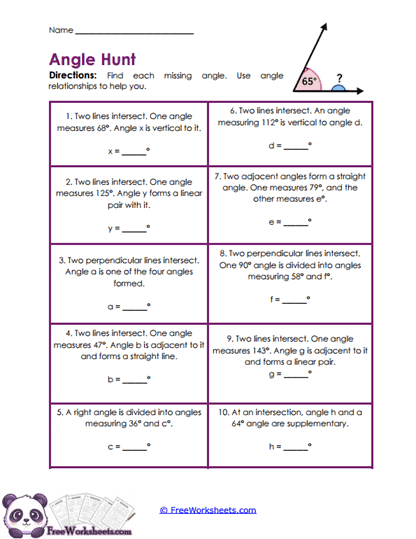
This worksheet helps eighth-grade students find unknown angle measures by using common angle relationships. Ten problems ask students to apply vertical angles, linear pairs, right angles, straight angles, perpendicular lines, supplementary angles, and adjacent angles. Each question gives enough information for students to determine the missing angle without needing a complicated diagram. This keeps the focus on understanding the relationship and using the correct total.
For example, if one angle measures 68° and another is vertical to it, the missing angle is also 68°. If an angle measuring 125° forms a linear pair with another angle, students subtract from 180° to find the missing measure. These problems help students see that different relationships lead to different solving strategies.
What Students Practice
Students practice deciding whether two angles should be equal, add to 90°, or add to 180°. They then use subtraction or simple reasoning to find the missing measure. This gives students repeated practice choosing the correct rule before performing the calculation.
The worksheet also includes situations involving perpendicular lines and straight lines. Students learn that a right angle measures 90° and a straight angle measures 180°, then use those totals when one part is known. Working with several relationship types on one page helps students become more flexible and independent.
Why This Skill Matters
Finding missing angles is a key geometry skill because it combines mathematical vocabulary with number reasoning. Students are not just subtracting; they must first understand why a certain total or equality applies. This helps build the reasoning they will need for equations, proofs, and more complex geometric figures.
The same ideas appear when students study parallel lines, polygons, and triangles. Vertical angles, supplementary relationships, and right-angle relationships often appear inside larger problems. Strong practice with these simpler cases gives students a dependable foundation.
Common Challenges
One common mistake is assuming every pair of nearby angles adds to 180°. Students need to identify the relationship before choosing a total. Remind them that complementary angles add to 90°, while linear pairs and supplementary angles add to 180°.
Students may also forget that vertical angles are equal and unnecessarily subtract from 180°. Encourage them to write a short note such as “vertical = equal” or “linear pair = 180” before calculating. That quick step can prevent many errors.
How To Use It
Teachers can use this worksheet during a lesson on missing-angle relationships or as mixed review after students have learned several angle types. It works well for classwork, small-group instruction, homework, or an exit check. You might have students name the relationship before solving so you can see whether they understand the geometry as well as the arithmetic.
Parents and homeschool teachers can keep the practice simple by asking one question first: “What relationship do these angles have?” Once the student identifies that, ask whether the angles should be equal, total 90°, or total 180°. This helps students build a repeatable problem-solving routine.
Grade Alignment
This worksheet is intended for Grade 8 math and supports work with angle relationships and geometric reasoning. It aligns closely with CCSS 8.G.A.5, which includes establishing and using facts about angles created by intersecting and parallel lines. The activity reinforces the reasoning students need to find unknown angle measures accurately.
Students should already know basic angle vocabulary and simple subtraction. After completing this page, they are ready for multi-step angle equations and more advanced problems involving transversals, triangles, and parallel lines.