
About This Worksheet
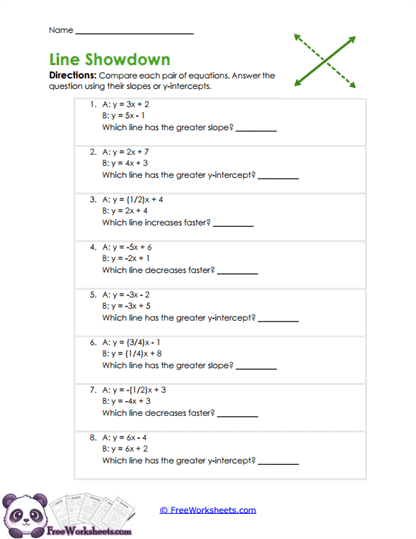
This worksheet helps eighth-grade students compare two linear equations by looking closely at their slopes and y-intercepts. Each problem gives a pair of equations and asks students to decide which line has the greater slope, greater y-intercept, or faster increase or decrease. The activity keeps the focus on reading the structure of y = mx + b and understanding what each number tells us. Students do not need to graph every line because they can make the comparison directly from the equations. This is a strong way to build confidence with analyzing linear relationships quickly and accurately.
What Students Practice
Students identify m and b in each equation before making a comparison. Some questions ask which line rises faster, while others ask which one decreases more quickly or starts at a greater y-value. The worksheet includes positive slopes, negative slopes, fractions, and different intercepts, so students must pay close attention to signs and magnitude. They also practice separating the idea of rate of change from the idea of starting value. This helps students understand that two lines can have the same slope but different intercepts, or the same intercept but different slopes.
Why This Matters
Comparing linear equations is important because students often need to decide which situation changes faster or which one starts higher. Looking only at one number in the equation can lead to mistakes if students confuse slope with y-intercept. This worksheet helps them learn that the coefficient of x controls the rate of change, while the constant term controls the starting point. That distinction becomes especially important when students compare functions, solve systems, and interpret real-world models. Strong comparison skills make later algebra much easier to understand.
Teaching Tips
Have students underline the slope in each equation and circle the y-intercept before answering the question. If the problem asks which line increases faster, compare only the slopes first. If it asks which has the greater starting value, compare the intercepts instead. For negative slopes, remind students that the more negative value represents a faster decrease. Saying each comparison aloud can also help students avoid mixing up the two parts of the equation.
Curriculum Standards
This worksheet supports CCSS.MATH.CONTENT.8.F.A.2, which asks eighth-grade students to compare properties of functions represented algebraically and in other forms. It also reinforces CCSS.MATH.CONTENT.8.F.B.4 by strengthening understanding of rate of change and initial value. The direct equation comparisons help students analyze linear functions efficiently without relying only on graphs. It works well for independent practice, homework, review, or preparation for systems of equations.