
About This Worksheet
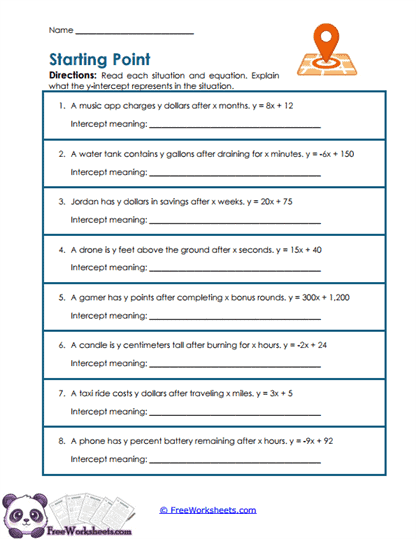
This worksheet helps eighth-grade students interpret the y-intercept as the starting value in a real-world linear situation. Students work with equations about app charges, draining water, savings, drone height, game points, candle height, taxi fares, and phone battery life. In each problem, they identify the constant term and explain what that value means before any change has taken place. This helps students connect the y-intercept with the idea of an initial amount when x = 0. It is a strong way to show that the y-intercept has practical meaning beyond simply being where a graph crosses an axis.
What Students Practice
Students read each equation and locate the constant term, b, in the form y = mx + b. They then connect that value to the starting quantity in the story, such as an initial fee, beginning amount of water, starting savings balance, or initial height. The problems include both positive and negative rates of change, which helps students separate the meaning of slope from the meaning of the intercept. Students also practice using units when they explain what the initial value represents. This gives them repeated experience interpreting equations instead of only identifying numbers.
Why This Matters
Students often learn that the y-intercept is “where the line crosses the y-axis” without understanding why that point matters. In a real-world equation, the intercept usually tells what was already there before the changing part began. That idea helps students understand linear models much more deeply. It also makes it easier to compare two situations that may have different starting values but similar rates of change. This understanding is important for later work with graphs, functions, and systems of equations.
Teaching Tips
Have students set x = 0 mentally and ask what y would equal in that moment. Then connect that number back to the story using a full sentence. Encourage them to use phrases such as “starts with,” “begins at,” or “initially has.” If they confuse the slope and intercept, ask which number changes with x and which number stays fixed. That simple distinction usually helps clear up the roles of m and b.
Curriculum Standards
This worksheet directly supports CCSS.MATH.CONTENT.8.F.B.4, which asks students to interpret the rate of change and initial value of a linear function in terms of the situation it models. It also reinforces the structure of equations written in slope-intercept form. The real-world contexts help students connect algebraic notation to meaningful quantities. The worksheet works well for guided practice, homework, intervention, or review before students compare linear models.