
About This Worksheet
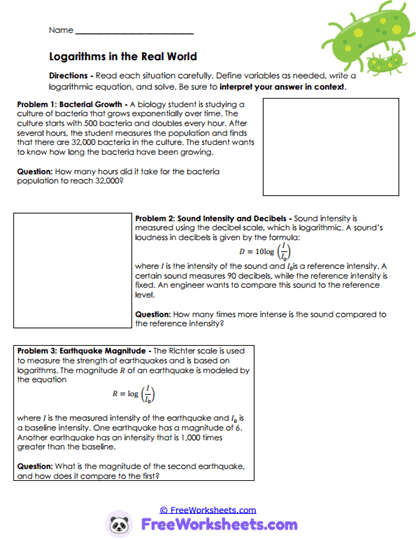
Logarithms are used in many real-world situations involving growth, sound intensity, and earthquake measurements. This worksheet helps students apply logarithmic thinking to practical science and measurement problems. Students analyze bacterial growth, decibel scales, and earthquake magnitude formulas using logarithmic relationships. For example, earthquake magnitudes compare the intensity of seismic activity using logarithmic scales. The activity helps students see how logarithms are used outside the classroom in real scientific applications.
Curriculum and Grade Alignment
This worksheet supports Algebra 2 standards involving logarithmic functions and real-world modeling. The main learning goal is to interpret logarithmic relationships within scientific and applied contexts. Students should already understand basic logarithm notation and exponential growth before beginning. The next learning step is modeling more advanced exponential and logarithmic systems. This aligns with HSF-LE.A.4 because students interpret logarithms as inverse exponential relationships in real-world formulas.
Student Tasks
On this worksheet, students will analyze bacterial growth situations using powers and logarithms. They will interpret sound intensity measured in decibels and compare earthquake magnitudes using logarithmic scales. Students also define variables, explain relationships, and answer contextual questions using complete sentences. Several problems ask learners to interpret what logarithmic values mean in practical situations.
Common Challenges and Misconceptions
Some students may focus only on calculations and overlook what the logarithm represents in context. Others may struggle to connect scientific formulas to logarithmic reasoning. A common mistake is assuming logarithmic scales increase at the same rate as linear scales. Teachers can help by discussing how logarithms compare large changes in a manageable way.
Implementation Guidance
This worksheet works well during applied algebra lessons or interdisciplinary connections with science classes. Teachers can model one real-world example before assigning independent practice. Parents helping at home can ask students why scientists use logarithmic scales for sound and earthquakes. Those conversations often help students understand the usefulness of logarithms in everyday life.
Details and Features
The worksheet includes real-world logarithm applications involving bacteria growth, decibel levels, and earthquake magnitudes. Students practice interpreting formulas and explaining logarithmic relationships in context. The printable layout provides organized answer spaces for calculations and written explanations. The science-based themes help students connect algebra concepts to practical applications.