
About This Worksheet
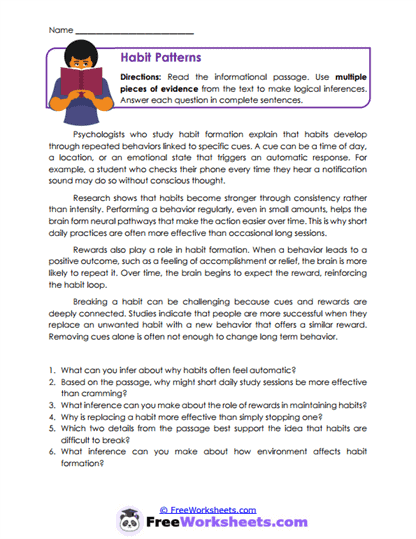
This worksheet is a reading analysis activity focused on making logical inferences from informational text. It is designed for 10th-grade students learning how habits form and change. The passage explains how repeated behaviors become automatic over time. Students use evidence from the text to draw conclusions about human behavior. For example, repeated actions become habits through brain patterns.
Curriculum and Grade Alignment
This worksheet aligns with Grade 10 standards for making inferences and analyzing informational texts. The main goal is to help students use evidence to support logical conclusions. Students should already understand basic reading comprehension skills. This activity prepares them for deeper analysis and reasoning tasks. It connects to CCSS.ELA-LITERACY.RI.9-10.1, which focuses on citing evidence to support analysis.
Student Tasks
On this worksheet, students will read a passage about how habits develop. They answer questions that require them to make inferences based on evidence. Students must explain their thinking using details from the text. They also analyze how habits are formed and changed. The task builds strong reasoning and comprehension skills.
Common Challenges and Misconceptions
Students may confuse inferences with guesses that are not based on evidence. Some might struggle to explain their thinking clearly. Others may overlook key details that support strong conclusions. It can also be difficult to connect ideas across the passage. Teachers can help by modeling how to use evidence when making inferences.
Implementation Guidance
Teachers can use this worksheet during lessons on inference and reasoning. It works well as independent practice or guided discussion. Parents can use it at home to support reading comprehension. This worksheet is helpful for building critical thinking skills. It prepares students for deeper text analysis.
Details and Features
The worksheet includes a clear informational passage about habits. It provides structured questions that guide students toward making inferences. There is space for written responses. The layout is easy to follow and print. It supports both reading and reasoning development.