
About This Worksheet
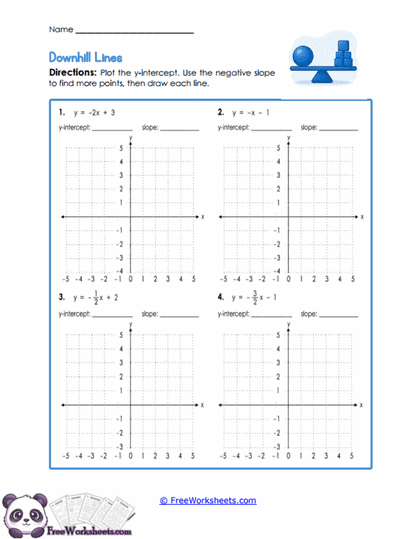
This worksheet helps ninth-grade students focus on graphing linear equations with negative slopes. Each problem gives a linear equation and coordinate grid, and students begin by plotting the y-intercept. They then use the negative slope to move to additional points before drawing the line. This targeted practice helps students become more comfortable with lines that fall from left to right.
For example, in y = -2x + 3, students start at (0, 3). A slope of -2 can be written as -2/1, so they can move down 2 and right 1 to locate another point. Repeating that movement creates a downward-sloping line.
What Students Practice
Students practice identifying negative slopes and translating them into movement on a graph. They also reinforce the role of the y-intercept as the starting point. This gives them repeated experience with a type of graph that often causes sign mistakes.
The worksheet includes both whole-number and fractional negative slopes. Students must pay attention to which part of the slope represents the rise and which represents the run. This helps strengthen careful graphing habits.
Why This Skill Matters
Negative slopes represent relationships where one quantity decreases as another increases. Students see this in many real-world situations, such as decreasing temperatures, falling account balances, or distance remaining. Understanding how to graph negative slopes makes these relationships easier to interpret.
This skill is also important for systems of equations and function comparisons. Students need to recognize whether a line is increasing or decreasing and how steeply it changes. Strong practice with negative slopes builds that understanding.
Common Challenges
Students may accidentally graph a negative slope as if it were positive. Remind them that a negative slope means the line should fall as it moves from left to right. If their graph rises, they should check their movement.
Another common mistake is putting the negative sign on both the rise and run. That would create a positive slope because a negative divided by a negative is positive. Encourage students to keep only one part of the slope movement negative.
How To Use It
Teachers can use this worksheet as focused review after students have already graphed positive slopes. It works well for guided practice, independent classwork, homework, or intervention with students who struggle with signs. Comparing one positive-slope graph with one negative-slope graph can make the difference very clear.
Parents and homeschool teachers can ask, “Should this line rise or fall as we move right?” If the slope is negative, the answer should be fall. Then have the student use the y-intercept as the starting point and move according to the slope.
Grade Alignment
This Grade 9 worksheet supports CCSS HSF-IF.C.7a by giving students practice graphing linear functions with negative slopes. It also reinforces interpretation of slope as a rate of change. The activity helps students connect algebraic signs with visual direction.
Students should already understand slope and y-intercept. After this practice, they can move into mixed-slope graphing and more complex linear-function comparisons.