
Main idea Worksheets
Main idea practice in 1st grade reading helps children identify the big point of a passage and separate it from supporting details. These free, ready-to-print PDF worksheets are prepared for immediate classroom use, literacy centers, homeschool lessons, guided reading, homework, or independent practice. Students strengthen central-idea recognition, supporting-detail analysis, and summarizing while working toward important 1st grade reading curriculum goals.
About This Collection of Worksheets
Understanding the main idea helps 1st grade readers figure out what a passage is mostly about instead of focusing on only one interesting fact. Students learn to look across several sentences, notice what the details have in common, and identify the broader message that connects them. This skill supports comprehension, summarizing, retelling, and stronger understanding of both stories and informational text.
This collection gives children several ways to practice finding main ideas and distinguishing them from details. Students choose central ideas from answer choices, identify a story’s main subject, write main ideas in their own words, select titles, draw or write an overall message, compare narrative and informational texts, classify details, and use titles as clues to a passage’s focus. Pasted text
Teachers can use these worksheets during 1st grade guided reading, comprehension centers, nonfiction lessons, small groups, homework, or intervention. Parents and homeschool educators can help by asking children what all the details have in common before they choose an answer. The variety of multiple-choice, written-response, drawing, sorting, and title-based activities gives students repeated practice with the same core comprehension skill in different formats.
Paul’s Teacher Tip
When children confuse a detail with the main idea, ask, “Does this tell about the whole passage or just one part?” A helpful visual is an umbrella: the main idea is the umbrella, while the supporting details fit underneath it. Before answering, have students name two or three details and explain what they all have in common. If a response is too broad, such as simply “school” or “birds,” ask what the passage specifically says about that topic. Having children retell the passage in one sentence can also make the main idea much easier to identify.
Worksheet Collection Skill Spotlights
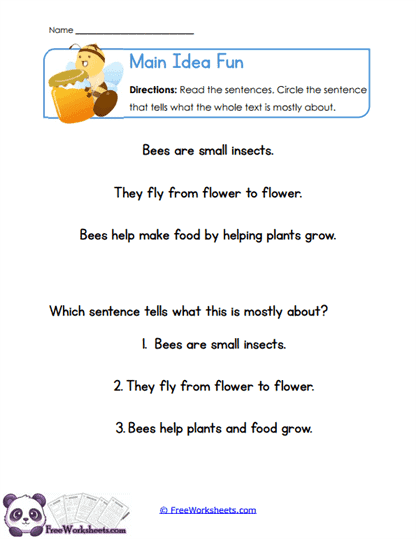
Bee Basics
What Kids Do:
Children read three simple informational sentences about bees, including facts about insects, flowers, and helping plants grow. They compare answer choices and circle the sentence that best explains what the entire passage is mostly about rather than selecting one smaller detail.
Target Skill:
This activity introduces the difference between a main idea and a supporting fact. Students practice considering all the sentences together, identifying the broadest message, and recognizing that one interesting detail does not necessarily represent the overall point of a passage.
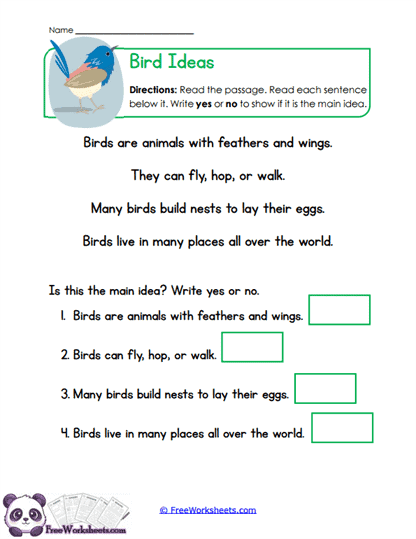
Bird Focus
What Kids Do:
Children read a short informational passage about birds and then review four statements from the text. For each statement, they decide whether it represents the main idea or only a supporting detail and mark their answer Yes or No.
Target Skill:
The worksheet strengthens main-idea discrimination by asking students to compare broad and specific statements. Children practice recognizing that several true facts may appear in a passage, but only one idea is broad enough to connect the information as a whole.
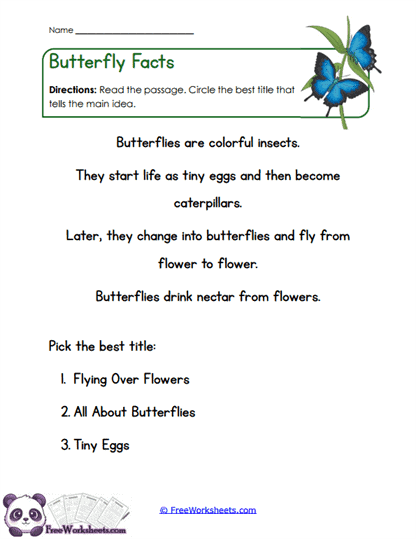
Butterfly Theme
What Kids Do:
Children read a short passage about butterflies, including their life cycle, movement, and feeding habits. They then compare three possible titles and choose the one that best represents all of the information in the passage.
Target Skill:
This activity connects title selection with main-idea comprehension. Students learn that a strong title should reflect the whole passage rather than one isolated fact, strengthening summarizing and their ability to recognize the central focus of informational text.
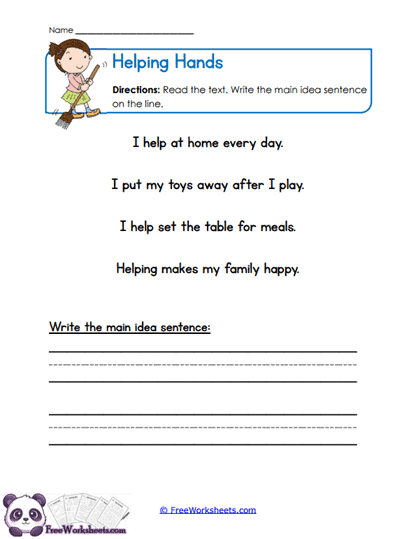
Helpful Idea
What Kids Do:
Children read a short passage about helping at home by putting away toys and setting the table. They think about what the actions have in common and then write a sentence that explains the passage’s overall message.
Target Skill:
The worksheet develops the ability to combine several supporting details into one central idea. Students practice moving beyond individual chores and identifying the broader concept of being helpful at home, strengthening summarizing and written comprehension.
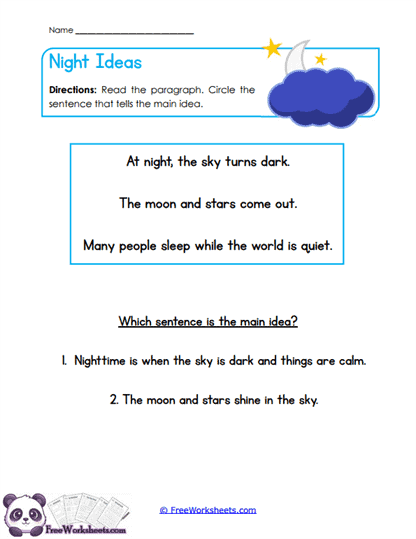
Night Theme
What Kids Do:
Children read a short paragraph about nighttime, including darkness, the moon and stars, sleeping, and quiet surroundings. They compare two possible main ideas and select the one that best covers the paragraph as a whole.
Target Skill:
This activity helps students distinguish a broad central idea from a narrower supporting detail. Children practice evaluating which statement applies to every sentence in a passage rather than choosing the most vivid or memorable piece of information.
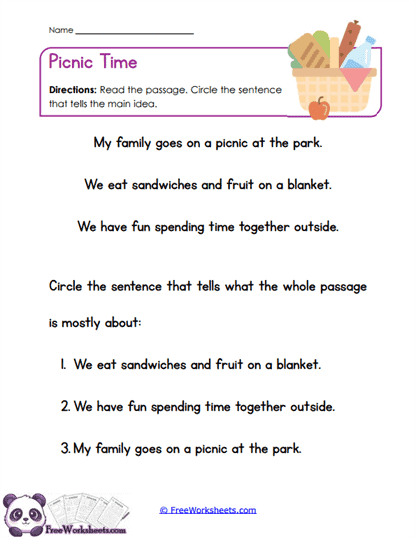
Picnic Point
What Kids Do:
Children read a three-sentence passage about a family going to the park, eating together on a blanket, and enjoying their time outdoors. They compare three choices and circle the sentence that best summarizes the entire picnic experience.
Target Skill:
The worksheet strengthens main-idea recognition in narrative text. Students learn to separate setting and event details from the larger message that connects them, helping them summarize a short story in a single meaningful idea.
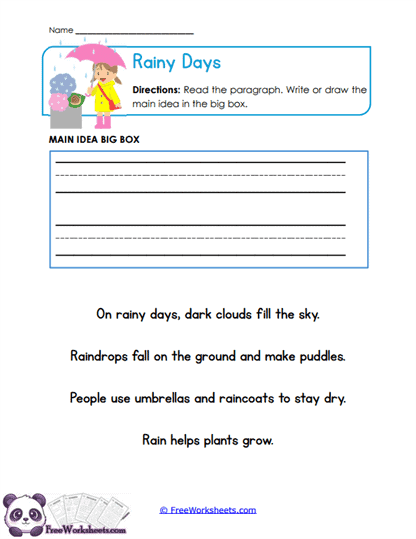
Rainy Overview
What Kids Do:
Children read a paragraph about dark clouds, puddles, umbrellas, raincoats, and rain helping plants grow. They then use a large response box to write, draw, or combine both methods to show what the paragraph is mostly about.
Target Skill:
This activity develops flexible main-idea expression by allowing children to represent understanding visually or in writing. Students practice connecting several related weather details and showing the broader idea that unites the entire paragraph.
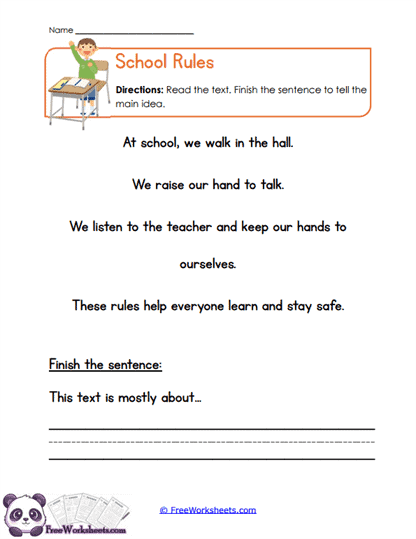
School Rules
What Kids Do:
Children read an informational passage describing several school behaviors, including walking in the hall, raising a hand, listening to the teacher, and keeping hands to themselves. They complete the sentence “This text is mostly about…” using their own words.
Target Skill:
The worksheet develops written main-idea formation rather than simple answer selection. Students practice grouping several related rules under one larger concept and creating a concise statement that captures the passage without copying a single detail.
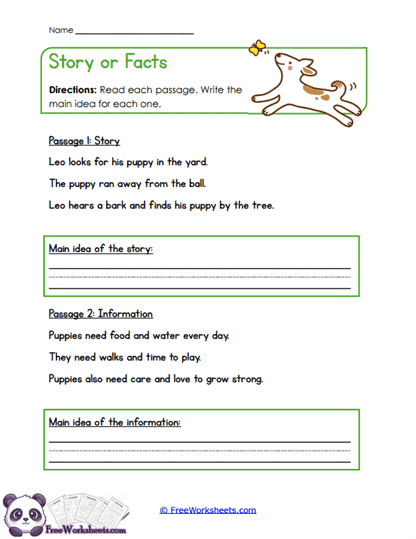
Story Facts
What Kids Do:
Children read two different texts: a short story about Leo looking for his puppy and an informational passage about what puppies need. They write the main idea for each passage in separate response spaces.
Target Skill:
This activity teaches students that main ideas can be identified across different text types. Children practice summarizing both narrative and informational passages while noticing that the same comprehension strategy applies even when the purpose and structure of the text change.
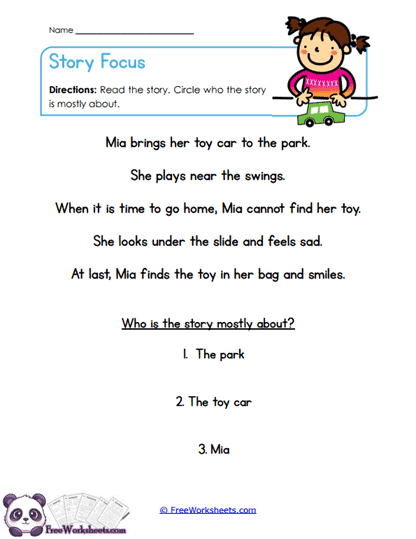
Story Subject
What Kids Do:
Children read a short story about Mia taking a toy car to the park, losing it, and later finding it in her bag. They choose whether the story is mostly about Mia, the park, or the toy car.
Target Skill:
The worksheet strengthens identification of the main subject in narrative text. Students practice determining which character or topic connects the events throughout the story instead of selecting an important object or setting that appears in only part of the passage.
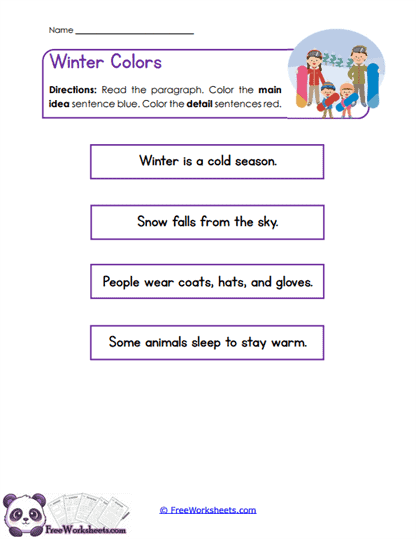
Winter Details
What Kids Do:
Children read four sentences about winter and use two colors to separate the broad main-idea sentence from the more specific supporting details. They consider cold weather, snow, warm clothing, and how animals stay warm before coloring.
Target Skill:
This activity makes the relationship between central ideas and supporting details visually clear. Students practice recognizing which statement is broad enough to include the others and which sentences provide specific facts that fit underneath that larger idea.
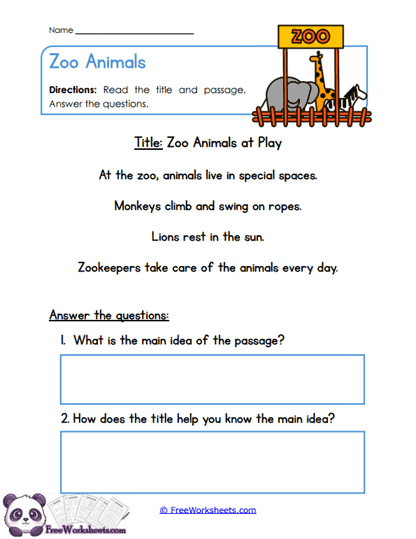
Zoo Focus
What Kids Do:
Children read the title “Zoo Animals at Play” and a passage about zoo animals, their spaces, behaviors, and caretakers. They write the main idea and then explain how the title gives them a clue about what the text will discuss.
Target Skill:
The worksheet strengthens the use of text features to support comprehension. Students practice connecting a title with passage details, identifying the central idea, and explaining how the title prepares readers for the topic before and after reading.