
Patterns and Algebraic Thinking Worksheets
Patterns are everywhere once children know how to look for them. They appear in music, nature, clothing, calendars, and, of course, math. These free Grade 1 Patterns and Algebraic Thinking worksheets help students discover that numbers, shapes, and colors often follow predictable rules. As children learn to spot those rules, they're doing much more than completing a worksheet-they're building the kind of logical thinking that becomes the foundation for algebra later on.
About This Collection of Worksheets
One of the best things about teaching patterns is watching students shift from guessing to predicting. Instead of wondering what comes next, they begin asking themselves, “What’s repeating?” That small change in thinking is a huge step in mathematical development. Whether children are coloring train cars, finishing shape necklaces, or hunting for a mistake hidden inside a pattern, they’re learning to recognize relationships instead of memorizing answers.
This collection keeps that learning fresh by offering several different types of pattern activities. Some worksheets ask students to extend repeating color sequences, while others have them draw missing shapes or play detective by finding the one figure that doesn’t belong. Although every page focuses on patterns, each activity encourages children to look at them from a different perspective. That variety keeps students engaged while strengthening the same important skill.
These printable worksheets fit naturally into classroom lessons, math centers, early finisher activities, homework, and homeschool instruction. They’re especially helpful for encouraging careful observation, problem-solving, and flexible thinking. By the time students finish the collection, they’ll start noticing patterns in places they never expected-and that’s exactly what good mathematicians do.
Paul’s Teacher Tip
When children get stuck, try asking “What part keeps repeating?” instead of asking, “What’s next?” That simple question encourages them to find the rule before searching for the answer. You can even have them point to the repeating section with their finger and say it out loud: “red, blue… red, blue…” or “circle, square, triangle…” Once they recognize the repeating unit, the rest of the pattern usually becomes much easier to complete.
Worksheet Collection Skill Spotlights
Color Sequences
What Kids Do:
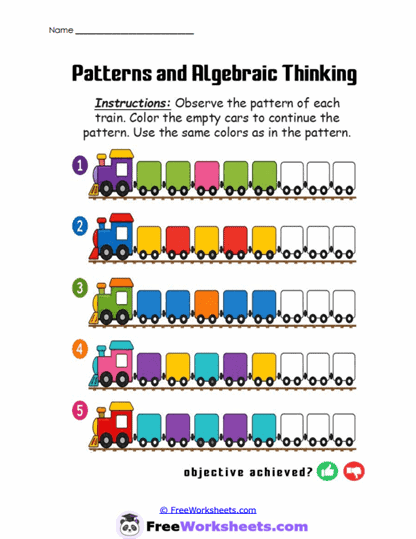
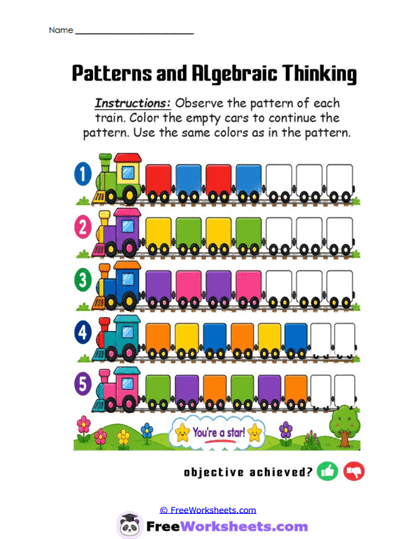
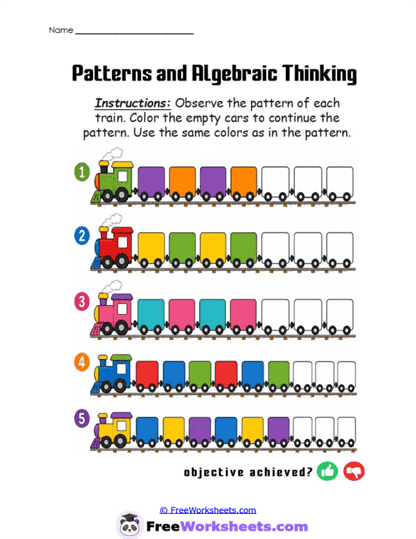
These trains are halfway painted, and it’s up to students to finish the job. Before reaching for a crayon, they’ll study the colors that have already been used and figure out which sequence keeps repeating. Once they spot the pattern, completing the rest of the train becomes surprisingly satisfying.
Target Skill:
Children practice recognizing repeating color patterns while learning that successful mathematicians look for rules instead of random answers.
Color Trains
What Kids Do:
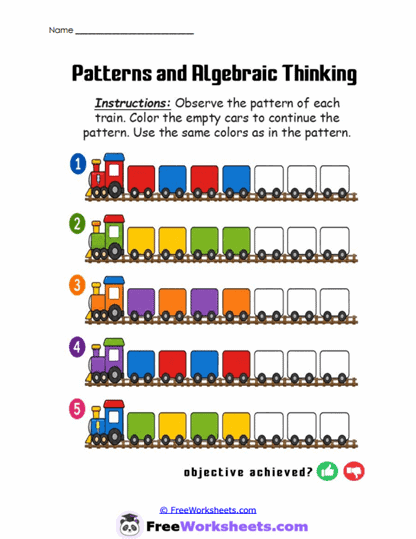
Every train follows its own colorful rhythm. Students continue each pattern by coloring the empty train cars, making sure every new color fits perfectly with the sequence that came before it.
Target Skill:
This activity builds confidence extending repeating patterns while strengthening careful observation and attention to detail.
Pattern Cars
What Kids Do:
Some trains repeat two colors, while others follow longer sequences that require a little more concentration. Students become pattern builders as they complete each colorful line of train cars.
Target Skill:
Extending patterns helps children recognize that mathematical rules stay consistent from beginning to end.
Pattern Detective
What Kids Do:
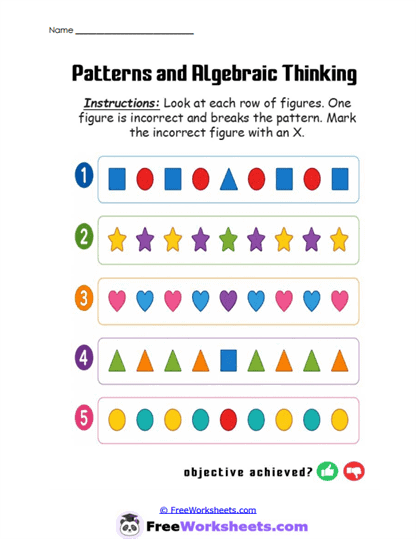
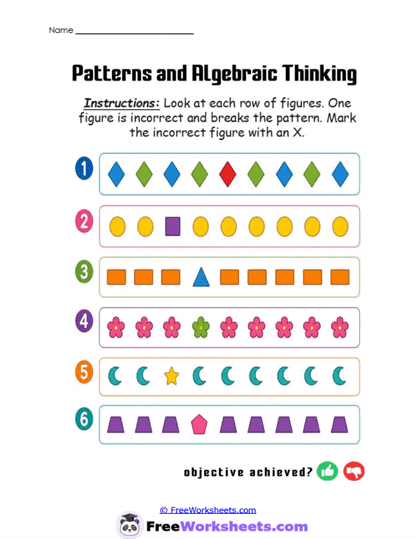
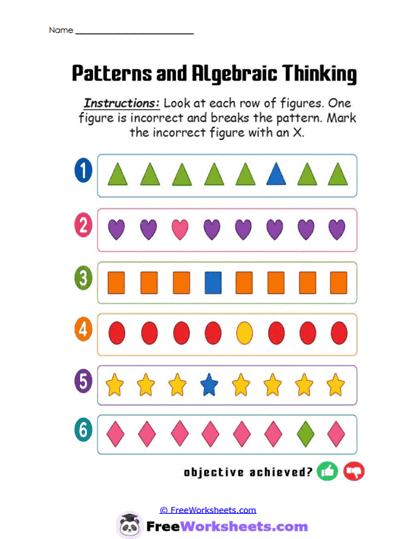
Something isn’t quite right on these pages. Students search through rows of repeating shapes to find the one figure that broke the pattern. Every row feels like solving a tiny mystery before moving on to the next case.
Target Skill:
Finding mistakes encourages children to analyze patterns instead of simply copying them, building stronger reasoning skills.
Pattern Express
What Kids Do:
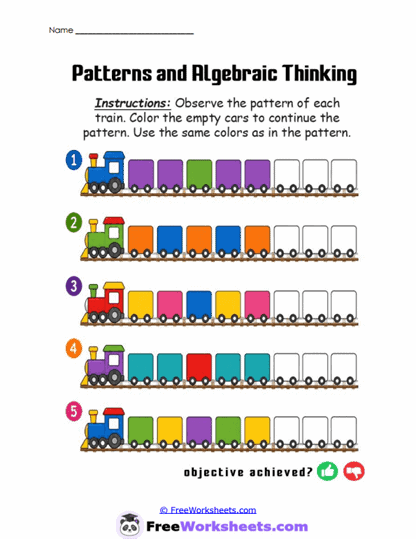
The train is ready to leave, but several cars still need color. Students study the repeating pattern carefully before finishing the journey one train car at a time.
Target Skill:
Children strengthen prediction skills by learning that once the repeating rule is known, every future step becomes easier.
Pattern Finder
What Kids Do:
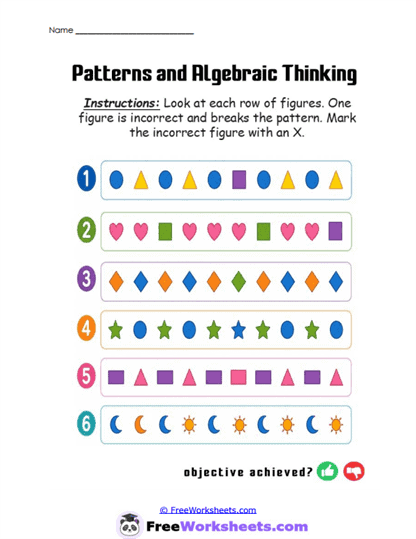
This worksheet turns students into careful inspectors. Each row hides one shape that doesn’t belong, and children must look closely to uncover the mistake before marking it.
Target Skill:
Analyzing completed patterns develops logical thinking while helping students become more confident recognizing mathematical rules.
Pattern Patrol
What Kids Do:
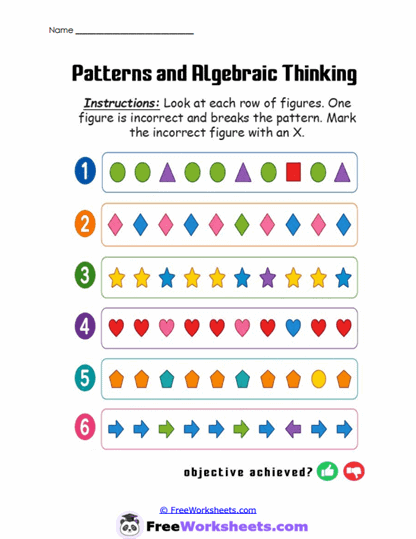
Young detectives patrol each row, searching for the one shape or color that wandered into the wrong place. It takes careful eyes to catch every mistake, especially when the patterns become longer.
Target Skill:
This activity encourages students to slow down, examine every part of a pattern, and explain why one figure doesn’t belong.
Pattern Puzzle
What Kids Do:
Every completed row hides a small puzzle waiting to be solved. Students identify the repeating sequence first, then track down the single shape that interrupts the pattern.
Target Skill:
Children strengthen flexible thinking by learning to verify the entire pattern before deciding which figure is incorrect.
Pattern Repeat
What Kids Do:
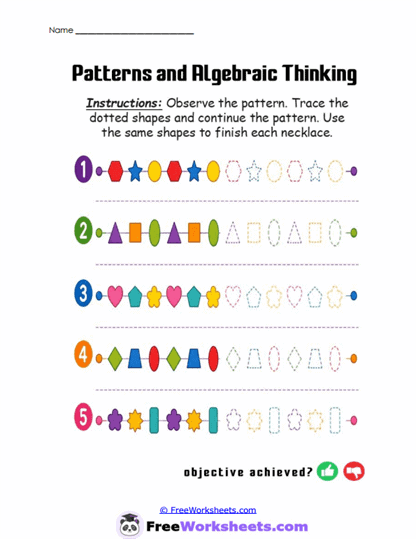
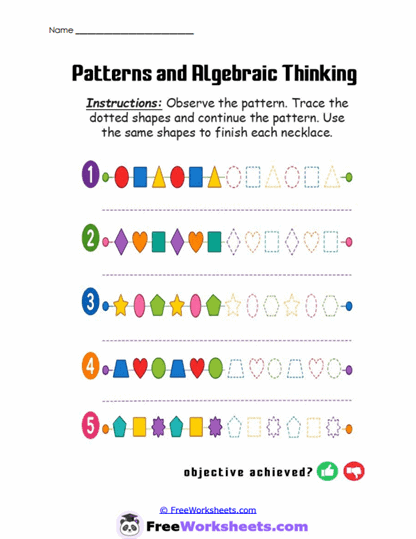
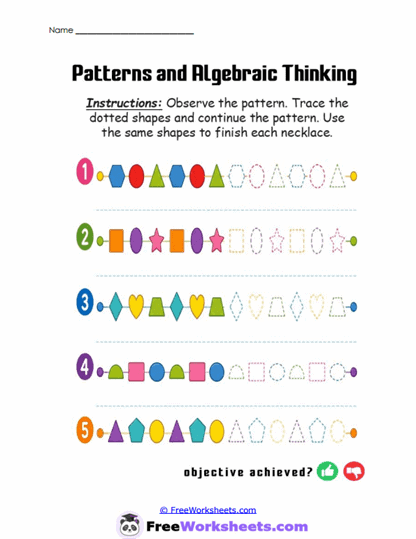
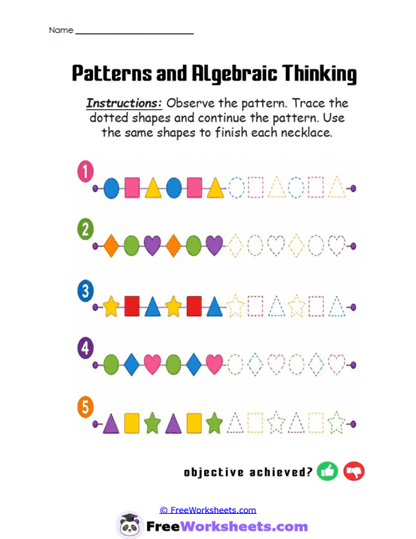
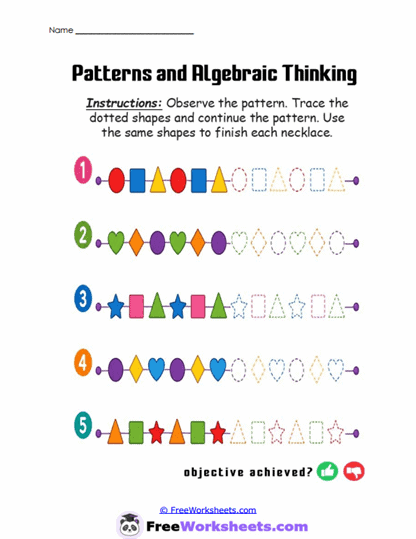
These necklaces aren’t finished yet. Students trace the guided shapes before continuing the repeating design on their own, carefully keeping the same rhythm all the way to the end.
Target Skill:
Tracing first gives students extra confidence before they begin extending patterns independently.
Pattern Tracing
What Kids Do:
This page blends drawing and math together. Students trace the beginning of each necklace, discover the repeating shape sequence, and finish the design by adding the missing shapes themselves.
Target Skill:
Combining fine motor practice with pattern recognition helps reinforce both mathematical thinking and pencil control.
Shape Chains
What Kids Do:
Each necklace follows its own repeating design, but several links are missing. Students figure out the pattern and draw the shapes needed to complete every chain.
Target Skill:
Children begin recognizing that patterns aren’t limited to colors-shapes follow predictable rules too.
Shape Necklaces
What Kids Do:
Instead of beads, these necklaces are made from repeating shapes. Students trace the first few pieces before continuing the design, watching the pattern grow one shape at a time.
Target Skill:
Drawing repeating sequences strengthens visual memory while helping students recognize mathematical relationships.
Shape Strings
What Kids Do:
Students continue each string of shapes by carefully following the established pattern. Every completed necklace becomes a colorful reminder that good patterns always have a rule.
Target Skill:
Recognizing and extending shape sequences helps build the logical thinking children will use in future algebra lessons.
Train Patterns
What Kids Do:
Every locomotive pulls a different color pattern behind it. Students examine the first few cars, discover the repeating sequence, and finish coloring the rest of the train without breaking the pattern.
Target Skill:
Children develop confidence predicting what comes next by relying on the repeating rule instead of trial and error.
Triangle Trouble
What Kids Do:
Not every shape is telling the truth! One figure sneaks into each repeating pattern where it doesn’t belong, and students must uncover the impostor before moving on to the next challenge.
Target Skill:
Spotting pattern errors strengthens observation skills while helping children understand that even small changes can break a mathematical rule.