
Number Patterns Worksheets
Some of the biggest "aha!" moments in first-grade math happen when children realize that numbers don't appear randomly; they follow patterns. These free Grade 1 Number Patterns worksheets help students recognize those predictable sequences through colorful trains, picture puzzles, and missing-number activities. Along the way, they'll strengthen counting skills, build confidence with skip counting, and begin thinking like young mathematicians who look for rules instead of relying on guesswork.
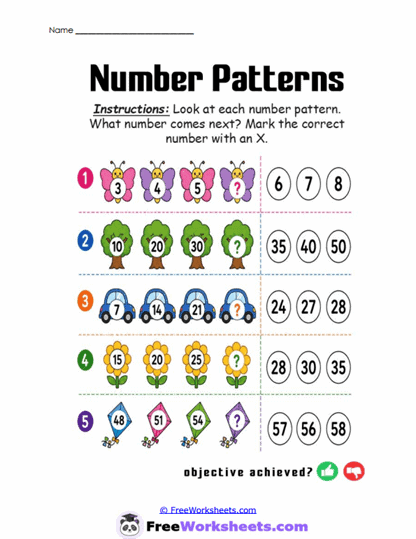
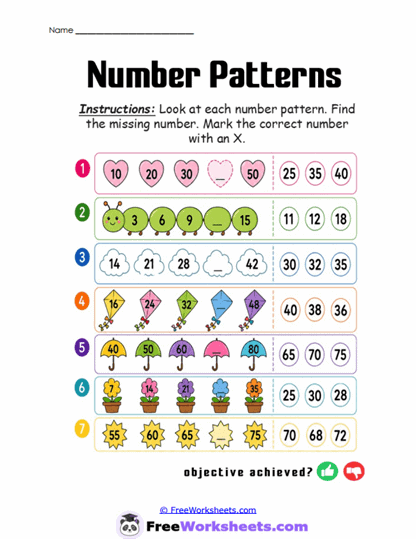
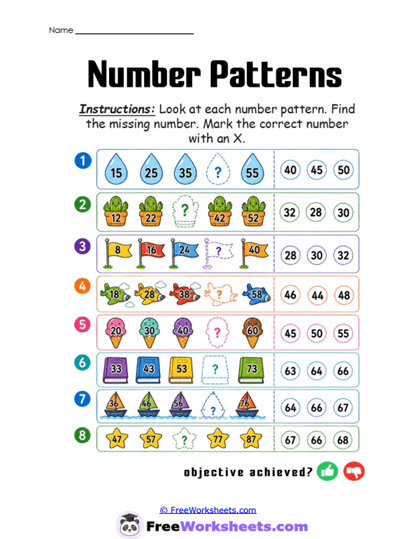
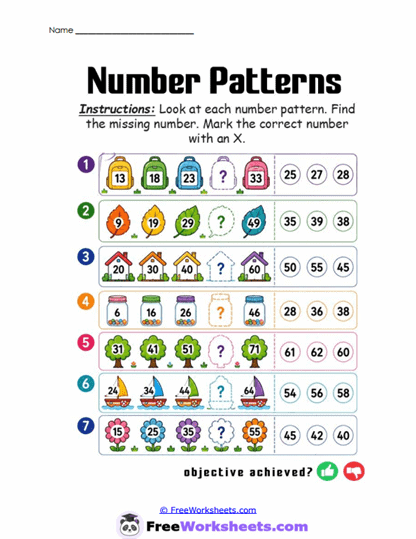
About This Collection of Worksheets
Every time a child notices that the numbers are increasing by twos, fives, or tens, they’re doing much more than counting. They’re learning to recognize relationships between numbers. That ability becomes incredibly important later when students begin multiplication, division, place value, and even algebra. Number patterns teach children that math is full of predictable ideas waiting to be discovered.
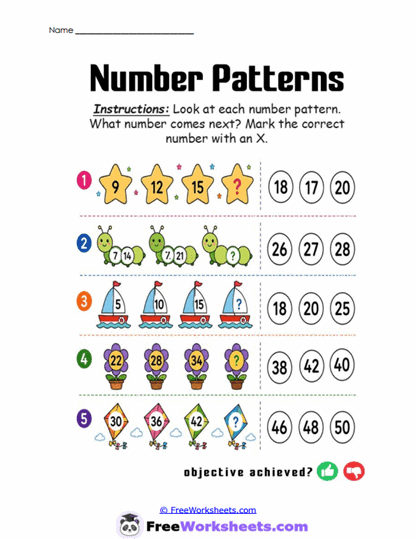
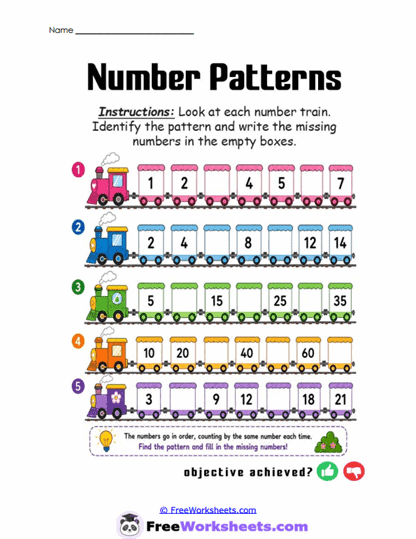
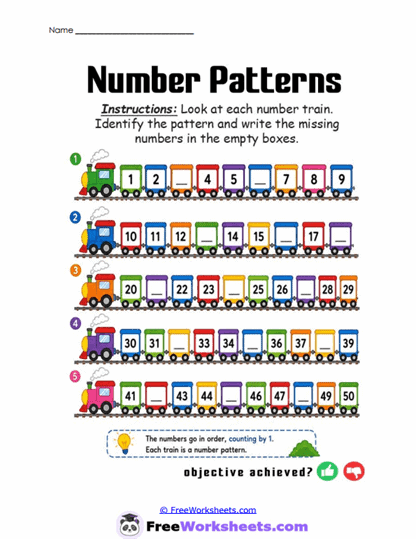
This collection keeps pattern practice fresh by presenting the same concept in several different ways. Some worksheets ask children to finish number trains by filling in missing cars. Others challenge them to choose the missing number from several answers or predict what comes next in a growing sequence. The variety encourages students to think about the pattern itself rather than memorizing one type of worksheet.
Whether you’re introducing skip counting, reviewing classroom lessons, or giving students extra practice at home, these printable worksheets fit naturally into almost any first-grade math routine. Because the activities gradually become more challenging, children build confidence while learning one of the most important habits in mathematics: always look for the pattern first.
Paul’s Teacher Tip
Whenever a child gets stuck, resist the urge to give the answer right away. Instead, ask, “How much did the number change?” or “What happened between these two numbers?” Those simple questions encourage students to look for the rule instead of guessing. You can even cover the missing number with your finger and have them say the pattern out loud before writing anything. After a little practice, many children begin spotting patterns almost automatically.
Worksheet Collection Skill Spotlights
Counting Rails
What Kids Do:
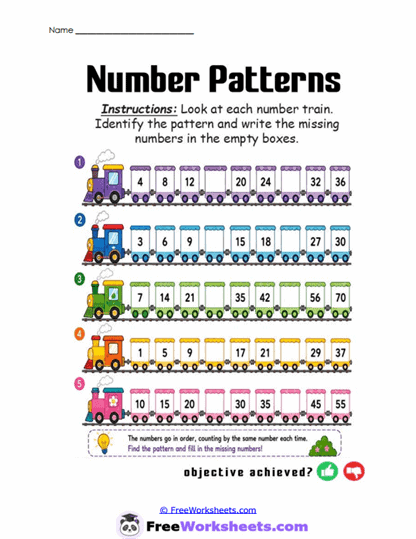
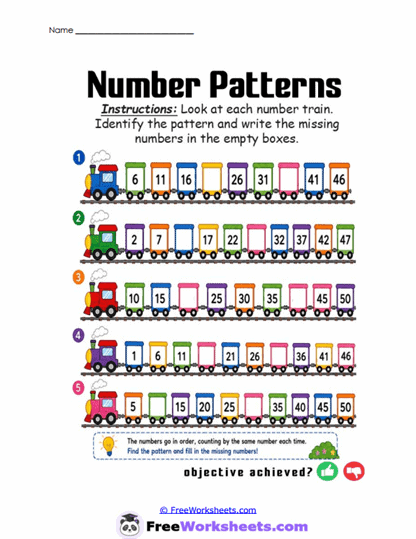
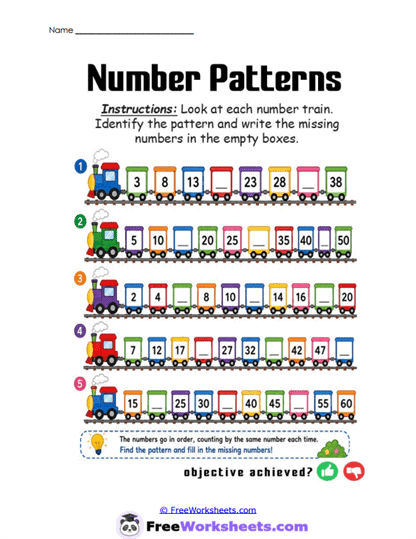
Every train is missing a few passengers, and it’s up to students to figure out who belongs in each empty train car. Before writing a number, children study the pattern to discover how the train is moving down the tracks. Some trains count by ones, while others make bigger jumps, turning each row into a small puzzle.
Target Skill:
Students practice recognizing consistent counting intervals instead of treating every missing number as a separate problem. That habit makes skip counting feel much more natural over time.
Growing Numbers
What Kids Do:
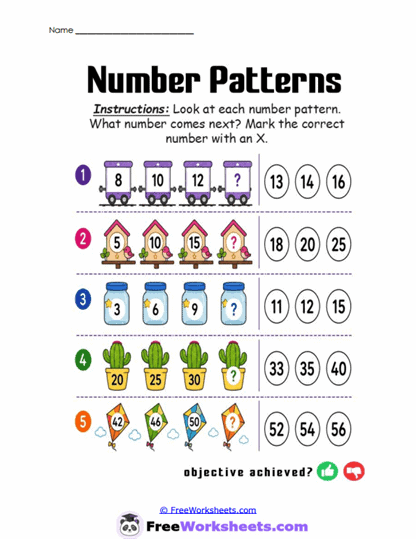
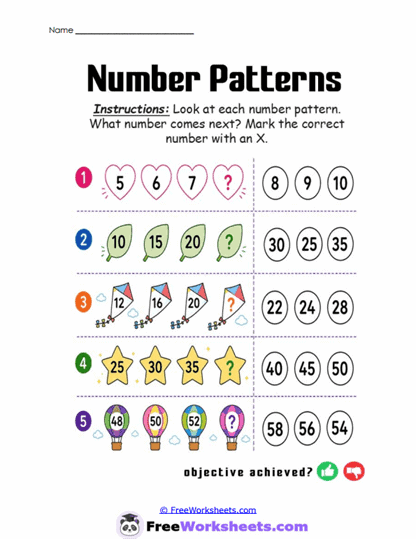
Children look for the rule hiding inside each number sequence before choosing what comes next. Every row encourages them to pause, notice how the numbers change, and make a thoughtful prediction rather than simply guessing.
Target Skill:
This activity helps students connect counting with logical reasoning by teaching them that every pattern follows a rule they can discover.
Missing Rule
What Kids Do:
Instead of filling in blanks, students play the role of pattern detectives. They study each sequence, uncover the counting rule, and then choose the number that keeps everything moving in the right direction.
Target Skill:
Children strengthen flexible thinking by learning to identify the “how” behind a sequence instead of focusing only on the missing number.
Next Number
What Kids Do:
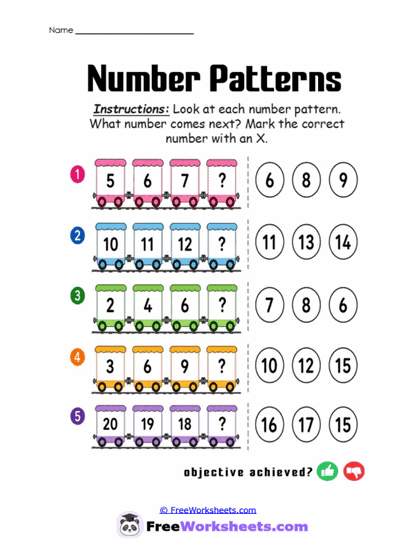
Every train gives students a short counting sequence and asks one simple question: “What comes next?” As children work through the page, they begin recognizing familiar skip-counting patterns more quickly with every problem.
Target Skill:
Predicting the next value strengthens number sense while helping students become more confident recognizing repeating counting intervals.
Pattern Choice
What Kids Do:
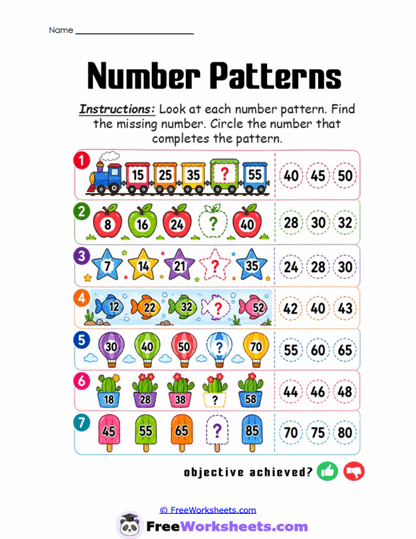
Each colorful picture row presents a different counting challenge. Students compare three possible answers before deciding which number keeps the pattern going. The multiple-choice format lets children spend more time thinking and less time writing.
Target Skill:
This worksheet encourages careful observation and helps students explain why one answer fits the pattern better than the others.
Pattern Finder
What Kids Do:
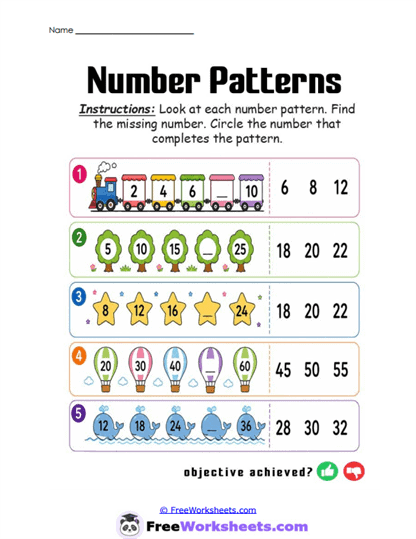
Some numbers are missing, but the clues are all there. Students study the sequence, discover the rule, and choose the number that completes it. Each solved pattern builds confidence for the next challenge.
Target Skill:
Children develop the habit of searching for mathematical relationships instead of relying on trial and error.
Pattern Hunt
What Kids Do:
This worksheet feels a little like a scavenger hunt. Students search each row for clues, figure out how the numbers are changing, and then hunt for the answer that belongs in the empty space.
Target Skill:
Recognizing counting patterns helps students become more comfortable with skip counting while strengthening logical reasoning skills they’ll use throughout elementary school.
Pattern Puzzle
What Kids Do:
Every sequence acts like a puzzle waiting to be solved. Students examine the numbers, spot the rule, and complete the pattern by selecting the missing value. The themed pictures add just enough fun without distracting from the math.
Target Skill:
This activity encourages children to slow down, analyze patterns, and make decisions based on evidence instead of instinct.
Pattern Tracks
What Kids Do:
The trains are back, but these routes require a little more thinking. Students complete missing train cars by paying close attention to how the numbers change from one stop to the next. Every completed train reinforces the importance of following the same rule all the way across.
Target Skill:
Children strengthen skip-counting fluency while learning that patterns remain consistent from beginning to end.
Pattern Trains
What Kids Do:
Students help finish each train by filling empty cars with the numbers that belong. Some sequences move by ones, while others skip ahead by larger amounts, giving children plenty of opportunities to practice different counting strategies.
Target Skill:
Working with a variety of counting intervals helps students become flexible thinkers instead of depending on only one counting method.
Picture Steps
What Kids Do:
Bright pictures catch students’ attention, but it’s the numbers that tell the real story. Children look past the illustrations to uncover the counting rule before choosing the next value in each sequence.
Target Skill:
Students learn to separate important mathematical information from decorative details while strengthening pattern recognition.
Sequence Match
What Kids Do:
Each row presents an unfinished sequence and a few possible answers. Students compare the choices carefully before circling the one that keeps the counting pattern on track.
Target Skill:
The activity reinforces thoughtful decision-making by encouraging children to verify the rule before choosing an answer.
Sequence Solver
What Kids Do:
Students solve one pattern after another by discovering how the numbers grow from step to step. Every completed row feels like cracking a tiny math code, keeping learners engaged from beginning to end.
Target Skill:
This worksheet develops confidence recognizing increasingly complex counting patterns while strengthening reasoning skills.
Skip Counting
What Kids Do:
These trains don’t stop at every station. Instead, they jump ahead by the same amount each time, and students fill in the missing cars along the journey. It’s a fun way to practice skip counting without feeling repetitive.
Target Skill:
Children build fluency counting by twos, fives, tens, and other intervals while laying the groundwork for multiplication and place value.
Train Sequence
What Kids Do:
Every train leaves a few empty cars behind, and students complete the trip by filling in the missing numbers. As they work, they quickly discover that every successful train follows one simple counting rule from engine to caboose.
Target Skill:
This worksheet helps students recognize that patterns aren’t random-they’re built on predictable rules that make future numbers easier to find.