
Number Bonds Worksheets
Number bonds are one of those math ideas that seem simple at first but end up helping children in almost every area of early arithmetic. Instead of seeing numbers as fixed amounts, students begin discovering that the same number can be built in many different ways. These free Grade 1 Number Bonds worksheets give children plenty of opportunities to break numbers apart, put them back together, and build confidence with addition in ways that feel natural instead of repetitive.
About This Collection of Worksheets
When children understand number bonds, addition starts making a lot more sense. Instead of memorizing facts one by one, they begin recognizing relationships between numbers. A total of 8 isn’t just 4 + 4. It can also be 5 + 3, 6 + 2, or 7 + 1. Those discoveries help students solve problems more efficiently and lay the foundation for subtraction, fact families, and mental math.
This collection approaches number bonds from several different angles so children don’t feel like they’re doing the same worksheet over and over. Some pages ask students to build number bonds using apples or flowers. Others challenge them to find missing parts, decide which number bond doesn’t belong, or represent numbers with groups of dots on colorful butterflies. Every activity reinforces the same big idea while presenting it in a fresh and engaging way.
These worksheets work well whether you’re introducing number bonds for the first time or giving students extra practice after a classroom lesson. They’re equally useful for math centers, independent work, intervention groups, homework, or homeschool lessons. Because the activities gradually become more challenging, children can build confidence one step at a time while strengthening the flexible number thinking they’ll use throughout elementary school.
Paul’s Teacher Tip
One of the easiest ways to teach number bonds is to grab a handful of everyday objects like pennies, blocks, cereal pieces, or buttons. Ask your child to make a group of six. Then slide some objects to one side and the rest to the other. “How many are here? How many are there?” Before long, children begin noticing that there isn’t just one way to make six-there are lots of possibilities. Once they understand that idea with real objects, the worksheets become much more meaningful because they’re recording relationships they’ve already discovered with their own hands.
Worksheet Collection Skill Spotlights
Addition Bonds
What Kids Do:
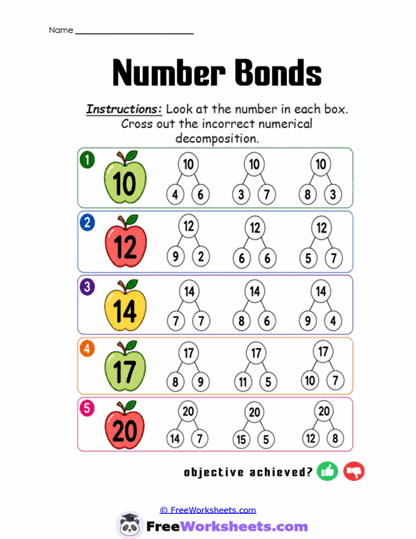
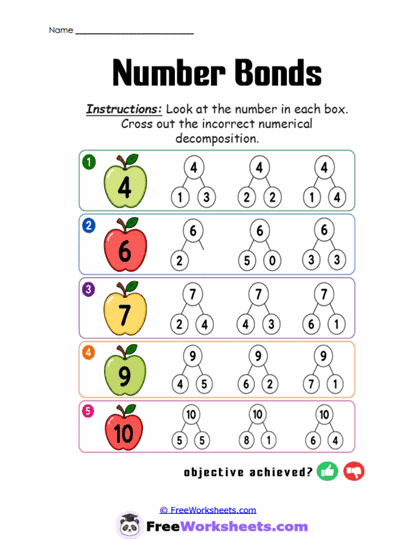
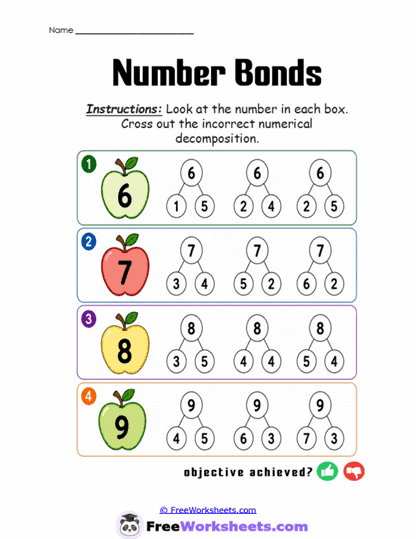
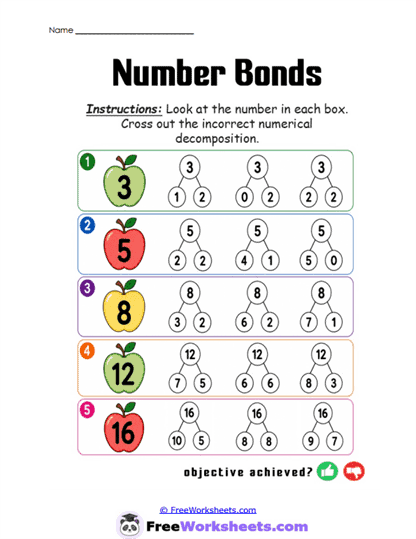
Students become math detectives by checking several number bonds and deciding which one doesn’t fit. Every problem asks them to test each pair before crossing out the incorrect answer, encouraging careful thinking instead of quick guessing.
Target Skill:
Children learn that checking their work is just as important as finding an answer. They build confidence verifying addition facts while strengthening the habit of looking for mistakes before moving on.
Apple Partners
What Kids Do:
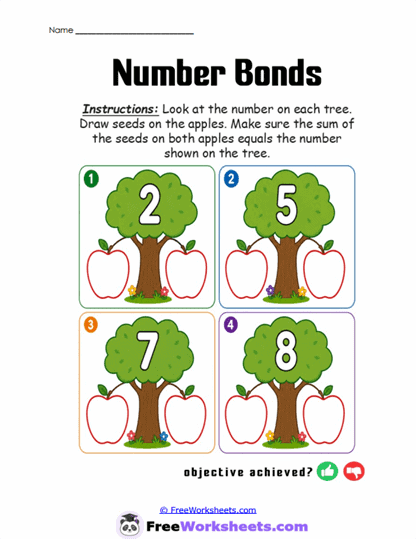
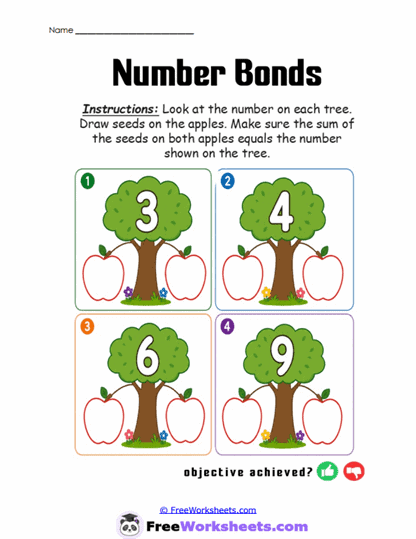
Each tree displays a whole number, and students get to decide which two numbers belong in the apples below. There isn’t just one right answer, so children have the freedom to experiment with different combinations that all reach the same total.
Target Skill:
This worksheet helps students realize numbers are flexible. Seeing multiple ways to build the same total develops stronger number sense and makes addition feel much less intimidating.
Apple Sums
What Kids Do:
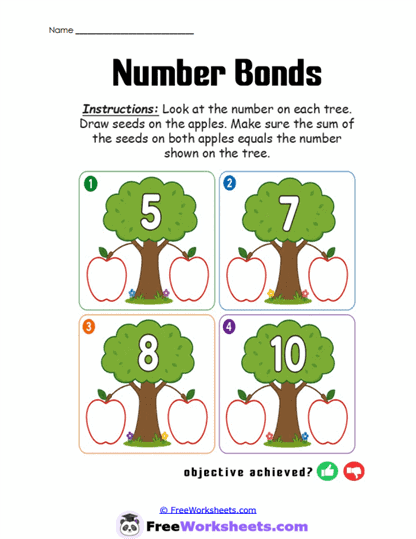
Students fill each pair of apples with numbers that combine to match the number growing on the tree. As they move from tree to tree, they begin spotting familiar number combinations without having to count every time.
Target Skill:
Learners develop a stronger understanding of part-part-whole relationships, one of the biggest building blocks for future addition and subtraction success.
Bond Builder
What Kids Do:
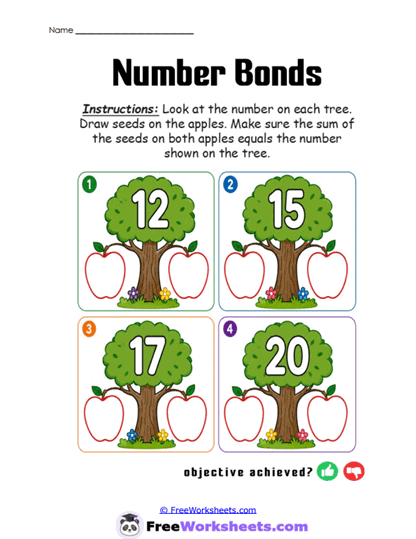
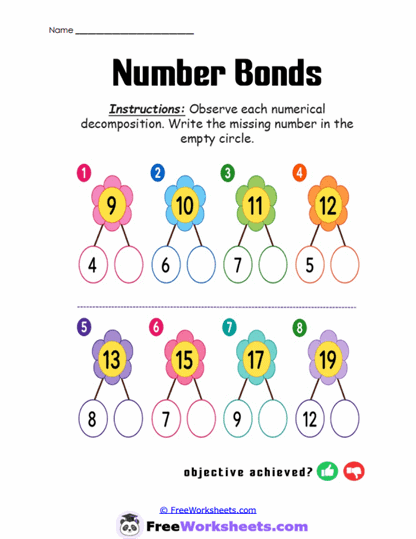
The numbers get a little larger on this page, giving students a chance to stretch their thinking while still using the same familiar number bond format. Children decide which two numbers work together to build each whole.
Target Skill:
Working with larger totals helps students trust what they already know instead of becoming nervous when the numbers grow beyond basic facts.
Bond Check
What Kids Do:
Not every answer on this worksheet is correct, and that’s exactly the point. Students carefully inspect each number bond before crossing out the one that doesn’t belong. It’s a little like proofreading-but for math.
Target Skill:
Instead of simply solving problems, children practice evaluating mathematical thinking. That extra layer of reasoning builds stronger problem-solving habits over time.
Bond Detective
What Kids Do:
Every row presents several number bonds, but one contains a mistake. Students investigate each option before deciding which one should be crossed out. It feels more like solving a mystery than completing an addition worksheet.
Target Skill:
Children strengthen addition accuracy while learning that good mathematicians don’t accept every answer at face value-they check the evidence first.
Bond Match
What Kids Do:
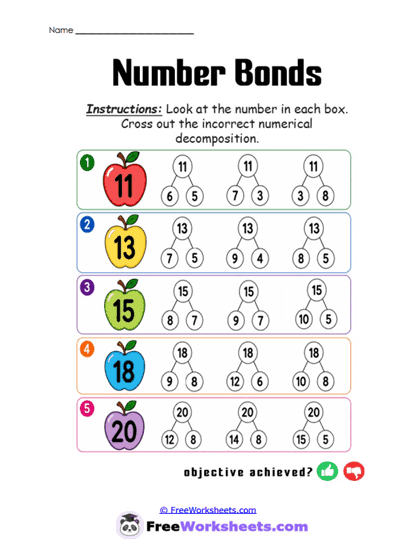
Students compare several possible number bonds and identify the one that doesn’t equal the whole number. The activity encourages them to slow down and think through each choice before making a decision.
Target Skill:
Comparing multiple solutions helps children recognize correct addition patterns while improving their confidence explaining why an answer works-or doesn’t.
Butterfly Bonds
What Kids Do:
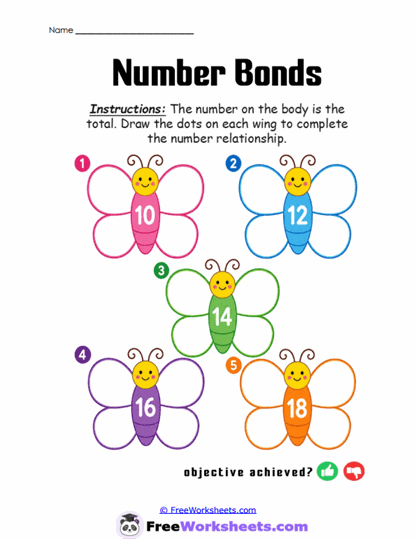
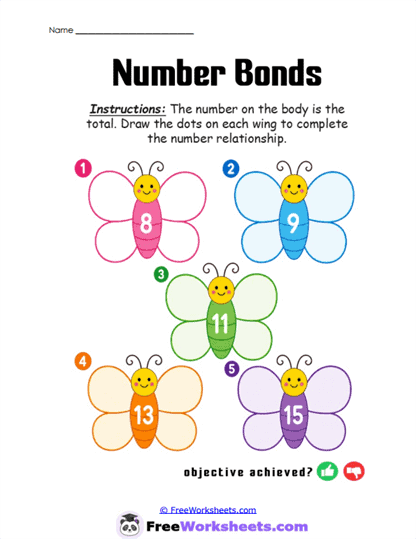
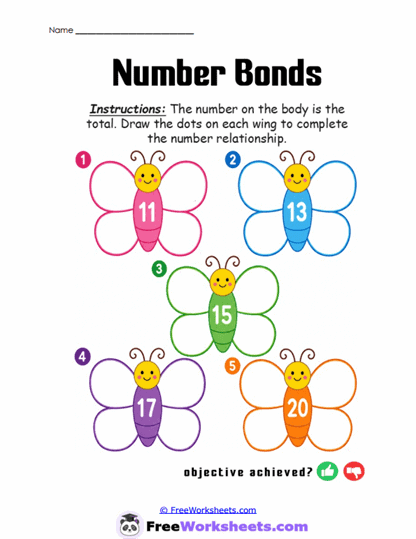
Instead of writing numbers, students create number bonds by drawing groups of dots on butterfly wings. Watching the two groups come together to match the butterfly’s body makes the idea of “parts making a whole” much easier to picture.
Target Skill:
Visual models help young learners connect counting with addition, making abstract math concepts much easier to understand.
Butterfly Groups
What Kids Do:
Children fill butterfly wings with two groups of dots that add up to the number on the butterfly’s body. Many students enjoy discovering they can create completely different dot patterns that still reach the same answer.
Target Skill:
This activity strengthens counting accuracy while encouraging flexible thinking about how numbers can be broken apart and rebuilt.
Flower Parts
What Kids Do:
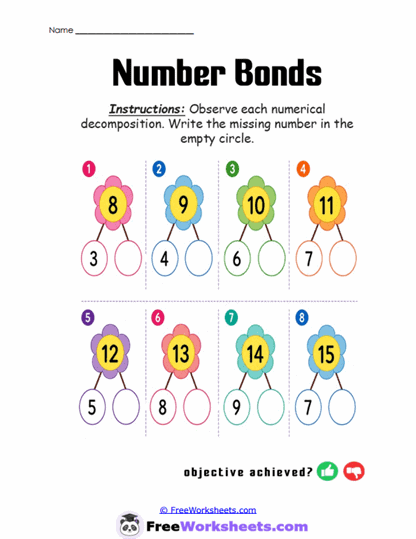
Each flower is missing one piece of its number bond puzzle. Students use the whole number and the known part to figure out which number belongs in the empty circle. Every completed flower feels like solving a small puzzle.
Target Skill:
Finding missing parts naturally prepares students for subtraction because they begin thinking about what’s needed to complete a whole instead of always adding forward.
Missing Parts
What Kids Do:
Students continue practicing missing-number puzzles by completing unfinished number bonds. Rather than guessing, they learn to use the information already provided to figure out what belongs in the empty space.
Target Skill:
This worksheet develops logical thinking while helping children become more comfortable solving unknown-value problems they’ll encounter throughout elementary math.
Number Proof
What Kids Do:
Students act like fact-checkers, reviewing several completed number bonds to find the one that’s incorrect. Every decision requires a quick mental addition check before moving to the next problem.
Target Skill:
The activity builds careful mathematical habits and reminds children that taking a few extra seconds to verify an answer is always worthwhile.
Tree Totals
What Kids Do:
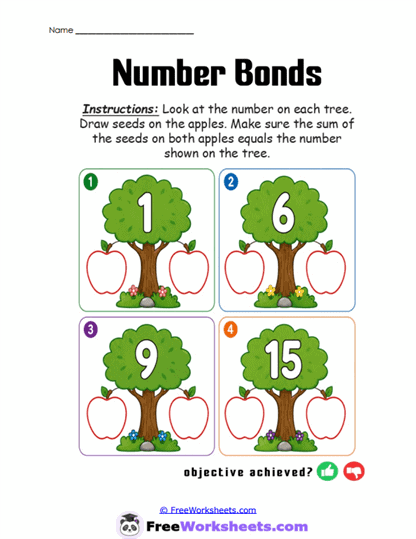
Each tree grows a different whole number, and students choose two apple numbers that combine to match it. Children often discover there are several correct answers, making the activity feel open-ended instead of restrictive.
Target Skill:
Repeated practice composing numbers helps students develop fluency with addition while seeing numbers as combinations rather than isolated facts.
Whole Numbers
What Kids Do:
Students build complete number bonds by filling apples with two parts that match each whole number shown on the tree. As they work, they naturally begin recognizing familiar addition facts without relying on memorization alone.
Target Skill:
Children strengthen the connections between addition facts, helping them solve problems more quickly and confidently in future lessons.
Wing Totals
What Kids Do:
Butterflies return for one more visual challenge as students create matching dot groups on each wing to equal the number in the butterfly’s body. Every butterfly becomes its own little counting activity.
Target Skill:
Representing numbers visually helps children understand that addition isn’t just about writing equations-it’s about seeing how smaller groups combine to create something larger.