
About This Worksheet
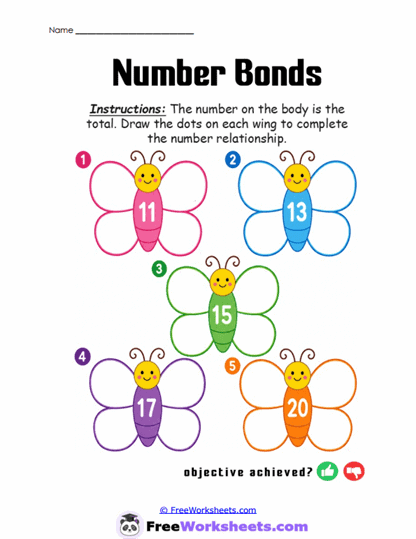
This worksheet introduces first graders to number bonds by using butterflies to represent whole numbers and their parts. The number shown on each butterfly’s body is the whole, and students draw dots on the wings to show two groups that combine to make that total. Number bonds help children understand that numbers can be separated into smaller parts and then combined again. For example, 13 becomes 6 and 7 because 6 + 7 = 13. The engaging butterfly theme makes early addition practice both fun and meaningful.
Curriculum and Grade Alignment
This worksheet is intended for Grade 1 students who are developing addition fluency through visual models. Students should already understand simple addition facts before completing the activity. Drawing dot groups strengthens part-whole relationships while preparing learners for subtraction, mental math, and fact families. The activity supports CCSS.MATH.CONTENT.1.OA.C.6 by building fluency with addition and aligns with TEKS 1.3.C through composing and decomposing numbers. It encourages students to represent addition visually instead of relying only on numerals.
Student Tasks
On this worksheet, students will look at the whole number displayed on each butterfly. They draw dots on the butterfly’s wings to create two groups that add together to equal the body number. Students complete every butterfly while checking that the combined dots match the total shown. As they work, they discover different ways to represent the same whole number.
Common Challenges and Misconceptions
Some students may draw too many or too few dots because they lose track while counting. Others may place all the dots on one side instead of creating two separate groups. A few learners may forget to count the total after finishing the butterfly. Encourage students to count both wings together before moving to the next problem.
Implementation Guidance
Teachers can introduce this worksheet after modeling number bonds with counters or linking cubes. It works well during guided math lessons, centers, or independent review. Parents can practice the same concept at home using buttons, beans, or small toys before completing the worksheet. Asking children to explain their dot groupings reinforces both counting and addition skills.
Details and Features
The worksheet includes five large butterfly illustrations with plenty of room for students to draw dot groups. Bright colors and friendly graphics keep young learners engaged throughout the activity. The printable design is easy to use in classrooms, tutoring sessions, and homeschool environments. Its visual format supports students who learn best through pictures and hands-on thinking.