
About This Worksheet
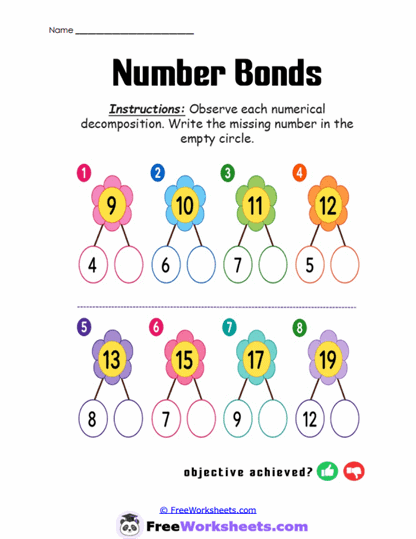
This worksheet gives first graders additional practice finding the missing number in a number bond. Students use the whole number and one known part to determine the missing part needed to complete the bond. Number bonds help children understand that numbers can be broken apart and put back together in many ways. For example, if the whole is 15 and one part is 7, the missing part is 8 because 7 + 8 = 15. This repeated practice builds confidence with addition facts and mental math.
Curriculum and Grade Alignment
This worksheet is intended for Grade 1 students who have begun working with addition within 20. Students should understand basic number bonds before completing these missing-part problems. Developing this skill prepares children for subtraction strategies, fact families, and place value concepts. The activity supports CCSS.MATH.CONTENT.1.OA.C.6 by encouraging fluency with addition and aligns with TEKS 1.3.C through number decomposition. It also reinforces mathematical reasoning by asking students to determine unknown values.
Student Tasks
On this worksheet, students will study each flower to identify the whole number and the known part. They write the missing number inside the empty circle to complete the number bond correctly. Students solve every problem by checking that both parts add up to the whole. When finished, they review their work to make sure each completed bond is accurate.
Common Challenges and Misconceptions
Some students may forget that the two smaller numbers must equal the larger number exactly. Others may choose a number that is close without verifying the total. A few learners may rely on counting instead of recognizing familiar addition facts. Encourage students to check every answer by adding the two parts together before moving on.
Implementation Guidance
Teachers can use this worksheet as independent practice after introducing missing-part number bonds. It also works well in small groups where students explain how they found each answer. Parents can support learning by using everyday objects to model the same number combinations before completing the worksheet. Asking children to explain their thinking helps strengthen conceptual understanding.
Details and Features
The worksheet includes eight colorful flower number bond diagrams with clearly printed whole numbers. Large answer circles provide enough room for beginning writers to record their responses. The uncluttered layout keeps students focused on solving one problem at a time. It prints clearly for classroom instruction, homework, or homeschool practice.