
About This Worksheet
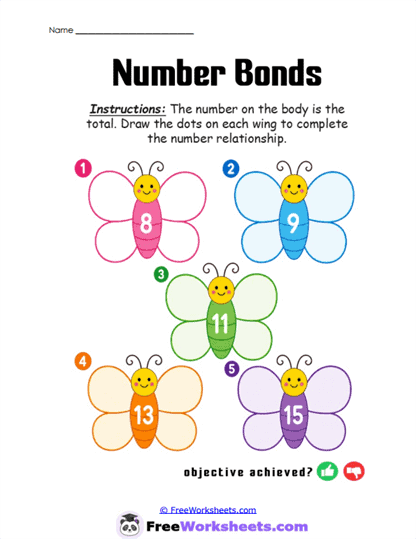
This worksheet helps first graders practice number bonds by drawing dot groups that combine to make a whole number. Each butterfly displays a whole number on its body, and students complete the wings with two groups of dots that equal the total. Number bonds teach children that one number can be made from many different combinations of smaller numbers. For example, 11 becomes 5 and 6 because 5 + 6 = 11. This visual activity strengthens counting, addition, and flexible number thinking.
Curriculum and Grade Alignment
This worksheet is designed for Grade 1 students who are learning to compose and decompose numbers using visual models. Students should already understand counting and simple addition before beginning. Number bond practice prepares learners for subtraction strategies, mental computation, and place value lessons. This worksheet supports CCSS.MATH.CONTENT.1.OA.C.6 by reinforcing addition fluency and aligns with TEKS 1.3.C through part-whole relationships. It also develops strong visualization skills that support future mathematics learning.
Student Tasks
On this worksheet, students will study the whole number shown on each butterfly. They draw one group of dots on one wing and another group on the opposite wing so both groups together equal the total. Students repeat this process for every butterfly while checking their counting carefully. After finishing, they can compare different dot combinations that create the same whole number.
Common Challenges and Misconceptions
Some learners may accidentally draw the correct total but place every dot on one side instead of making two groups. Others may lose count while drawing and end up with the wrong number of dots. A few students may believe there is only one correct combination for each butterfly. Encourage students to count each group separately and then count the combined total before moving on.
Implementation Guidance
Teachers can use this worksheet during guided instruction, math centers, or independent practice after introducing number bonds. It also works well as a small-group activity where students compare different correct dot combinations. Parents can recreate the activity at home with small objects before transferring the idea to paper. Encouraging children to discover multiple solutions builds confidence and flexibility with addition.
Details and Features
The worksheet features five large butterfly diagrams with spacious wings for drawing dot groups. The colorful illustrations help maintain student interest while keeping the directions simple. The printable layout provides plenty of room for careful counting and neat work. It is ideal for classroom lessons, homework, tutoring, or homeschool instruction.