
Grade 1 Reading Comprehension Worksheets
Grade 1 reading comprehension in 1st grade reading helps children understand story details, sequence events, compare ideas, and answer questions from text. These free, ready-to-print PDF worksheets are prepared for immediate classroom use, literacy centers, homeschool lessons, intervention, homework, or independent practice. Students strengthen detail recall, sequencing, and text-evidence skills while working toward important 1st grade curriculum goals.
About This Collection of Worksheets
Reading comprehension in 1st grade helps children move beyond simply recognizing words and begin thinking about what a passage actually says. Young readers learn to identify characters and settings, remember important details, follow event order, compare information, and answer questions using evidence from the text. These habits build the foundation for stronger comprehension as stories and informational passages become longer and more complex.
This collection gives students several ways to show what they understand after reading. Children identify the main subject of a story, visualize a picnic through drawing, answer Yes-or-No questions, complete sentences with story details, fact-check informational text, answer who-what-where questions, sequence events, identify character actions, compare two passages, answer multiple-choice questions, complete a story map, and verify statements against a snow-day story. Pasted text
Teachers can use these worksheets during 1st grade guided reading, comprehension centers, small groups, independent work, homework, or intervention. Parents and homeschool educators can encourage children to return to the passage whenever they are unsure instead of guessing from memory or background knowledge. Because the pages use several response formats, students get repeated practice with comprehension while learning that good readers can explain and prove their answers in different ways.
Paul’s Teacher Tip
Teach children to go back to the text before answering whenever possible. Even if they remember the story, finding the sentence that supports an answer helps build an important comprehension habit. For detail questions, have students underline or point to the exact words that provide the evidence. When sequencing, ask what must happen first and what could not happen until later. For comparison activities, remind children that an answer about both passages has to be supported by each text, not just one.
Worksheet Collection Skill Spotlights
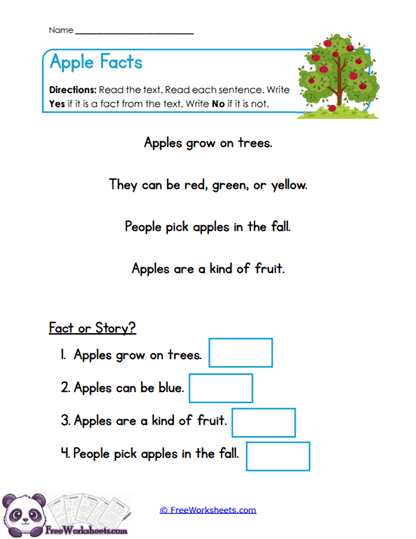
Apple Facts
What Kids Do:
Children read a short informational passage about apples and then decide whether four statements match the information in the text. They answer Yes or No for details involving where apples grow, their colors, when they are picked, and what type of food they are.
Target Skill:
This activity strengthens nonfiction comprehension and early fact checking. Students practice comparing a statement with directly stated information, separating prior knowledge from text evidence, and returning to an informational passage to verify whether an answer is supported.
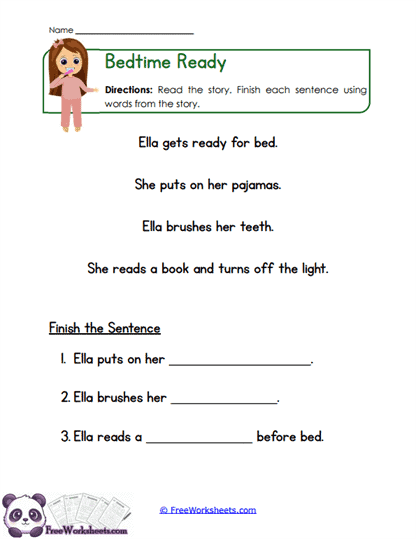
Bedtime Details
What Kids Do:
Children read a short passage about Ella getting ready for bed and complete three sentences using details from the story. They identify what she puts on, what she brushes, and what she reads, then reread the completed sentences to check their answers.
Target Skill:
The worksheet builds detail recall and text-based answering. Students practice locating exact information in a passage, matching a question with the relevant sentence, and using words from the text accurately rather than relying only on memory.
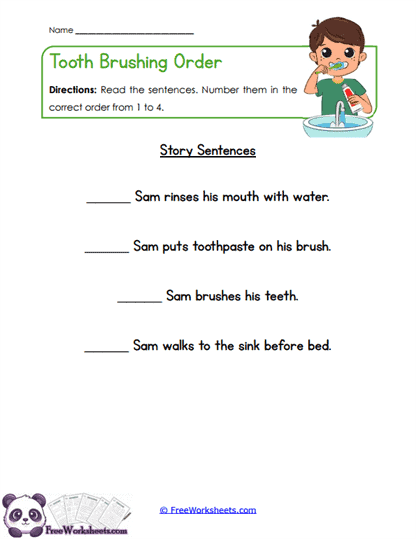
Brushing Steps
What Kids Do:
Children read four sentences describing Sam’s tooth-brushing routine and number the events from 1 through 4. They decide which action happens first, determine the middle steps, identify the final event, and reread the reordered routine to check that it makes sense.
Target Skill:
This activity develops sequencing and retelling skills. Students practice using both textual information and logical order to organize events, helping them understand how actions unfold across a short passage rather than viewing each sentence separately.
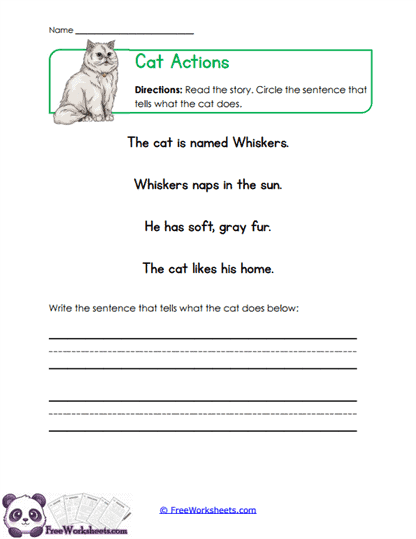
Cat Actions
What Kids Do:
Children read a short passage about Whiskers the cat and choose the sentence that tells what the cat actually does. They distinguish the action from sentences describing his name, appearance, or preferences and then copy the action sentence onto the writing lines.
Target Skill:
The worksheet strengthens comprehension of character actions while reinforcing simple grammar awareness. Students learn to separate what a character does from descriptive information and identify the sentence that provides direct evidence of behavior.
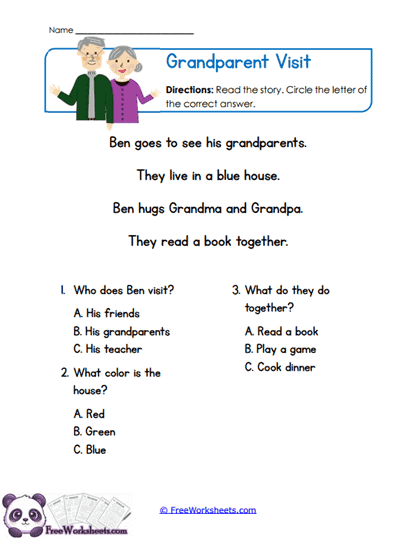
Family Visit
What Kids Do:
Children read a short story about Ben visiting his grandparents and answer three multiple-choice questions. They identify who Ben visits, the color of the house, and what the family does together, returning to the passage whenever they need to verify a detail.
Target Skill:
This activity develops accurate retrieval of explicitly stated story information. Students practice matching questions with relevant details, eliminating unsupported answer choices, and using the passage as evidence instead of guessing from memory.
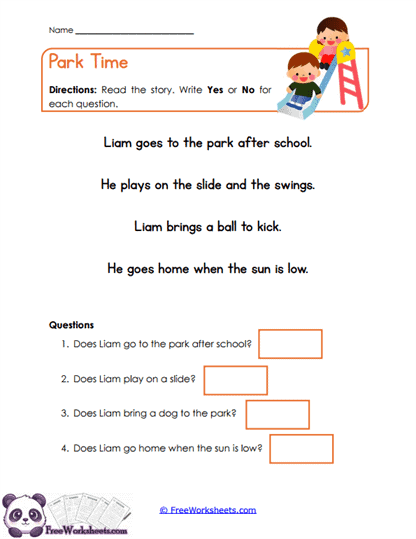
Park Facts
What Kids Do:
Children read a short passage about Liam going to the park after school and answer four Yes-or-No questions. They check details about where he goes, what playground equipment he uses, what he brings, and when he leaves.
Target Skill:
The worksheet strengthens careful reading and evidence-based answering. Students learn to compare each statement with the passage, distinguish story facts from assumptions, and reread specific sentences when they are unsure about an answer.
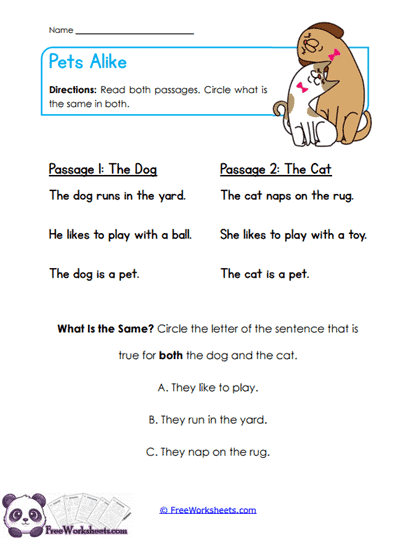
Pet Compare
What Kids Do:
Children read one short passage about a dog and another about a cat, then examine three answer choices and identify the statement that is true for both pets. They can point to evidence in each passage that supports the shared detail.
Target Skill:
This activity introduces comparing information across two texts. Students practice identifying similarities, checking an idea against both passages, and understanding that a comparison statement must be supported by information from each source.
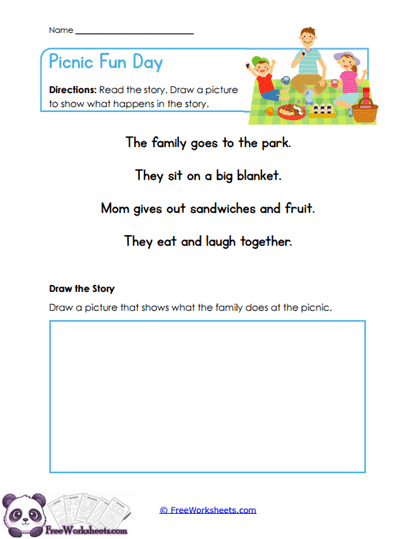
Picnic Picture
What Kids Do:
Children read a short passage about a family picnic and draw a picture showing the important events and details. Their illustration can include the park, blanket, sandwiches, fruit, and family members eating and laughing together.
Target Skill:
The worksheet develops visualization and detail comprehension. Students practice turning written information into a mental image and then representing key setting, character, and action details in a drawing that reflects what the passage actually says.
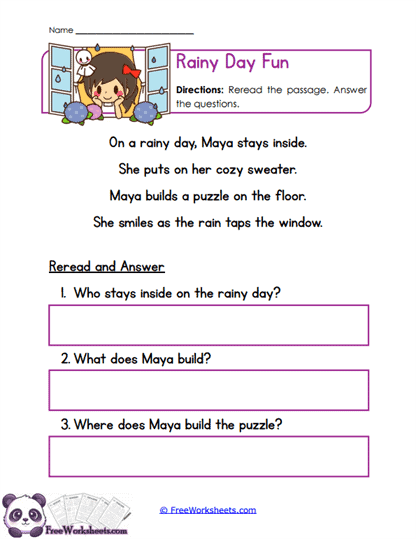
Rainy Details
What Kids Do:
Children read a rainy-day passage about Maya and answer three open-response questions asking who stays inside, what she builds, and where she builds it. They write short answers and can return to the story to locate each detail.
Target Skill:
This activity strengthens comprehension of who, what, and where questions. Students practice identifying what type of information a question is requesting and retrieving the appropriate person, action, or place directly from the passage.
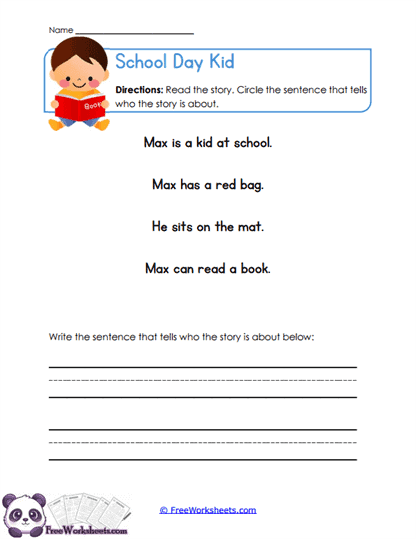
School Subject
What Kids Do:
Children read a short passage about Max and decide which sentence best tells who the story is mainly about. They circle the strongest sentence and then copy it onto handwriting lines at the bottom of the worksheet.
Target Skill:
The worksheet introduces the idea of identifying a passage’s main subject. Students practice distinguishing the overall focus from smaller supporting details and recognizing which sentence most clearly represents who the entire passage discusses.
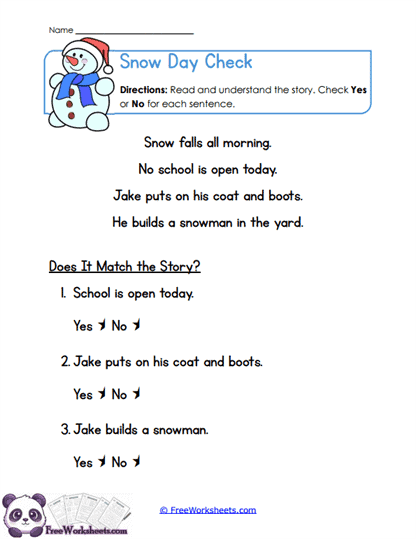
Snow Check
What Kids Do:
Children read a short story about a snowy day and compare three Yes-or-No statements with the passage. They decide whether each statement accurately reflects details such as the school closing, Jake’s clothing, and building a snowman.
Target Skill:
This activity develops close reading and statement verification. Students practice noticing when one changed word makes a claim inaccurate and learn to support each Yes-or-No decision by locating the matching information in the text.
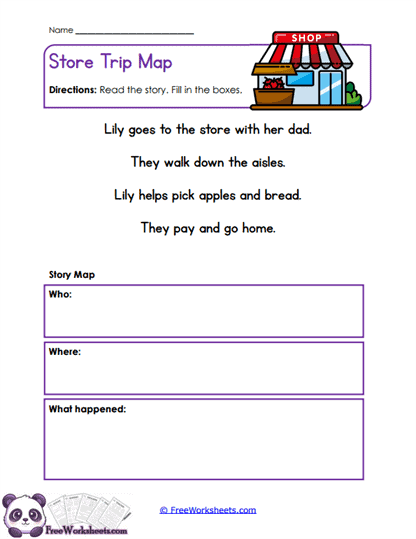
Story Mapping
What Kids Do:
Children read a short story about Lily going to the store with her dad and complete a three-part story map. They record who appears in the story, where it takes place, and what happens, using the passage as often as needed.
Target Skill:
The worksheet strengthens understanding of basic narrative structure. Students practice separating characters, setting, and main events into distinct categories, then using those elements to support retelling and simple summarizing of a story.