
Grade 1 Reading Passages Worksheets
Grade 1 reading passages in 1st grade reading help children practice phonics, comprehension, fluency, sequencing, and responding to short texts. These free, ready-to-print PDF worksheets are prepared for immediate classroom use, literacy centers, homeschool lessons, intervention, homework, or independent practice. Students strengthen decoding, text comprehension, and sequencing while working toward important 1st grade reading curriculum goals.
About This Collection of Worksheets
Short reading passages give 1st grade students a manageable way to practice several reading skills inside connected text. Instead of working only with isolated words or questions, children can apply phonics, sight-word recognition, comprehension, fluency, and sequencing while reading complete ideas. This helps students see how individual reading skills work together during real reading.
This collection includes phonics searches, main-character questions, sight-word hunts, visualization activities, sentence editing, repeated reading, CVC word building, Yes-or-No comprehension, event sequencing, guided retelling, character-action responses, and sentence construction. The variety allows students to read for different purposes while repeatedly returning to the text for evidence and support. Pasted text
Teachers can use these worksheets during 1st grade guided reading, literacy centers, phonics review, comprehension groups, intervention, homework, or independent reading practice. Parents and homeschool educators can choose passages based on whether a child needs more support with decoding, fluency, story details, sequencing, or written responses. Because the passages are short and focused, children can practice one skill at a time without losing sight of the overall meaning of what they read.
Paul’s Teacher Tip
Before children answer a question or complete an activity, have them read the entire passage once for meaning first. On a second read, they can hunt for vowel patterns, sight words, evidence, or sequencing clues without losing the story itself. If a question asks for a detail, encourage students to point to the exact sentence that supports their response. For fluency passages, focus on smoother and clearer rereading rather than speed alone. When children retell or build a sentence, having them say the answer aloud first often makes the written response much easier.
Worksheet Collection Skill Spotlights
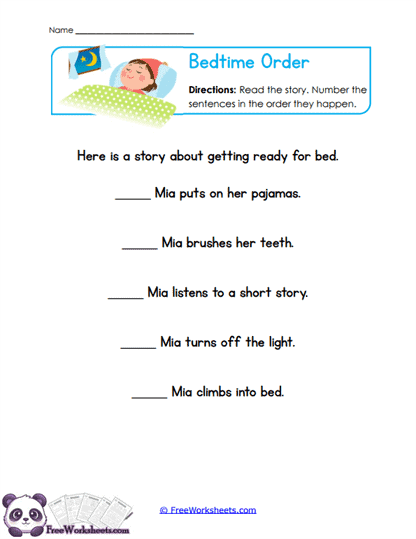
Bedtime Sequence
What Kids Do:
Children read five sentences about Mia’s bedtime routine and arrange the events from first to last. They number actions such as putting on pajamas, brushing teeth, hearing a story, turning off the light, and climbing into bed, then reread the completed sequence.
Target Skill:
This activity strengthens sequencing and understanding of event order. Students practice identifying what happens first, next, and last, using both passage information and logical relationships to support retelling and comprehension of narrative structure.
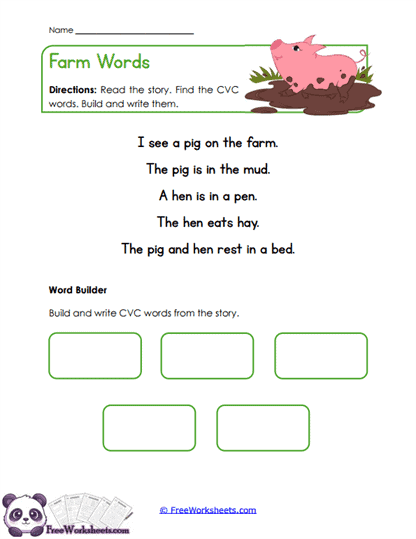
Farm Phonics
What Kids Do:
Children read a short farm passage containing words such as pig, hen, mud, pen, and bed. They search the story for simple CVC words, choose several examples, copy them into word-building boxes, and read the selected words aloud.
Target Skill:
The worksheet connects phonics practice with connected reading. Students strengthen decoding, spelling, and CVC pattern recognition by locating familiar consonant-vowel-consonant words inside a meaningful passage instead of working only with isolated examples.
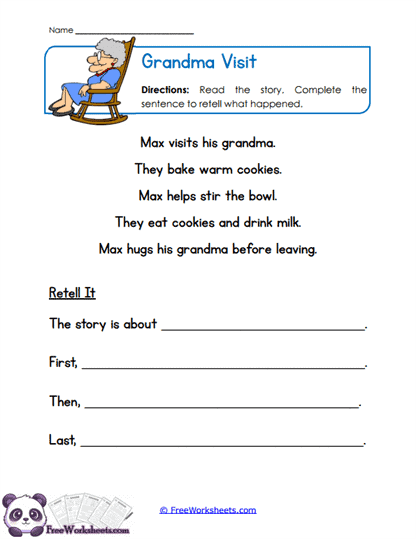
Grandma Retell
What Kids Do:
Children read a story about Max visiting his grandma, baking cookies, stirring the bowl, eating cookies with milk, and giving her a hug. They then complete a guided retell using the prompts First, Then, and Last.
Target Skill:
This activity develops sequencing, summarizing, and retelling. Students practice deciding which events are most important, organizing them into beginning, middle, and ending sections, and expressing the story in a shorter, clearer form.
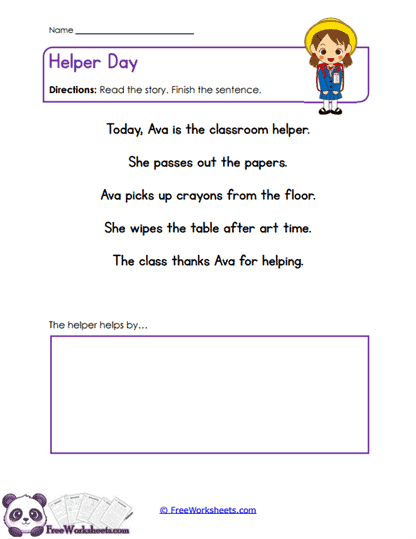
Helper Actions
What Kids Do:
Children read about Ava helping in the classroom by passing out papers, picking up crayons, and wiping the table. They use those details to complete the sentence starter “The helper helps by…” in a large written-response box.
Target Skill:
The worksheet develops comprehension of character actions and simple summarizing. Students practice combining several supporting details into one larger idea while grounding their written response in actions directly stated in the passage.
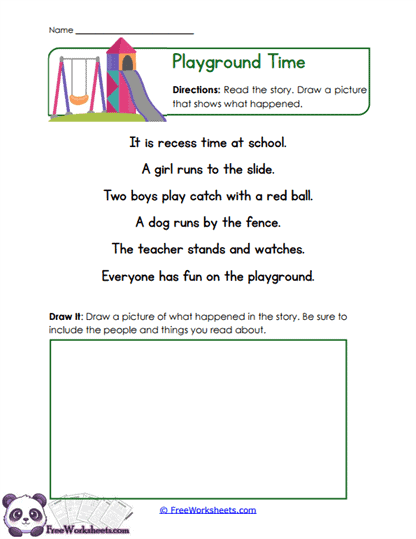
Playground Picture
What Kids Do:
Children read a recess story describing a girl on the slide, boys playing catch with a red ball, a dog near the fence, and a teacher watching. They then draw the scene and include details from the passage in their picture.
Target Skill:
This activity strengthens visualization and attention to text details. Students practice turning written information into a mental image, identifying important people, objects, and actions, and demonstrating comprehension through an accurate visual response.
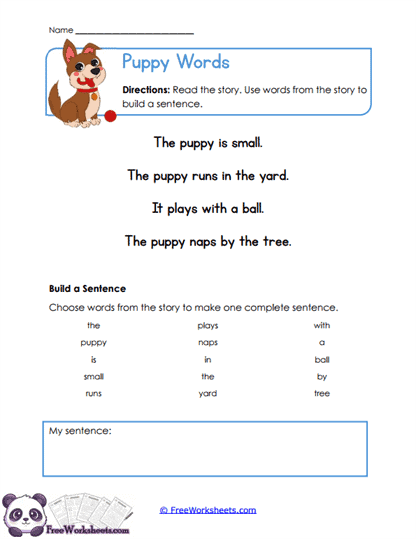
Puppy Sentence
What Kids Do:
Children read a short passage about a puppy running in the yard, playing with a ball, and napping by a tree. They choose words from the story’s word bank and arrange them into one complete sentence of their own.
Target Skill:
The worksheet connects reading comprehension with sentence construction. Students practice selecting vocabulary from a passage, organizing words into logical order, and producing a complete thought while reinforcing grammar awareness and writing fluency.
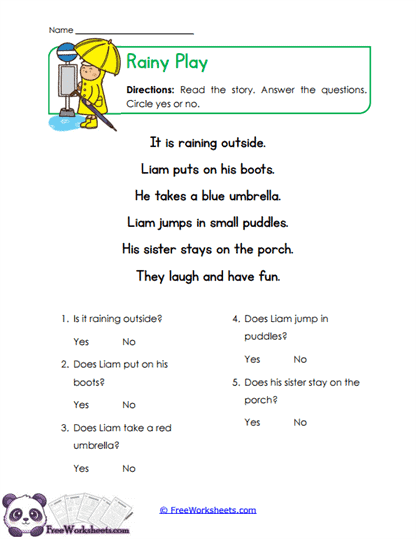
Rainy Answers
What Kids Do:
Children read a rainy-day passage about Liam wearing boots, carrying a blue umbrella, jumping in puddles, and spending time with his sister. They answer five Yes-or-No questions and return to the passage to verify each response.
Target Skill:
This activity strengthens detail recall and evidence-based comprehension. Students practice comparing questions with information directly stated in the passage and learn to use the text to confirm an answer rather than relying on assumptions or memory alone.
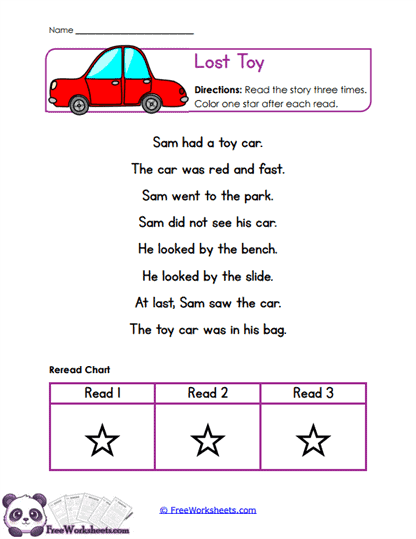
Repeated Story
What Kids Do:
Children read the short “Lost Toy” story about Sam searching for his toy car three times. After each reading, they color a star on the progress chart and try to make the next reading smoother, clearer, and less hesitant.
Target Skill:
The worksheet develops oral reading fluency through purposeful repetition. Students strengthen automatic word recognition, accuracy, pacing, and confidence while experiencing how familiar text becomes easier to read and understand across repeated attempts.
School Reader
What Kids Do:
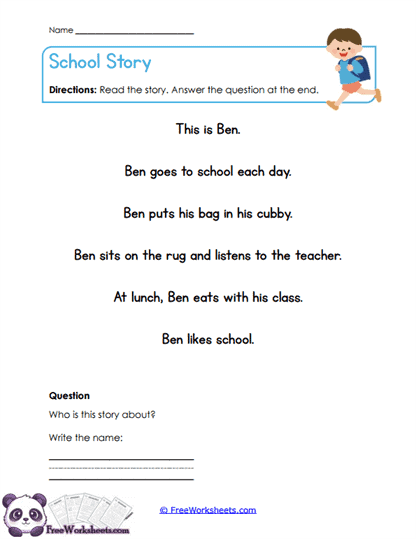
Children read a short school passage about Ben putting away his bag, sitting on the rug, eating lunch, and listening to his teacher. They identify who the story is mainly about and write the character’s name on the provided lines.
Target Skill:
This activity develops understanding of the main character and basic who questions. Students practice connecting several supporting details to the person they describe and using direct information from the passage to support a simple written response.
Sentence Repair
What Kids Do:
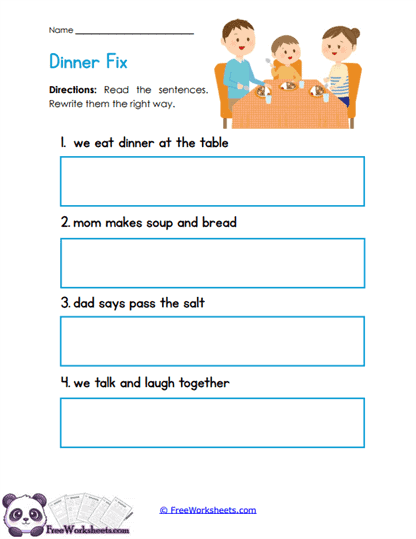
Children read four short dinner-themed sentences that contain missing capitals, missing punctuation, or incorrect sentence form. They identify what needs to change and rewrite each sentence correctly in the large spaces provided.
Target Skill:
The worksheet strengthens sentence awareness and reading-writing connections. Students practice recognizing that complete sentences begin with capital letters, end with appropriate punctuation, and should be reread carefully to make sure the written form is correct.
Sight Search
What Kids Do:
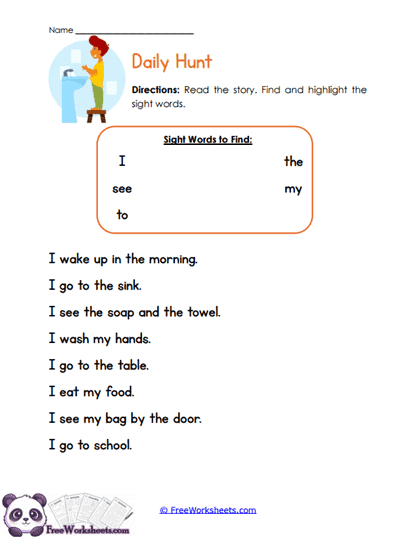
Children review a list of common sight words such as I, see, to, the, and my and then search for those words inside a short daily-routine passage. They highlight each occurrence and reread the passage after completing the search.
Target Skill:
This activity strengthens automatic recognition of high-frequency words in connected text. Students practice scanning sentences, recognizing repeated word forms, and building fluency by reducing the need to stop and decode words they encounter frequently.
Sound Search
What Kids Do:
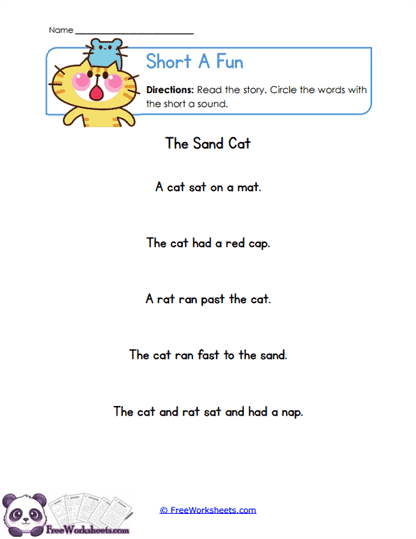
Children read “The Sand Cat” and circle short-a words such as cat, sat, mat, cap, rat, ran, sand, and nap. After identifying the words, they can reread the story and say each target word aloud to hear the repeated vowel sound.
Target Skill:
The worksheet helps students transfer short-a phonics knowledge into connected reading. Children strengthen vowel-sound recognition, decoding, spelling-pattern awareness, and word recognition by locating the same phonics feature across several different words in a passage.