
Point of View Worksheets
1st grade reading point of view worksheets help young learners recognize who is telling a story and how a narrator's voice shapes the text. Free, ready-to-print worksheets in PDF format are designed for immediate classroom use, independent practice, homework, literacy centers, or homeschool lessons. Students strengthen narrator identification, pronoun recognition, and perspective comparison while developing reading skills that support curriculum expectations.
About This Collection of Worksheets
Understanding point of view helps beginning readers recognize who is telling a story and distinguish between a character’s voice and an outside narrator. These 1st grade reading worksheets introduce that idea through clear first-person and third-person examples, helping students notice how words such as I, my, he, she, and character names provide clues about the speaker. As students learn to connect pronouns, actions, and story details with the narrator, they build a stronger foundation for comprehension and thoughtful reading.
The collection includes short passages, multiple-choice questions, sorting activities, dialogue matching, yes-or-no questions, paired-text comparisons, and open-response tasks. Students identify speakers in school, birthday, lunch, library, weather, recess, and animal-themed texts while practicing several ways to demonstrate their understanding. Some activities focus directly on first-person and third-person clues, while others ask children to infer an unnamed narrator, follow changing speakers in dialogue, or compare the experiences of two different storytellers.
Teachers can use these worksheets to introduce point of view during whole-group reading, provide guided practice in small groups, or reinforce the skill through literacy centers and independent work. Parents, tutors, and homeschool educators can also use the collection for focused review by asking children to circle narrator clues, explain how they know who is speaking, and retell sentences from a different point of view. Because the activities move from straightforward pronoun recognition to comparison and inference, the collection offers flexible practice for students who need support as well as those ready for a greater challenge.
Paul’s Teacher Tip
Begin by teaching students to ask one simple question: “Is the person telling the story also doing the actions?” Model how I, me, my, and we usually signal first person, while names and words such as he and she often signal third person. When students struggle, have them underline the pronoun or character name that proves their answer instead of relying on a guess about who the story is “about.” A useful extension is to rewrite one sentence from first person into third person, or vice versa, so children can hear exactly how the narrator’s voice changes. For students ready for more challenge, ask them to explain how two narrators can describe the same kind of event differently even when both passages use first person.
Worksheet Collection Skill Spotlights
Animal Speaker
What Kids Do:
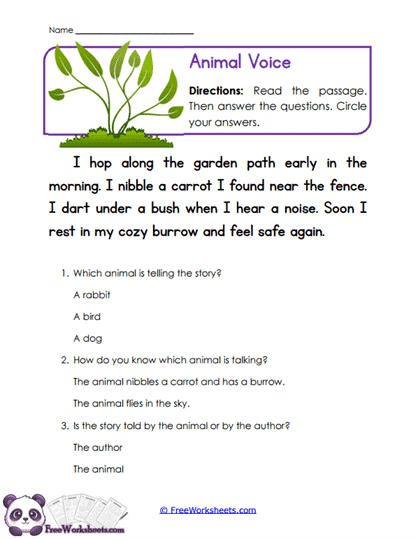
Students read a short first-person passage about an animal that hops along a garden path, eats a carrot, hides beneath a bush, and rests in a burrow. They answer multiple-choice questions to determine which animal is speaking, select the strongest clue, and decide whether the narrator is inside the story or an outside storyteller.
Target Skill:
This activity strengthens the ability to combine point-of-view clues with simple inference. Rather than relying only on the pronoun I, 1st grade students connect the narrator’s actions and habitat with their background knowledge to identify the speaker and support the answer with textual evidence.
Birthday Speaker
What Kids Do:
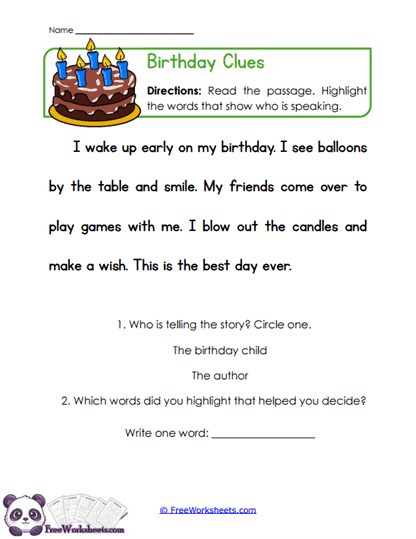
Children read a birthday story told by a child who wakes up early, sees balloons, plays games, blows out candles, and makes a wish. After reading, they identify who is telling the story and provide a clue word from the passage, requiring them to connect the narrator with the first-person language used throughout the text.
Target Skill:
Students develop first-person point-of-view recognition by using pronouns such as I, my, and me as evidence. The task reinforces an important 1st grade reading expectation: identifying who is telling a story and pointing to a specific word or detail that supports that conclusion.
Library Voice
What Kids Do:
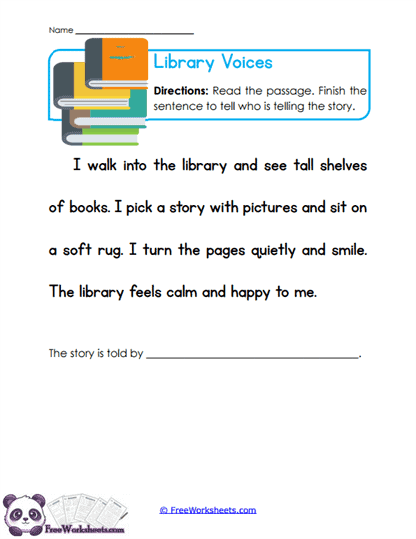
Students read a short library passage in which an unnamed speaker walks among the books, chooses a picture story, sits on a rug, and turns the pages quietly. They then complete an open-response sentence naming who tells the story, using repeated first-person clues and the speaker’s actions to formulate their answer.
Target Skill:
This worksheet develops narrator identification when a character is not given a proper name. 1st grade students learn that repeated use of I can reveal that a character inside the events is speaking, strengthening both point-of-view understanding and the ability to explain comprehension in their own words.
Lunch Narrator
What Kids Do:
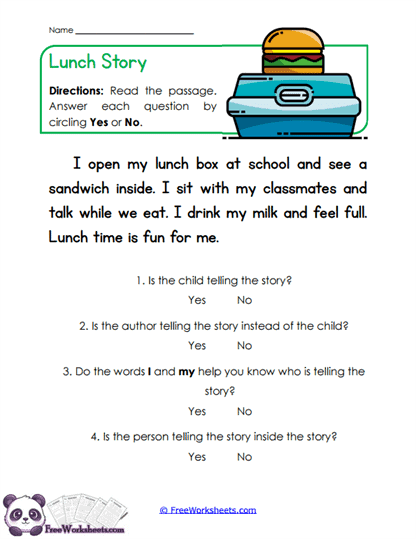
Children read a lunchtime passage about opening a lunch box, seeing a sandwich, sitting with classmates, drinking milk, and enjoying the meal. They respond to four yes-or-no questions that ask whether the child is narrating, whether an outside author is speaking, and whether words such as I and my reveal the storyteller.
Target Skill:
The repeated question format helps students confirm first-person narration from several angles. 1st grade readers practice recognizing that a narrator who uses I and my is participating in the events, while also learning to distinguish the person telling a story from the author who created it.
Pronoun Piles
What Kids Do:
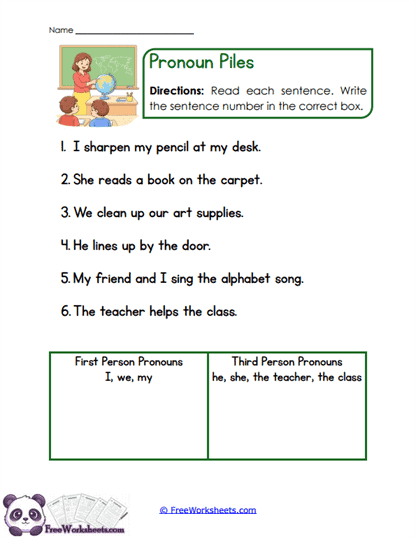
Students examine six school-themed sentences and sort each sentence number into one of two categories. They place examples using I, we, or my with first person and sentences using he, she, the teacher, or the class with third person, comparing the two groups side by side.
Target Skill:
This sorting activity builds quick recognition of the pronouns and sentence subjects that signal point of view. Students strengthen 1st grade reading and language skills by deciding whether the speaker is included in an action or whether the sentence describes another person or group from an outside perspective.
Rainy Voice
What Kids Do:
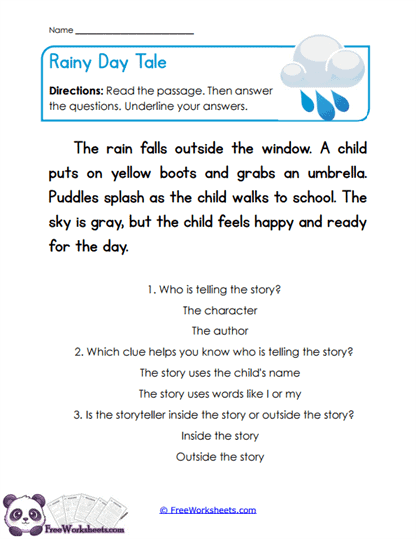
Children read a rainy-day passage describing a child putting on yellow boots, grabbing an umbrella, walking through puddles, and getting ready for the day. They answer three questions about who tells the story, which clue supports the answer, and whether the storyteller is located inside or outside the events being described.
Target Skill:
Students practice identifying third-person narration by noticing language such as the child and recognizing the absence of first-person pronouns. This helps 1st grade readers understand that a story can focus closely on a character even when that character is not the person telling the story.
Recess Views
What Kids Do:
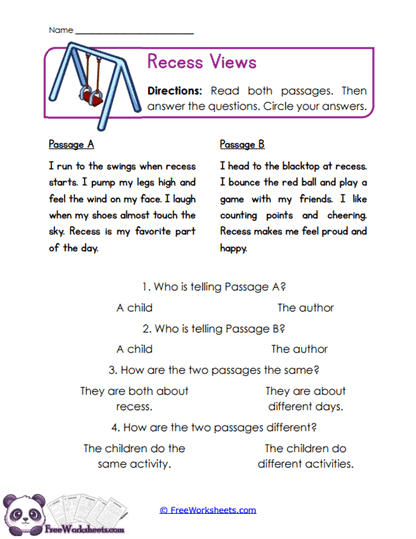
Students read two short first-person passages about recess. One narrator describes swinging and enjoying the wind, while another describes playing four square and feeling proud. Children answer four questions to identify each narrator, recognize how the passages are alike, and explain how the speakers’ recess experiences differ.
Target Skill:
This paired-text activity combines narrator recognition with comparing perspectives. Students strengthen 1st grade comprehension by recognizing that two passages can both use first person while still describing different activities and experiences, helping them separate the question of who is speaking from what each speaker says.
Silly Speaker
What Kids Do:
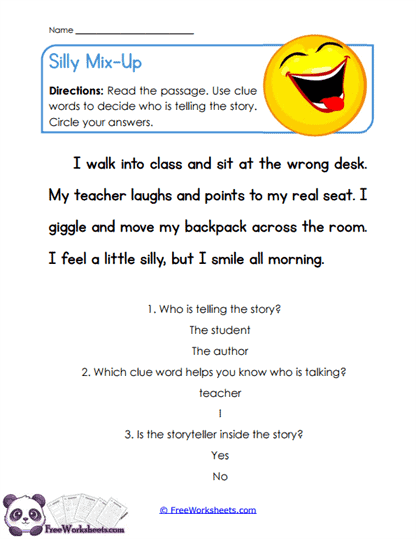
Children read a humorous classroom story about a student sitting at the wrong desk, hearing the teacher laugh, moving a backpack, and feeling silly. They answer questions to identify the storyteller, choose a pronoun clue that supports their decision, and determine whether the narrator is participating directly in the events.
Target Skill:
The worksheet reinforces first-person narration by asking students to distinguish the speaker from another important character in the same story. 1st grade readers use I, my, and me as textual evidence and practice focusing on who experiences the actions rather than simply choosing a character mentioned in the passage.
Speaker Clues
What Kids Do:
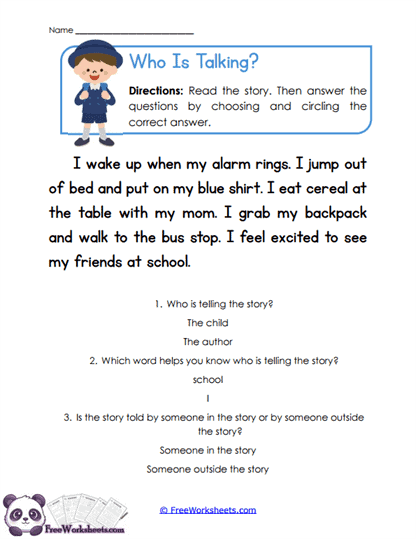
Students read a short passage about getting ready for school, eating breakfast, picking up a backpack, and walking to the bus stop. They complete three multiple-choice questions that ask who is telling the story, which clue word reveals the narrator, and whether the storyteller is a character inside the events or someone outside them.
Target Skill:
This introductory activity helps students recognize the basic structure of first-person narration. By using I as evidence and distinguishing a character narrator from an outside storyteller, 1st grade readers build foundational point-of-view skills that support later work with narrator perspective and comprehension.
Speaker Match
What Kids Do:
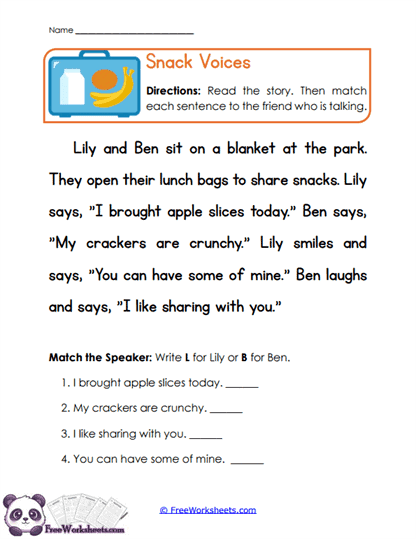
Children read a short park story featuring Lily and Ben as they talk while sharing snacks. They study four lines of dialogue and write L for Lily or B for Ben beside each one, returning to quotation marks, nearby character names, and dialogue tags in the passage whenever they need evidence about who is speaking.
Target Skill:
Students strengthen their ability to track multiple speakers within one text. The activity supports 1st grade reading comprehension by teaching children to connect quoted words with dialogue tags and surrounding context rather than assuming that speakers alternate or relying only on memory of the conversation.
Voice Sort
What Kids Do:
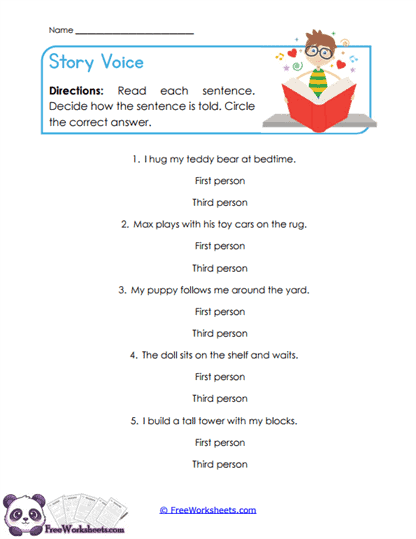
Students read five short sentences about familiar subjects such as teddy bears, toy cars, puppies, dolls, and blocks. For every sentence, they circle either First person or Third person, using the subject and pronouns to decide whether the speaker is talking about themselves or describing someone else.
Target Skill:
This quick classification task develops fluency in identifying first-person and third-person language. 1st grade students compare pronouns such as I and my with names and words such as he and she, building the grammatical awareness needed to recognize narrator voice across simple texts.
Weather Voices
What Kids Do:
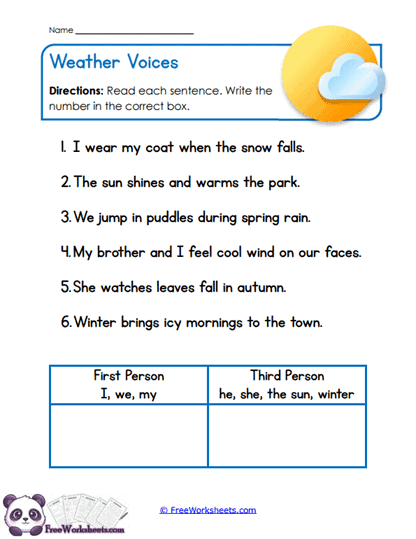
Children read six short weather-themed sentences involving snow, sunshine, puddles, wind, autumn leaves, and winter mornings. They sort each sentence number into a first-person or third-person box, using headings with pronouns and sentence subjects as references and explaining which clue helped them make each classification.
Target Skill:
The activity gives students repeated practice identifying point of view across individual sentences rather than longer passages. 1st grade readers learn to focus on whether the speaker is included in the action and to use pronouns, names, or other sentence subjects as concrete evidence for a first-person or third-person choice.