
About This Worksheet
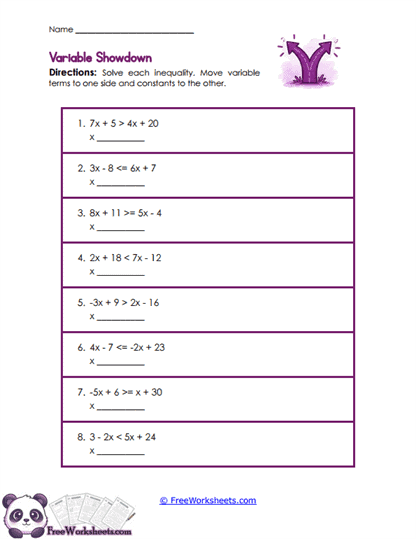
This worksheet helps ninth-grade students solve linear inequalities with variable terms on both sides of the inequality symbol. Students work through eight problems where they must decide which variable terms to move and which constants to move before isolating x. This gives them practice choosing an efficient direction for their algebra instead of following one fixed pattern. Several problems also include negative coefficients, so students must pay close attention to the final division step.
For example, in 7x + 5 > 4x + 20, students can subtract 4x from both sides to collect the variable terms on the left. They then subtract 5 and divide to isolate x. Other problems may be easier if students move the variable terms in the opposite direction to avoid a negative coefficient.
What Students Practice
Students practice collecting variable terms on one side and constants on the other. They use subtraction or addition to move terms while keeping the inequality balanced. This gives students repeated experience with equations that cannot be solved by working on only one side.
The worksheet also encourages strategic thinking. Students may choose to move the smaller variable term or the larger one depending on which option creates easier arithmetic. This helps students see that more than one valid solving path can lead to the same answer.
Why This Skill Matters
Variables on both sides are common in Algebra 1, and students need to know how to simplify these problems before isolating x. This type of inequality requires stronger organization than a basic one-step problem. Learning to move terms carefully gives students an important algebra foundation.
The same reasoning is used when solving linear equations, systems, and more advanced expressions. Students who can manage terms on both sides are much better prepared for later algebra. The added inequality rules make this especially valuable practice.
Common Challenges
Students may move a variable term across the inequality symbol by simply changing its sign without thinking about the actual operation. Remind them that they are adding or subtracting the same term from both sides. Writing that operation on both sides can make the process clearer.
Another common mistake happens when the final coefficient of x is negative. If students divide by that negative number, the inequality symbol must reverse. Encourage them to check the sign of the coefficient before writing the final answer.
How To Use It
Teachers can use this worksheet after students are comfortable solving multi-step inequalities with variables on one side. It works well for guided instruction, independent classwork, homework, or review before special-case inequalities. Comparing two valid solution methods for one problem can also show students that algebra allows flexibility.
Parents and homeschool teachers can ask, “Which side do you want the x-terms on?” Then help the student move all variable terms to that side and constants to the other. Before the last division, ask whether the number multiplying x is positive or negative.
Grade Alignment
This worksheet is intended for Grade 9 Algebra 1 and directly supports CCSS HSA-REI.B.3, which involves solving linear inequalities in one variable. It also reinforces HSA-REI.A.1 by asking students to maintain equivalence while moving terms across both sides. The problems provide strong practice with increasingly complex inequality structures.
Students should already know how to combine like terms and solve multi-step inequalities. After this practice, they are ready for inequalities that simplify to all real numbers, no solution, or other special cases.