
About This Worksheet
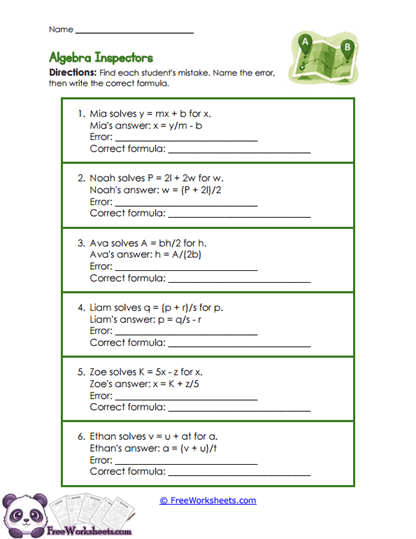
This worksheet helps ninth-grade students find and correct mistakes in rearranged literal equations. Each problem shows a student’s attempted solution for a formula, and students must identify what went wrong before writing the correct formula. The mistakes include incorrect subtraction, wrong division, missing grouping, and improper isolation of the requested variable. This turns literal-equation practice into a reasoning activity instead of simply asking students to rearrange formulas from scratch.
For example, a student may try to solve y = mx + b for x but fail to subtract b before dividing by m. Another may divide only one term instead of an entire expression. Looking closely at these errors helps students understand why each algebraic step matters.
What Students Practice
Students practice reading someone else’s algebra and deciding whether the variable was isolated correctly. They compare the proposed formula with the original equation and then explain the error in clear mathematical language. This strengthens both equation-solving skill and error analysis.
The worksheet also reviews several common formula structures, including multiplication, division, fractions, and sums. Students must pay close attention to parentheses and fraction bars because those details change the meaning of a formula. This makes the activity especially useful for students who know the basic steps but still make small setup mistakes.
Why This Skill Matters
Being able to check a rearranged formula is just as important as being able to create one. Students often lose points because of a small sign or grouping error even when they understand the overall method. Error analysis helps them become better at catching those mistakes before they finish.
This skill also supports work in science, geometry, and other subjects where formulas are rearranged often. Students who can explain why a formula is wrong are more likely to understand how to fix it correctly. That deeper reasoning makes them more independent problem solvers.
Common Challenges
Students may notice that a final formula looks wrong but struggle to explain the first incorrect step. Encourage them to compare the original equation and the proposed answer one operation at a time. This helps them locate exactly where the work stopped being equivalent.
Another common mistake is saying only that “the math is wrong.” Ask students to be more specific by naming the operation, such as subtracting the wrong term or dividing only part of an expression. Clear explanations show stronger understanding.
How To Use It
Teachers can use this worksheet after students have already practiced solving literal equations independently. It works well for partner discussion, small-group review, homework, or a whole-class error-analysis lesson. Asking students to defend one correction aloud can lead to strong algebra conversations.
Parents and homeschool teachers can treat each problem like a puzzle. Ask, “What did this student do to the equation?” and then, “Was that operation applied to the whole side?” This keeps the focus on understanding rather than simply replacing the answer.
Grade Alignment
This worksheet is designed for Grade 9 Algebra 1 and supports CCSS HSA-CED.A.4, which asks students to rearrange formulas to highlight a quantity of interest. It also reinforces HSA-REI.A.1 by asking students to reason about whether each algebraic transformation preserves equivalence. The error-analysis format strengthens mathematical explanation and self-checking.
Students should already know how to solve basic literal equations. After this practice, they are better prepared to work with more complicated formulas and catch errors in their own work.