
About This Worksheet
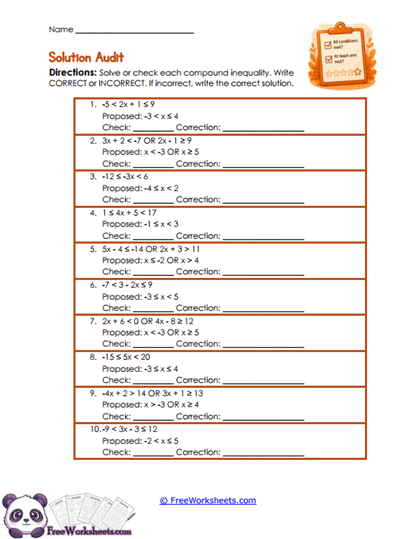
This worksheet helps ninth-grade students check proposed solutions to compound inequalities and correct any mistakes. Ten problems provide an original compound inequality along with a suggested solution. Students solve or verify the inequality, decide whether the proposed answer is correct, and then write a correction when needed. This gives them practice combining algebra skills with careful error checking.
For example, a proposed solution may have the correct boundary numbers but use the wrong inequality signs. Another may incorrectly combine an OR statement into one interval. Students must compare the proposed answer with the actual solution rather than accepting it at face value.
What Students Practice
Students practice solving compound inequalities and comparing their results with another person’s proposed solution. They check boundary values, inequality directions, sign reversals, and AND/OR structure. This creates a broad review of the most important compound inequality rules.
The worksheet also reinforces mathematical verification. Students must decide whether an answer is CORRECT or INCORRECT and provide a fixed version when necessary. That helps them become more confident at reviewing their own work.
Why This Skill Matters
Being able to audit a solution is an important part of mathematical reasoning. Students often make small errors in signs or boundaries that can completely change the answer. Learning to spot those differences helps reduce careless mistakes.
This skill also prepares students for tests and more advanced algebra. Strong students do not only solve problems; they check whether their answers make sense. Compound inequalities are especially good practice because there are several details to verify at once.
Common Challenges
Students may assume a proposed answer is correct if the numbers look familiar. Encourage them to solve or test the inequality independently before judging the proposal. Matching boundary values alone is not enough.
Another common mistake is overlooking whether an endpoint should be included. The difference between < and ≤ can change the solution set. Teachers can remind students to check the symbols just as carefully as the numbers.
How To Use It
Teachers can use this worksheet as a cumulative review, partner activity, homework assignment, or pre-test check. It works especially well after students have practiced solving AND and OR inequalities in several formats. Asking students to explain why an incorrect proposal fails can make the activity even stronger.
Parents and homeschool teachers can have students first cover the proposed solution and solve the problem on their own. Then compare the two answers and look for any differences. This helps prevent the suggested answer from influencing their reasoning too early.
Grade Alignment
This worksheet is intended for Grade 9 Algebra 1 and supports CCSS HSA-REI.B.3 through solving and verifying linear inequalities in one variable. It also strengthens error analysis, symbolic accuracy, and logical interpretation of compound solution sets. The activity gives students a useful final review of AND and OR inequalities.
Students should already understand how to solve and graph compound inequalities. After this practice, they are ready for mixed assessments and more advanced real-world applications.