
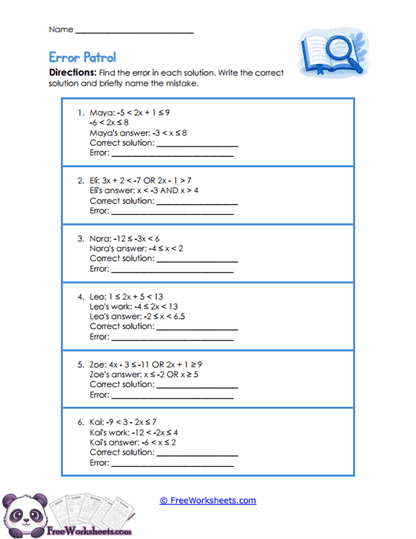
About This Worksheet
This worksheet helps ninth-grade students find and correct mistakes in compound inequality solutions. Six worked examples contain errors involving sign direction, AND versus OR logic, incomplete solving, or incorrect boundary values. Students identify the mistake, write the correct solution, and briefly explain what went wrong. This gives them practice checking reasoning instead of only solving from scratch.
For example, a student may solve a chained inequality correctly but write one boundary symbol in the wrong direction. Another may turn an OR statement into an AND solution. Looking for these mistakes helps students see how small errors can change the entire solution set.
What Students Practice
Students practice reading compound inequality work line by line and checking whether each step is valid. They compare the proposed solution with the original statement and then make a correction. This strengthens both procedural skill and mathematical explanation.
The worksheet also reviews several common problem types. Students work with chained inequalities, separate OR statements, and inequalities containing negative coefficients. That variety makes the error analysis a strong cumulative review.
Why This Skill Matters
Students often make inequality mistakes that are easy to miss. A reversed sign, wrong connector, or missing endpoint can make an otherwise good solution incorrect. Learning to spot those errors helps students become more accurate in their own work.
Error analysis also builds stronger understanding. When students can explain why an answer is wrong, they usually understand the rule more deeply than when they simply copy a correct procedure. This skill supports later algebra topics as well.
Common Challenges
Students may look only at the final answer and not check where the error first occurred. Encourage them to compare each step with the one before it. Finding the first incorrect move makes the correction much clearer.
Another common problem is giving a corrected answer without explaining the mistake. Ask students to use specific language such as “the inequality sign should have reversed” or “OR was changed to AND.” This makes their reasoning more precise.
How To Use It
Teachers can use this worksheet for partner discussion, small-group review, test preparation, or a whole-class correction activity. It works especially well after students have learned several forms of compound inequalities. Asking students to defend one correction aloud can deepen understanding.
Parents and homeschool teachers can treat each item like a puzzle. Ask, “Where does the work first stop making sense?” and then, “What rule should have been used instead?” This keeps the focus on reasoning rather than just replacing the answer.
Grade Alignment
This worksheet is intended for Grade 9 Algebra 1 and supports CCSS HSA-REI.B.3 through solving and checking linear inequalities in one variable. It also strengthens mathematical reasoning and the interpretation of compound solution sets. The error-analysis format helps students build better self-checking habits.
Students should already understand how to solve AND and OR inequalities. After this practice, they are better prepared to handle mixed compound inequality problems accurately and explain their work clearly.