
About This Worksheet
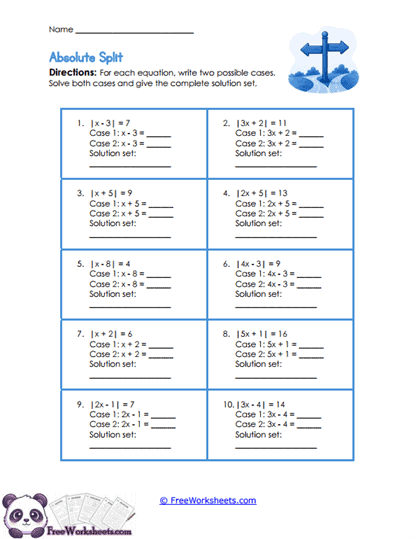
This worksheet helps ninth-grade students learn how to solve absolute value equations by breaking each equation into two possible cases. Students work through ten equations where the absolute value expression is already isolated, so they can focus on understanding why two equations are normally needed. Since absolute value describes distance from zero, a positive distance can come from a positive value or its negative partner. For example, |x – 3| = 7 becomes x – 3 = 7 or x – 3 = -7, and students solve both cases to find the complete solution set.
The problems include addition and subtraction inside the absolute value bars as well as expressions with coefficients such as 2x and 3x. Students write both cases and then solve each one separately. This helps them see why absolute value equations often have two answers instead of just one.
What Students Practice
Students practice taking an equation in the form |expression| = positive number and rewriting it as two ordinary equations. One equation uses the positive value, while the second uses its negative opposite. Students then solve both equations and collect the answers into one solution set.
The worksheet also gives students practice with inverse operations and simple multi-step equation solving. Because the two-case structure is already provided, students can concentrate on setting up each case correctly. Repeated practice helps this important absolute value pattern become easier to recognize.
Why This Skill Matters
Absolute value represents distance, and distance can happen in two directions. A number can be 7 units away from zero by being 7 or -7, and the same idea applies when an expression is inside absolute value bars. Understanding this idea helps students make sense of why many absolute value equations have two solutions.
This skill becomes increasingly important in Algebra 1. Students will later solve more complicated absolute value equations and inequalities, graph absolute value functions, and use absolute value to model distance and error. Learning the two-case idea now gives them the foundation for all of those topics.
Common Challenges
A common mistake is solving only the positive case. Students may see |x – 3| = 7 and write only x – 3 = 7, forgetting that x – 3 could also equal -7. Remind them that a positive absolute value usually creates two possible equations.
Students may also put the negative sign in the wrong place. The entire value on the other side becomes negative for the second case, not the expression inside the absolute value bars. Encourage students to write both equations before solving either one so they can clearly see the two paths.
How To Use It
Teachers can use this worksheet right after introducing the idea that absolute value measures distance from zero. It works well for guided practice, independent classwork, homework, or a short check before moving into equations that first require isolation. Completing the first example together can help students understand where the positive and negative cases come from.
Parents and homeschool teachers can explain the idea in simple language by asking, “What two numbers are 7 units away from zero?” Once the student answers 7 and -7, connect that same idea to the expression inside the absolute value bars. This makes the two-equation process feel much more logical.
Grade Alignment
This worksheet is designed for Grade 9 Algebra 1 and supports solving equations involving absolute value. It connects with CCSS HSA-REI.A.1, which asks students to explain and justify the steps used when solving equations, and it reinforces equation-solving skills from HSA-REI.B.3. The activity emphasizes why an absolute value equation may split into two valid cases rather than treating the process as a memorized rule.
Students should already understand basic one- and two-step equations and positive and negative numbers. After this practice, they can move into absolute value equations that require isolating the absolute value expression first.