
About This Worksheet
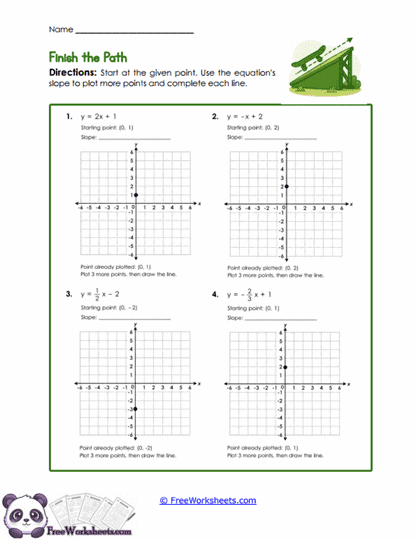
This worksheet helps ninth-grade students complete a linear graph from a given starting point and slope. Each problem provides an equation, identifies a point that has already been plotted, and asks students to use the slope to plot three more points. Students then draw the line through those points. This gives them practice continuing a graph once the starting location is known.
For example, if the equation is y = 2x + 1 and the point (0, 1) is already plotted, students use the slope 2/1 to move up 2 and right 1. They repeat that movement several times to create a clear line. This helps students see how slope creates a steady pattern across the coordinate plane.
What Students Practice
Students practice identifying slope from a linear equation and applying that slope repeatedly from a known point. They use rise over run to generate additional ordered pairs. This reinforces the idea that every point on a straight line follows the same rate of change.
The worksheet includes both positive and negative slopes. Students must pay attention to whether the line should rise or fall as x increases. Repeated point plotting helps make that visual pattern more familiar.
Why This Skill Matters
Students need to understand that slope is constant along a linear graph. Once one point is known, the same rise-over-run movement can be used again and again to build the line. This worksheet makes that idea very clear.
The skill is useful when graphing from slope-intercept form, point-slope form, or real-world rate information. It also prepares students for comparing lines and solving systems graphically.
Common Challenges
Students may change the slope movement after plotting one point. Remind them that a linear equation has a constant slope, so the same rise and run should be repeated each time. The pattern should stay consistent across the graph.
Another common mistake is moving in the wrong direction with a negative slope. Encourage students to use either down and right or up and left, but not both negatives at once. This helps preserve the correct sign of the slope.
How To Use It
Teachers can use this worksheet as focused practice after students learn how slope moves a point along a line. It works well for guided practice, independent work, homework, or a graphing station. You might model one positive-slope and one negative-slope example before students continue.
Parents and homeschool teachers can ask, “What is the slope?” and then, “How do we move from the point that is already there?” Repeating the same movement three times makes the line easy to finish.
Grade Alignment
This Grade 9 worksheet supports CCSS HSF-IF.C.7a by giving students practice graphing linear functions. It also reinforces the idea of constant rate of change in a straight line. The activity helps students connect symbolic slope with repeated coordinate movement.
Students should already know how to identify slope from y = mx + b. After this practice, they can graph linear equations more quickly and accurately from different starting points.