
About This Worksheet
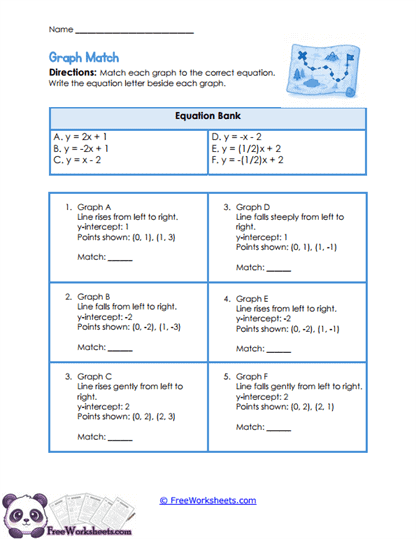
This worksheet helps ninth-grade students match descriptions of linear graphs to their correct equations. Each graph clue includes information about direction, y-intercept, and sample points, and students choose the equation from the bank that matches all of those details. This makes students use several pieces of graph information at once instead of relying on only one clue. It is a strong way to connect slope, intercept, points, and equation form.
For example, a line that rises from left to right, crosses the y-axis at 1, and contains points (0, 1) and (1, 3) must have slope 2 and y-intercept 1. That matches y = 2x + 1. Students repeat this kind of reasoning for positive, negative, steep, and gentle slopes.
What Students Practice
Students practice using graph descriptions to identify slope direction and y-intercept. They also use given points to check whether an equation fits the relationship. This strengthens their ability to move between verbal, numerical, and algebraic representations.
The worksheet includes lines with positive and negative slopes as well as fractional slopes. Students must think about whether the line rises gently, rises steeply, falls gently, or falls steeply. This helps build stronger visual sense for slope size.
Why This Skill Matters
Students need to recognize that a linear equation tells a story about how a graph behaves. The coefficient of x controls slope, while the constant controls the y-intercept. Matching these features helps students understand equations rather than just manipulate them.
This skill is also useful when students compare functions. They may need to identify which equation matches a graph or description without drawing everything from scratch. Strong recognition skills make those problems much faster.
Common Challenges
Students may match an equation based only on the y-intercept and ignore the slope. Remind them that both features must agree. A line can cross the y-axis at the same place as another line but move in a completely different direction.
Another common mistake is confusing steep and gentle slopes. Encourage students to compare the absolute value of the slope. Larger absolute values make steeper lines, while smaller fractional slopes make gentler lines.
How To Use It
Teachers can use this worksheet after students are comfortable identifying slope and y-intercept. It works well as independent practice, partner matching, homework, or test review. Asking students to explain one match using both slope and intercept can deepen understanding.
Parents and homeschool teachers can ask, “Does the line go up or down?” and then, “Where does it cross the y-axis?” Those two clues usually narrow the choices quickly. The given points can then be used as a final check.
Grade Alignment
This worksheet is intended for Grade 9 math and supports CCSS HSF-IF.C.7a, which focuses on graphing linear functions and identifying key features. It also supports CCSS HSF-IF.B.4, which involves interpreting features of functions from different representations. Matching graphs and equations strengthens students’ understanding of slope and intercept.
Students should already know slope-intercept form and how slope affects a graph. After this practice, they can move on to analyzing and comparing multiple linear functions more efficiently.