
About This Worksheet
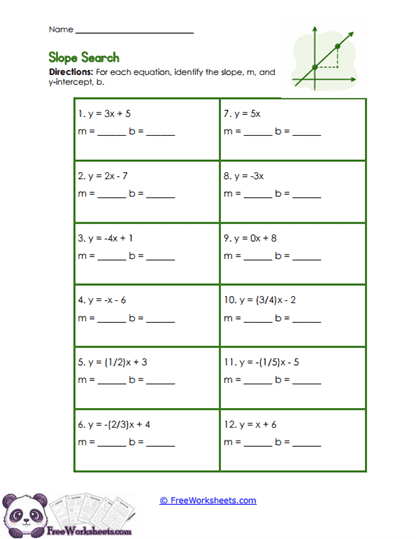
This worksheet helps ninth-grade students identify the slope and y-intercept from equations written in slope-intercept form. Students examine twelve linear equations and write the value of m for slope and b for the y-intercept. The equations include positive slopes, negative slopes, fractions, zero slope, and cases where a term may not be written explicitly. This gives students broad practice reading y = mx + b correctly.
For example, in y = 3x + 5, the slope is 3 and the y-intercept is 5. In y = -4x + 1, the slope is -4 and the intercept is 1. Students also see examples such as y = 5x, where the missing constant means b = 0.
What Students Practice
Students practice locating the coefficient of x and identifying it as the slope. They also identify the constant term as the y-intercept. This strengthens their understanding of what each part of slope-intercept form represents.
The worksheet includes fractions and negative values so students become comfortable with more than simple whole-number slopes. A horizontal-line example with a zero coefficient also reinforces the meaning of zero slope. These variations prepare students to graph a wider range of lines.
Why This Skill Matters
Students need to identify slope and y-intercept quickly before graphing equations in the form y = mx + b. The y-intercept tells them where to place the first point, while the slope tells them how to move from that point to create the rest of the line. Understanding these two pieces makes graphing much more efficient.
This skill also helps students interpret linear relationships. Slope describes how quickly y changes as x changes, while the y-intercept describes the starting value when x = 0. Those ideas appear throughout algebra, functions, and real-world modeling.
Common Challenges
Students sometimes confuse the slope and y-intercept because both are numbers in the equation. Remind them that slope is attached to x, while the y-intercept is the number standing by itself. Highlighting or circling those two parts can help.
Another common challenge is equations with an implied slope. In y = x + 6, the slope is 1 even though the 1 is not written. Likewise, in y = -x – 6, the slope is -1. Teachers can point out these hidden coefficients before students work independently.
How To Use It
Teachers can use this worksheet immediately before teaching students to graph from slope-intercept form. It works well as a warm-up, guided lesson, independent practice page, homework assignment, or quick assessment. Once students identify m and b, you can extend the activity by asking them to describe whether each line rises, falls, or stays horizontal.
Parents and homeschool teachers can use a very simple question routine. Ask, “What number is multiplying x?” for the slope, then ask, “What number is by itself?” for the y-intercept. That makes the structure of the equation easier to see.
Grade Alignment
This worksheet is intended for Grade 9 math and supports high-school work with linear functions. It aligns well with CCSS HSF-IF.C.7a, which includes graphing linear functions and showing important features, and CCSS HSF-LE.B.5, which involves interpreting the parameters in linear models. Recognizing slope and intercept is a key prerequisite for both skills.
Students should already understand basic linear equations and coefficients. After this practice, they can move directly into plotting the y-intercept and using slope to graph each line.