
Building Emotional Awareness Worksheets
These building emotional awareness worksheets help students in grades 3-12 identify, describe, track, and respond to emotions with greater confidence. Every activity is Free, Ready-to-print, available in PDF format, and designed for Immediate classroom use. Students develop CASEL-aligned skills in self-awareness, self-management, social awareness, relationship building, and responsible decision-making.
About This Collection of Worksheets
This collection helps students understand that emotions are often more layered than simple labels such as happy, sad, mad, or scared. Learners build a richer feeling vocabulary, connect emotions with events and body signals, recognize mixed or hidden feelings, and notice how emotions change over time. These activities give children and teens language they can use to explain what is happening inside them.
The worksheets combine short stories, daily check-ins, personal reflection, emotional tracking, vocabulary practice, and thought-balancing exercises. Students follow characters through stressful mornings, presentations, team projects, disappointing losses, and other relatable experiences. They also examine their own emotional patterns, consider how thoughts affect feelings, and plan healthier responses for future situations.
These printable SEL resources can be used during morning meetings, advisory periods, counseling groups, health lessons, classroom discussions, homeschool instruction, or private reflection. The collection aligns closely with the Collaborative for Academic, Social and Emotional Learning framework by strengthening self-awareness, self-management, social awareness, relationship skills, and responsible decision-making. Since the worksheets range from guided vocabulary practice to deeper personal reflection, teachers can select activities that match each student’s age, readiness, and comfort level.
Paul’s Teacher Tip
Remind students that the goal is not to find the “right” emotion but to choose a word that honestly fits their experience. Accept more than one thoughtful answer when the student can explain the reasoning behind it. Personal reflection pages should never be treated as punishment or require children to disclose more than they feel ready to share. When strong emotions appear, focus first on safety, calm, and connection before asking a student to analyze what happened. A trusted adult’s curious, nonjudgmental response can make emotional-awareness work feel supportive instead of exposing.
Worksheet Collection Skill Spotlights
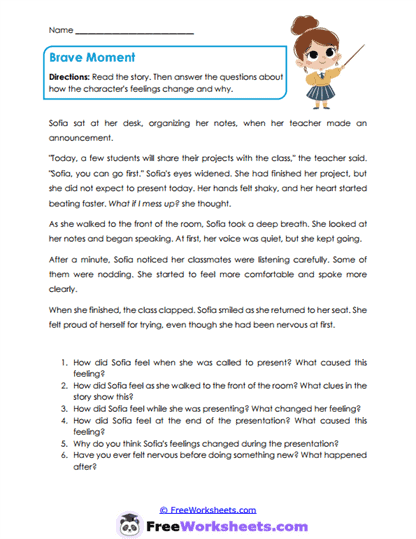
Courage Growth
What Kids Do: Students follow Sofia as she moves from nervousness and physical stress signals to growing confidence during a class presentation. They identify what caused each emotional shift, examine the strategies that helped, and connect the story with a brave moment from their own lives.
Target Skill: This activity strengthens self-awareness, self-management, and healthy risk-taking. Students learn that courage does not require the absence of fear and that preparation, breathing, and taking one manageable step can help confidence grow.
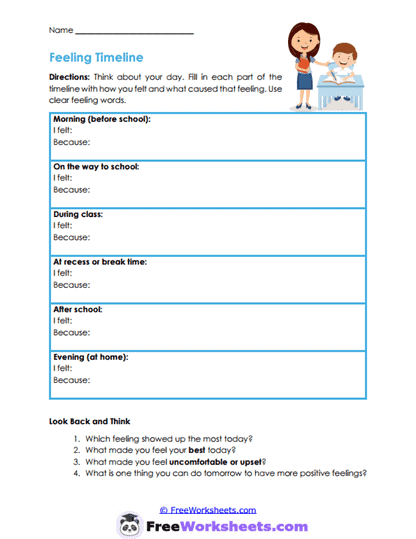
Daily Feelings
What Kids Do: Students track emotions from before school through the evening and explain what caused each feeling. They reflect on the emotion that appeared most often, identify the best part of the day, and consider what might create a more positive experience tomorrow.
Target Skill: Learners connect emotions with events, people, thoughts, and environments. The worksheet develops emotional naming, sequencing, reflection, and early problem-solving while reinforcing that one day can contain many different feelings.
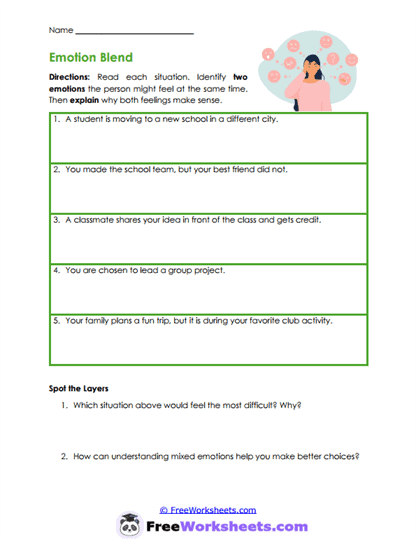
Emotion Layers
What Kids Do: Students read situations involving changes, leadership, friendship, success, and disappointment, then name two emotions that could exist at the same time. They explain why both reactions make sense instead of forcing the experience into one simple feeling.
Target Skill: This page builds flexible thinking and a more mature understanding of mixed emotions. Students practice recognizing emotional complexity and considering how competing feelings may influence choices, relationships, and decision-making.
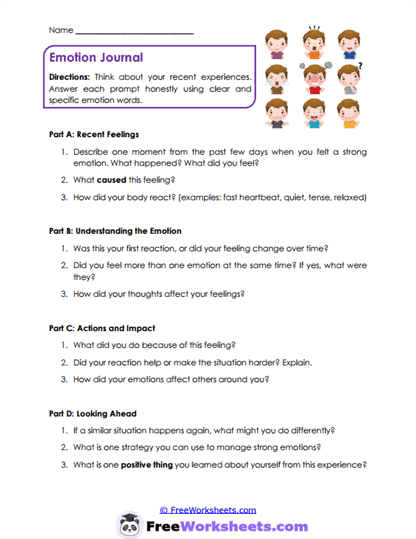
Emotion Reflection
What Kids Do: Students examine a recent strong emotion by describing the trigger, body response, thoughts, behavior, and effect on other people. They then identify what they learned and choose one realistic strategy they could use in a similar situation.
Target Skill: Learners develop self-awareness, personal responsibility, and reflective decision-making. The activity helps them view an emotional event as a sequence that can be understood and improved rather than as proof that they are a bad person.
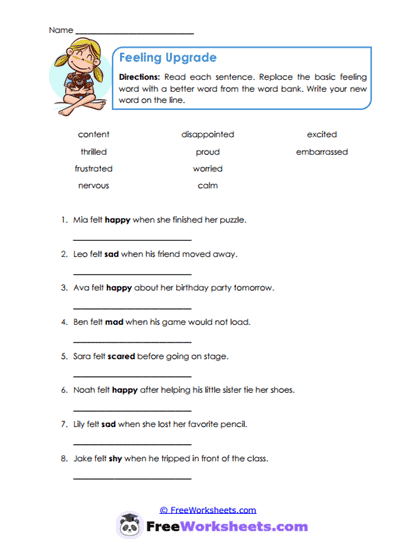
Emotion Upgrade
What Kids Do: Students replace broad feeling words such as happy, sad, mad, scared, and shy with more exact choices from an emotion word bank. They use each situation’s details to decide whether a character feels proud, frustrated, nervous, embarrassed, disappointed, or another precise emotion.
Target Skill: This activity strengthens emotional vocabulary, reading comprehension, and context-based word choice. More accurate feeling words help students communicate their needs and make it easier for adults and peers to respond with useful support.
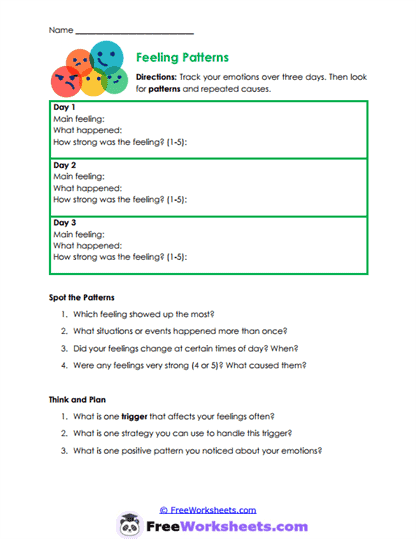
Feeling Patterns
What Kids Do: Students record their main emotions, triggers, and intensity levels over three days. Afterward, they review their entries to identify repeated feelings, common situations, intense moments, positive patterns, and one strategy they could try when a familiar trigger appears.
Target Skill: Learners practice emotional self-monitoring and pattern recognition. The worksheet helps them understand that emotions may connect with routines, tiredness, social situations, school demands, or helpful activities rather than appearing without explanation.
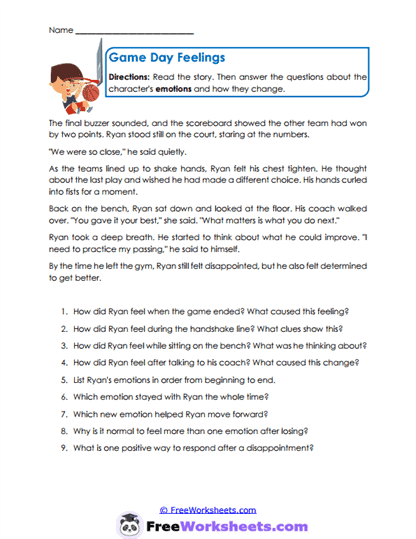
Game Recovery
What Kids Do: Students follow Ryan through sadness, frustration, disappointment, and determination after a close game. They use story evidence to place the emotions in order and consider how reflection, coaching, and a future plan help him recover.
Target Skill: This page builds resilience, emotional sequencing, and healthy coping with setbacks. Students learn that disappointment can be respected without allowing it to define their ability, effort, or next choice.
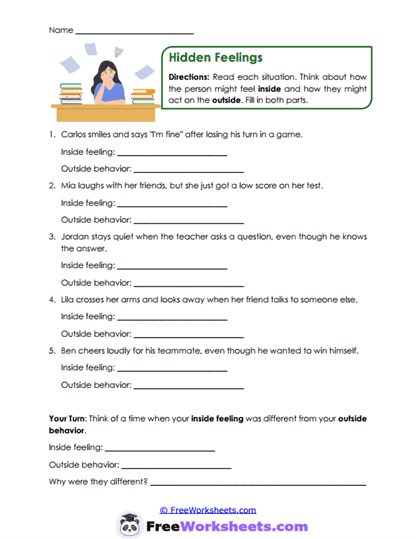
Hidden Feelings
What Kids Do: Students compare what characters may feel privately with the behavior they show publicly. They examine situations involving disappointment, nervousness, jealousy, and embarrassment, then reflect on a time when their own inner feeling differed from what others saw.
Target Skill: Learners strengthen empathy, social awareness, and thoughtful communication. The activity teaches them not to assume that a smile, silence, or calm appearance reveals the whole emotional story.
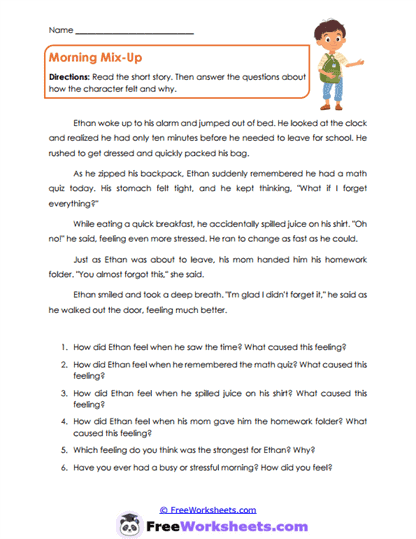
Morning Emotions
What Kids Do: Students read about Ethan’s stressful morning and track how his feelings change after waking late, remembering a quiz, spilling juice, and receiving help. They identify emotional clues and connect the story with a rushed or stressful morning of their own.
Target Skill: This worksheet combines reading comprehension with emotional cause and effect. Students learn to notice thoughts, actions, and body reactions as evidence of changing feelings and consider practical ways to make future mornings easier.
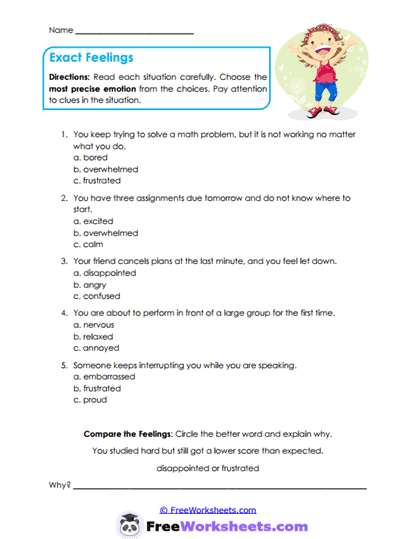
Precise Emotions
What Kids Do: Students choose the most accurate feeling word for short situations and compare closely related emotions such as disappointment and frustration. They explain how the cause and details of each event support one choice more strongly than the others.
Target Skill: Learners develop precise emotional language and stronger context-reading skills. The activity helps them communicate whether they feel overwhelmed, embarrassed, nervous, proud, confused, or another specific emotion instead of relying on broad labels.
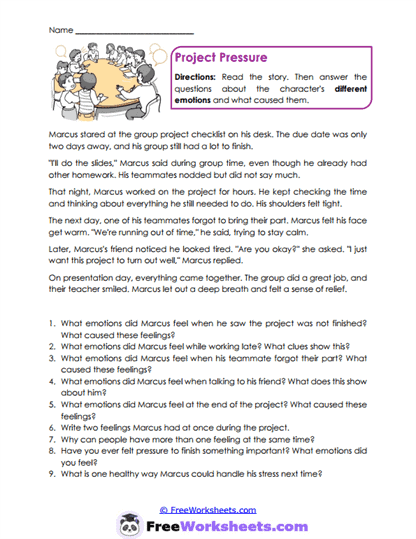
Team Pressure
What Kids Do: Students follow Marcus as worry, frustration, physical tension, relief, and pride develop during a difficult group project. They analyze what caused the stress, how communication helped, and which healthy strategy could make a future deadline easier to manage.
Target Skill: This activity supports self-awareness, self-management, relationship skills, and responsible decision-making. Students recognize stress signals and practice responding with communication, task planning, support-seeking, and shared responsibility.
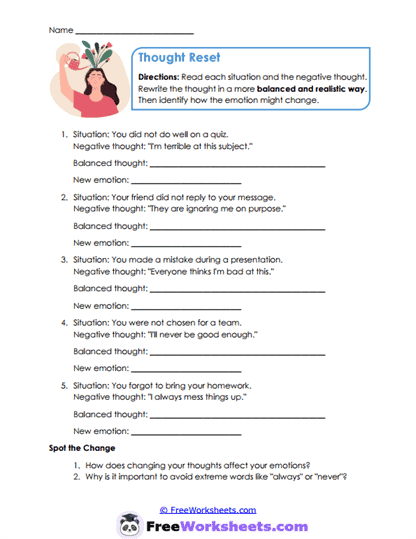
Thought Balance
What Kids Do: Students examine difficult situations paired with harsh or absolute thoughts, then rewrite each thought in a fairer and more believable way. They identify how the balanced thought might change the emotion without pretending the problem does not matter.
Target Skill: Learners practice flexible thinking, emotional regulation, perspective-taking, and healthier self-talk. The worksheet helps them recognize patterns involving words such as always, never, everyone, and no one and replace them with more accurate interpretations.